Battery / charger modifications: advice sought

N.A.

E34 / SF Bay
My old Xantrex charger has failed (display does odd things; still charges (at dock; not from engine) but I am not clear it would stop -- does not look like it will go to 'float' anymore.

Anyway, time for a new one. The person who might do the work has suggested:
- Victron charger
- Combining my two house batteries into a single bank, and adding a smaller 'start' battery (that does not power the house circuit, just the engine.)

Does this sound sensible? He says that running the two batteries together as a single house bank will allow one to get more power out of them, since the current draw will only be half from each. That actually makes sense to me, given that rapid discharge does decrease the power one can get out. But "makes sense" and "is right" are different things :) Anyway, seems like if I have a separate start battery, I don't really need to do the old 1/2/both/off system for the two full-size batteries I have.

Also, is Victron a good way to go?

Any advice appreciated! (including about anything else I should be cognizant of here / need to think about when replacing the battery charger / battery connections.)

PS: I was thinking I might add a galvanic isolator in the process.
 

bsangs

E35-3 - New Jersey
There are plenty of good charger options, no reason to think a new Victron won't work well. We have a ProSport 20 that is long in the tooth, but still works well.

As for batteries, we have been using only two Group 31 batteries wired in parallel for four years now. Have never felt the need for a starter battery. Our electronic use is pretty minimal, with the fridge being the biggest consumer, so as always, YMMV in that area. We do have a 200-watt solar panel attached to our hard bimini, and between that and the engine alternator, have never run out of juice on our trips (knock wood).

I had a galvanic isolator installed within two months of purchasing the boat, so I'd agree with that addition. Good luck.
 

peaman

Contributing Partner
A couple years ago, I was faced with the need to replace a battery charger. I had a pair of "smaller" batteries from he original build, and a pair of larger batteries, connected through a battery switch (off-1-both-2) which was kind of a pain to make sure I was drawing from and/or charging the right back at the right time. I ended up with a unique, but very friendly and reliable arrangement with a charger which relieves me of most battery maintenance concerns, an arrangement which I described here. At least a couple of seasons later, I am very happy with the arrangement. When I step on the boat, I switch the batteries to "on", and before I step off, I switch them to "off" and never need to think of them between, whether for a day sail or a three-day cruise. I have a Victron monitor to inform me of house battery capacity, but I know that the start battery is isolated, fully charged, and ready for engine start on command, entirely independent of house usage or issues. I hope that the link adequately describes my installation, but if not, if it interests you, let me know of any questions.
 

Pete the Cat

Sustaining Member
My old Xantrex charger has failed (display does odd things; still charges (at dock; not from engine) but I am not clear it would stop -- does not look like it will go to 'float' anymore.

Anyway, time for a new one. The person who might do the work has suggested:
- Victron charger
- Combining my two house batteries into a single bank, and adding a smaller 'start' battery (that does not power the house circuit, just the engine.)

Does this sound sensible? He says that running the two batteries together as a single house bank will allow one to get more power out of them, since the current draw will only be half from each. That actually makes sense to me, given that rapid discharge does decrease the power one can get out. But "makes sense" and "is right" are different things :) Anyway, seems like if I have a separate start battery, I don't really need to do the old 1/2/both/off system for the two full-size batteries I have.

Also, is Victron a good way to go?

Any advice appreciated! (including about anything else I should be cognizant of here / need to think about when replacing the battery charger / battery connections.)

PS: I was thinking I might add a galvanic isolator in the process.
I have always run my two banks together (as your yard guy is recommending) as one for 35 years including 2 years cruising full time. Never had, nor needed a starting battery. The only reason to have two banks is the ability to separate a bad cell in a battery--which also has never happened to me in all those thousands of cycles--but I have helped cruisers who did have a bad cell, so it happens. I think starting batteries in small diesels (different for 80 hp and above) is an especially obsolete concept in the era of pocket lithium car starters. But I am the person who has always wanted the simplest most easily understood, maintained and serviced systems on my boat. My experience is that every electrical connection on a vessel is a potential for some kind of head scratching failure at just the wrong time. I have an old three stage shore charger than I never use on my Ericson because my 100w solar panel and regulator keeps the batteries nicely topped off at a very kind rate and the alternator is there when I am actually going someplace and using more amps than solar will replace. Victron is what the guys at my yard always recommend and nothing else, they do not like having stuff come back for any reason and they tell me Victron stands behind their stuff--as they should for the extra expense. I have no shore power option on my Tartan 37 as it is sailed in Maine from a mooring and rarely is in a place with shore power and I have had no problem with that arrangement in the last decade there. FWIW.
 

Kenneth K

1985 32-3, Puget Sound
Blogs Author
Does this sound sensible? He says that running the two batteries together as a single house bank will allow one to get more power out of them, since the current draw will only be half from each.
Yeah, mostly. I mean, you draw what you draw, depending on what you are running and for how long. If your fridge, lights, autopilot and radio draw 25A-hrs over a given time period, then you've discharged a single 75A-hr battery by 33% of capacity. The same batteries in a two-battery, 150 A-hr bank would only have been drawn down by 17% of capacity. It's DEPTH of discharge, more than rate of discharge, that harms batteries (at least that's true with lead-acid batteries). A discharge of more than about 50% of capacity is considered as approaching a "deep discharge," which shortens battery life.

Anyway, seems like if I have a separate start battery, I don't really need to do the old 1/2/both/off system for the two full-size batteries I have.
I think you'd still need the switch. The 1/2/both/off switch determines; 1) which battery/bank powers the necessary loads (could be the starter, or house loads), and 2) what gets charged by the alternator once the engine is running. Even if the stater battery is hardwired to the engine, you still want to be able charge the house bank with the alternator. And, for emergencies, you want any bank to be able to power any system. If the house bank is dead and the engine won't start, you still want to be able to power the VHF radio from of the "starter" battery. Sure, there are ways to do this without the 1/2/both switch, but the old red switch is one of the simplest ways since the boat is already wired for it.

Also, is Victron a good way to go?
Victron has a great reputation. I bought a Sterling 30A battery charger and two Victron solar charge controllers. I've been very happy with both.
Here's a post I did about my battery charger replacement: https://ericsonyachts.org/ie/ubs/battery-systems-upgrade.921/
 

N.A.

E34 / SF Bay
Thanks, all. Victron it is!

The person also tells me to get a Blue Sea ACR. Apparently there are two versions of this, a 7620 and a 7622 that has an external switch which -- if I even understand this correctly -- allows one to combine or isolate battery banks. But I'm not sure I understand it. Do any of you have a Blue Sea ACR with such a switch? If so, why or why not get one (given one house bank and one dedicated start battery)?

PS: link, though I am not asking you to do my homework, but really wondering if one of you already uses one / knows what this is abot:
The 7620 seems identical but has no external switch.
 

Kenneth K

1985 32-3, Puget Sound
Blogs Author
The easiest way to think of an ACR is this: Every time it sees a charging source on any battery (voltage > 13V), it (metaphorically) switches your battery switch to BOTH. Of course it does this independently of the battery switch, but the effect is the same. When voltage is less than 13V (batteries are not charging) the ACR just sits there and does nothing (though it does continue to consume a small amperage draw while it continuously monitors battery voltage).

It kind of dummy-proofs your system, because it will ensure that, if a charge is available, it always goes to both banks. But there are some drawbacks:

1. It is totally unnecessary when you're charging via shore power with your battery charger, because all modern chargers are designed to charge multiple banks independently.

2. The ACR can be useful when charging from the alternator, but alternators typically put out 50 to 100 amps. So any wires to/from the ACR have to be large battery cables which drive up the cost and the difficulty of the ACR installation.

3. Unless you put an on/off switch on the ACR, you lose the ability to charge banks independently. If one bank is heavily discharged and one is already topped off, the alternator regulator only sees the combined voltage level (because the ACR sees a charging voltage and thus, combines the two banks). So the alternator regulator likely supplies neither bank with what it would have supplied to either bank had they been separated.

4. There's also something called start isolation to consider. If you're at the dock, with shore power hooked up and your battery charger running, the ACR will be active and both banks will be combined. If you go to start your engine, the high amperage draw from the starter motor causes the voltage level of all batteries to drop to a level that may harm sensitive electronics. Ideally, you would have wanted the house bank (sensitive electronics) and the starting bank separated so that only the starting bank saw the severe voltage drop. Well, for a few dollars more, the electrician will install a start-isolation circuit for you which will turn the ACR off whenever the start button is pressed. He'll tell you that this same start-isolation threat exists (even without an ACR) if you start your engine with the battery switch in the BOTH position. He's correct, but you can simply tell him that you can fix that problem with the flick of the (1/2/BOTH/OFF) switch, without paying him a dime.

So, if you don't mind managing the 1/2/BOTH/OFF switch by yourself, then there's no need for an ACR. Otherwise, put one in.
 
Last edited:

Solarken

Member III
My old Xantrex charger has failed (display does odd things; still charges (at dock; not from engine) but I am not clear it would stop -- does not look like it will go to 'float' anymore.

Anyway, time for a new one. The person who might do the work has suggested:
- Victron charger
- Combining my two house batteries into a single bank, and adding a smaller 'start' battery (that does not power the house circuit, just the engine.)

Does this sound sensible? He says that running the two batteries together as a single house bank will allow one to get more power out of them, since the current draw will only be half from each. That actually makes sense to me, given that rapid discharge does decrease the power one can get out. But "makes sense" and "is right" are different things :) Anyway, seems like if I have a separate start battery, I don't really need to do the old 1/2/both/off system for the two full-size batteries I have.

Also, is Victron a good way to go?

Any advice appreciated! (including about anything else I should be cognizant of here / need to think about when replacing the battery charger / battery connections.)

PS: I was thinking I might add a galvanic isolator in the process.
Victron would be my choice.
I would keep the batteries separate. You can use a switch and go to both setting to slow the rate of discharge. But if you have a battery go bad, its not going to kill the one that is still good.
 

N.A.

E34 / SF Bay
Thanks, Kenny, and Ken! This is very helpful.

Ken: I think I will get an ACR, since I am often singlehanding in very narrow shipping lanes (Golden Gate and approaches) and don't want to need to run below -- just want to be able to push 'start' when I need it, right then, regardless of battery setting.

I think the Blue Sea 7622 ACR external switch is explicitly for being able to isolate the batteries to charge them independently if one wants. I'll follow up on that with the electrician.

Kenny: I presume I can keep the batteries separate by keeping the 1/2/both/off switch, and just leave it on 'both' most of the time except in some weird case where I either want them all off, or something is wrong and . Am I following? Does that require the Victron to have 3 charging circuits, one for each house battery and one for the start battery? I am not sure the Victron's have 3; need to double check.
 

bigd14

Sustaining Partner
Blogs Author
I’m in the same boat. :)

On the last boat I went down the rabbit hole of backup battery and ACR. Of course the backup was never needed and I spent a ton of time getting it all wired up. My current 34-2 battery setup is a simple 1-2-both switch connected to two independent 12v batteries under the quarterberth. So far so good, but I am a little unclear if switching to Both is equivalent to wiring the batteries in parallel. Should I just leave the switch on Both all the time and draw from both batteries, or would it be better to wire the batteries into one bank and have a simple on-off switch and one cable from the shore power charger? This would eliminate a bunch of wiring and connections and simplify the system but I am not sure if it would be worth the effort to go this route. I have to add fusing and hold downs so some work will be needed in there.

As Ray says the likelihood of a bad battery is low so if I combine them I could probably get by with a $50 emergency start battery from Costco in case things go south. I will probably get one of those either way I go.


1763565183444.jpeg
 

Kenneth K

1985 32-3, Puget Sound
Blogs Author
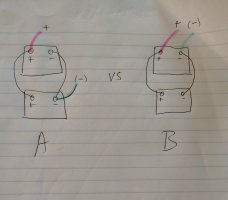
but I am a little unclear if switching to Both is equivalent to wiring the batteries in parallel.
I'd say that if the total resistance in the (+) and (-) battery cables for Batt #1 is exactly the same as that for Battey #2, you can argue that Both is equivalent to wiring in parallel. But if the resistance differs between 1 and 2, the lower resistance battery will always be favored in charge and discharge. Over many cycles, this puts more wear on one battery than the other.

The difference may be small, but it's probably similar to this:
IMG_20251119_150728283~2.jpg

Both are parallel, but (A) balances the batteries better.
 

bigd14

Sustaining Partner
Blogs Author
Thanks Ken, that is exactly what I needed to know. I think I will (eventually) revise the battery wiring and put them in parallel. I’m adding an always on bilge pump switch right now and trying to figure out how far upstream I need to go right now to start that project. For now, I’ll try to account for changing the battery setup to parallel in my bilge pump wiring exercise.
 

Kenneth K

1985 32-3, Puget Sound
Blogs Author
Yeah, lots of ways to do it--whatever you prefer. If you wire the batteries as a single bank, you could attach the unused (+) and (-) batt cables to power posts mounted in the battery compartment. That would give you convenient posts to connect an emergency jumper battery to (versus the posts that are on the "failed" batteries). And, if you someday want to add a remote starter battery, you could wire it to the posts, rather than having to wire all the way back to the 1/2/Both switch.
 
Last edited:
Top