Guest viewing is limited

N.A.

E34 / SF Bay
As you can tell from my flurry of posts, there is a lot of boat work going on :)

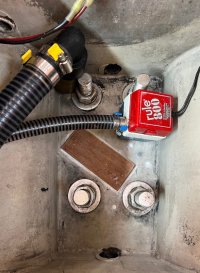
I am getting electrical work done on the boat and the person looked at my bilge pump and told me it was mounted wrong.

I have one of those "Rule 2000" units (see below), which just sits down near the keel bolts. It is not fastened down in any way. As far as I can tell, things were like this all the way from the factory, though I have only had the boat 4 years.

The person showed me that the red strainer piece snaps off (which I knew), but that it is designed for three screws to go through, screwing it to the hull. Then the pump snaps back on, and is fastened down to the hull.

I am uncomfortable with this -- not excited about screwing screws into the top of the keel, or the hull generally. What do you all do? Does anyone here fasten the pump don to the hull, and if so, how?

The person also suggested a second pump, bigger, with bigger hose*, mounted a bit higher and with a separate float switch and alarm, such that if the water level rose about 6" off the keel, it would kick in. It would mount under the galley sink, like the existing one, just off the the side upslope. That area has struts of the "triaxial force grid" that later Ericson's have, which would allow screwing the pump in to something that is not the hull... but is the triaxial force grid. Again I am uncomfortable. Any suggestions appreciated.

* all these pump exit hoses combine and exit via a non-valved, slightly above waterline throughhull on the starboard quarter. Unsure if a bigger hose will really help if it's getting forced through the same small opening... opinions welcome here too.

PS: I had been thinking separately of getting an extra humongous pump with a big hose and a plug to go into a 12V cigarette lighter socket, which I could use for emergency dewatering if things really hit the fan. But having something just mounted as a backup (with alarm) sounds at least as good. Again, opinions welcome. Boat currently has no flooding alarm, so something like that seems like a minimum.

Pump:
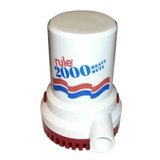
1763233683124.jpeg
 

Bolo

Contributing Partner
There are scores of postings and information on this site about pumps in the bilge. There's probably even a "Master Thread" here someplace, but to answer some of your questions, I've drill a number of holes in the bilge, on top of the keel, with no problem. Solid fiberglass there. And I've installed a variety of rotary type Rule bilge pumps, like the one you show pictured. All have failed on me within two years and allow water to drain back into the bilge causing the bilge float switch to cycle on and off constantly. I now have two diaphragm pumps. One for the main bilge and the other for the shower drain/mast bilge. I'm not familiar with the bilge design on a E34 but on the E32-3 there are two as I stated. I get the occasional water in my main bilge. Where it comes from is something I've tried to answer for years without success. The mast bilge will always have some water in it from rain and so the pump gets a regular work out. I got tired of Rule replacing pumps and squeezing them into the bilge so I went to diaphragm pumps located in the stern compartment which has the lid as part of the cockpit seat. They do not pump at the same volume as a rotary but they've lasted me for years and even been frozen up a couple of times (while on the hard) and still worked after thawed. In the bilge there is a solid state water level sensor (no moving parts) wired to the pump and a hose pointing down to the bottom of the bilge (attached to the TFAG wall) that goes up to a debris filter and then the line runs to the stern where the pump is located.

I do have a manual whale pump which has a large hose and I've thought of installing a larger volume rotary Rule pump up from the bottom of the bilge but I think it would be, if not tight, impossible to fit in and I'd have to drill another hole in the boat. IMHO, if a hole in the boat is big enough, no large bilge pump will keep it from sinking.

IMG_2146.jpeg
Two Diaphragm pumps in the aft compartment located next to the through hulls.
 

bigd14

Sustaining Partner
Blogs Author
This setup with the pumps to starboard of the engine came with the boat and seems to work ok once I unclogged the strainer and cleaned the bilge of algae and gunk. The hose is run from the aft pump to the compartment under the port settee with a strainer under the kitchen sink. The pumps are diaphragm wash down pumps but seem to work ok in this setting. Strangely, there is no float switch on the main bilge pump and the switch is on the main panel so you have to manually turn the switch to empty the bilge. I have a Water Witch float switch and separate Blue Sea bilge pump 3-way switch to add to the system.

1763243010097.jpeg
 
Last edited:

Loren Beach

O34 - Portland, OR
Senior Moderator
Blogs Author
As one might suspect from my prior posts, I much prefer the Jabsco diaphragm pumps, and our '88 boat came with two from the factory. Each with a separate hose run to the transom. And each with a "Rule" float switch and appropriate remote little panel with a bat-handle Manual/Auto switch. As for screwing stuff down to the hull, I have both the float switches and strum boxes screwed down to the bottom of the boat above the keel, with half-inch screws. The laminate is thick there, for sure. That said, I drilled very cautiously there and only as much as needed. :)

And regarding the exits for those bilge hoses back on the transom or quarter, just be sure to support the hose inside the boat so that it's well above the exit point.

Apropos of whatever, that engine compartment in Reply 3 looks very squared away. Nice work!
 

Prairie Schooner

Jeff & Donna, E35-3 purchased 7/21
. . .
I am uncomfortable with this -- not excited about screwing screws into the top of the keel, or the hull generally. What do you all do? Does anyone here fasten the pump don to the hull, and if so, how?
. . .
Everything I've always heard says there is absolutely no problem screwing into the thick foot at the keel joint. However, like you, I don't like the idea of drilling even small holes in it.

I soaked a piece of 1/4" plywood in penetrating epoxy and glued it to the well with 5200, screwing into that to mount a float switch. It's probably a lot of extra work for nothing, but it makes me feel better.

bilge pump 2024_6-9 58 sm.jpg

I mounted a new Whale Gusher in the cockpit with new hoses. And a Rule 2000 pump came my way for free and I'm setting that up with alligator clips for emergencies.

I keep a glossary of topics in this site and have recorded 16 threads on bilge pumps. There's a lot in here. I'll eventually upgrade our bilge pump system, but for now I just wanted to get what we have working well.
 

Kenneth K

1985 32-3, Puget Sound
Blogs Author
Yeah, endless possibilities….

There are some variations amongst Ericson models and there are other changes that have occurred over the years, but the typical Ericson setup was to install two 3/4” bilge pump hoses and a single 1.5” bilge hose From the bilge to the stern.

The 3/4” hoses were fitted with either diaphragm or centrifugal pumps. Usually, each had a dedicated thru-hull in the stern, but some boats used a single thru-hull with a tee fitting. A 3/4” hose can handle a pump rate of about 800 gph, so there’s not much gained by installing a pump bigger than that on your 3/4” hoses.

The factory installed 1.5” hose was usually dedicated to the manual Whale Gusher pump in the cockpit.

So if you have a Rule 2000 in your bilge, the first questions are; what hose is it connected to, and where does it exit the hull? It’s not necessarily a big deal that the pump isn’t screwed down—these pumps don’t create a lot of torque. But if it’s connected to a very light-duty, flexible hose, then it should probably be fastened to something to prevent it from kinking the hose. If you don’t want to drill down towards the keel, you can often drill sideways into the TAFG and use screw-down zip-ties to hold a pump.
 

N.A.

E34 / SF Bay
Thanks to all of you; really is much appreciated.

I'll probably go with @Prairie Schooner 's approach -- Just nervous about punching holes into unknown bits of the boat, when I know water could fill those holes regularly.

Also appreciate Ken's comment re: the 800 gph on a 3/4" hose. Based on that, I will probably rig an emergency de-watering pump with a big hose on it that I can throw out the companionway, since there is no easy way to run new big hoses below after the boat is built. But a high-water alarm: yes indeed, that is coming.

And I apologize for not doing more homework on the 16 other threads before asking. Hopefully you can empathize with the sudden struggle to make many decisions after engaging with someone to get work done -- the bilge pump was an aside that came up during the more urgent battery-charging electrical issues (see other post) and I didn't want to just say, "sure, screw into the keel" without asking here.
 

Prairie Schooner

Jeff & Donna, E35-3 purchased 7/21
. . .
And I apologize for not doing more homework on the 16 other threads before asking. Hopefully you can empathize with the sudden struggle to make many decisions after engaging with someone to get work done -- the bilge pump was an aside that came up during the more urgent battery-charging electrical issues (see other post) and I didn't want to just say, "sure, screw into the keel" without asking here.
I wasn't trying to cast shade on you. I just didn't want to junk the thread up with links. If you want, I can throw some in here.
 

N.A.

E34 / SF Bay
Thanks, @Prairie Schooner, but I had not worried -- that was just an honest apology/explanation on my part; I knew in advance I hadn't had time for a deeper dive, which I usually make it a point of doing first. Others had pointed me to additional resources as well, but (like you) also answered my question... which was really appreciated as it helped take these those decisions are off the 'must decide now so I can get the estimate on everything else' list.

BTW, one of the things I appreciate most about this website/community is that everyone is so friendly and helpful. I never worry about 'shade' here -- certainly not from you, but remarkably, not from anyone. I have never even seen a snide remark in any historical thread I've dug into. About as common in the modern age as stumbling across the Holy Grail, and definitely one of the things that makes me continually glad that the boat I purchased happened to be an Ericson : )
 

Sean Engle

Your Friendly Administrator
Administrator
Founder
BTW, one of the things I appreciate most about this website/community is that everyone is so friendly and helpful. I never worry about 'shade' here -- certainly not from you, but remarkably, not from anyone. I
It’s music to my ears… I’m glad you found the site useful… And yes, everyone here, even the people who just lurk mostly, are very nice and very friendly… Fortunately, we’ve had the opportunity to meet many of them…

And we’ll be in Gloucester in June if anyone’s there for the greasy pole competition! :egrin:
 

Christian Williams

E381 - Los Angeles
Senior Moderator
Blogs Author
How do you pick up, shake, unclog, and curse a Rule submersible if it is screwed down?

(Most submersibles probably just sit on the keel bolts, don't require fastening)

Thoughts on bilge pump installations:


bsangs

E35-3 - New Jersey
I have the 1500 version of that Rule and the strainer plate has been screwed into the bilge for as long as I've owned the boat, along with many years before that with the previous owner. No issues whatsoever. The screws aren't long.
 

Prairie Schooner

Jeff & Donna, E35-3 purchased 7/21
How do you pick up, shake, unclog, and curse a Rule submersible if it is screwed down?
:D Truth.
(Most submersibles probably just sit on the keel bolts, don't require fastening)
In case it isn't clear, our pump is not screwed down. The hose is stiff enough to keep it in place even in pitching seas. I might get an extra 1/2" of water out if it were fastened down, but with the back flow, this is negligible.

For winter storage there is an advantage to leaving it loose. Because we typically leave the mast in, any rain will add water to the bilge. In winterizing I pump anti-freeze through the hose then put the pump in a small bucket in the bilge with a/f. New water in the bilge doesn't dilute this. Even if I'm not working on the boat I stop by every 3 weeks or so to pump the bilge with a hand pump, or after a series of heavy rains. With climate change we can have a heavy rainfall in 40° followed by a long stretch of sub-20° weather.

Thoughts on bilge pump installations:
The back flow of the current pump offends whatever OCD traits I have and I can definitely see switching pumps. It just hasn't gotten bad enough and I keep the Honorary Beach Turkey Baster handy if the OCD spikes. When I do make the move, I've got your thread in my glossary as a guide.
 

Nick J

Contributing Partner
Moderator
Blogs Author
I have an insurance survey today, so I spent the weekend cleaning up and addressing some last minute / long overdue projects. One of the projects I forgot about was terminating the new manual bilge pump hose I installed a few years ago during my strut replacement project. I have no concerns securing bilge pumps or strom boxes above the keel. As mentioned above, you're actually screwing into the TAFG, not the hull. Tom has a pretty good picture of how thick the area is on his blog here:


Jeff brings up a good argument for not securing it above, but if you choose to screw into this area, don't worry too much about it.
 

Prairie Schooner

Jeff & Donna, E35-3 purchased 7/21
. . .
Jeff brings up a good argument for not securing it above, but if you choose to screw into this area, don't worry too much about it.
And to be fair, I could screw the strainer down and just snap the pump out for my winter ritual.
 

windblown

Member III
Blogs Author

I have an insurance survey today, so I spent the weekend cleaning up and addressing some last minute / long overdue projects. One of the projects I forgot about was terminating the new manual bilge pump hose I installed a few years ago during my strut replacement

We had a recent insurance survey. I have a Jabsco diaphragm pump in the stern, and it draws from a hose in the third-from-the-mast bilge to the original bilge-hose T and thru hull. In that bilge section, it has a jabsco filter with screen and a couple of feet of flexible (cheap) bilge hose that I can pull out to use to suck up the last of the water in bilges 1 and 2. (Thank you, Christian for this inspired idea!)That pump is operated (usually on manual setting) from a switch conveniently mounted close by under the port settee. I also have a highwater float alarm in that bilge section. In bilge 2-from-the-mast, I have had a series of centrifigal pumps that flow into the other bilge hose that drains out through the T in the stern. That pump has a float switch. Each of the little plastic “bottoms“ have been screwed with 1/2“ screws, but the cramped space makes it way too difficult to get the pump in and out of the little clips, so mine just sit near the bottom. In the bilge-closest to the mast (shower sump), I have another centrifigal pump, sharing the same hose as the other centrifigal, with a valve that lets me choose. That pump has a water-witch float switch, for when it is on automatic, which it almost never is.

I thought this system was pretty impressive, but the surveyor wrote me up because all of the bilge power is wired back to the “bilge” breaker on the DC panel, rather than being directly wired from the battery. argh. I’m not planning to comply with this recommendation; we like the visual leds for the bilge circuit and high water alarm, and having the option to turn off the bilge circuit for the seven months when the boat is on the hard works for us (we usually keep the batteries in the boat and have the option of AC power on all winter.)

I get the occasional water in my main bilge. Where it comes from is something I've tried to answer for years without success.

I am very pleased to report here that 2025 was our first full season (out of nine) with a reasonably dry bilge! (Which is why I finally got around to installing a high water bilge alarm; high water would be unusual and alarming!) Re-sealing the lower rudder bearing, installing a new “dripless“ shaft seal (ours was “new” when we got the boat, but apparently not functioning as it should when under power), replacing both foot pumps in the galley, and replacing a valve in the fresh water system all seems to have FINALLY eliminated three different (irregular) sources of water that resulted in a constant and disturbing accumulation of water in the bilge.

PS: I had been thinking separately of getting an extra humongous pump with a big hose and a plug to go into a 12V cigarette lighter socket, which I could use for emergency dewatering if things really hit the fan.
In regard to the turkey baster (which was a constant companion for many years and hundreds of gallons, before we added the diaphragm pump), I highly recommend getting an inexpensive, small, wet-dry vac because it is so very fast and extremely satisfying to suck up the last drop of water ANYWHERE, and toss it overboard. We started with the deWalt 2 gallon because it has battery and AC included. But we found it‘s shape stable for stowing, but awkward for vacuuming. Emptying two gallons of water from a rather shallow rectangular plastic base can be a sloppy nuisance, and the consequence of not emptying it and rinsing it immediately after each wet use results in the slimey mess no skipper or admiral wants on board. And, of course, the battery has to be chaeged with AC power.

Instead of acquiring a variety of items with a dc plug, an option might be to acquire an AC/DC inverter that will can be used if shore power isn’t available. We got one from Radio Shack years ago, and we use it in the car for laptop power more often than in the boat. If the engine isn’t running, beware of the drain on the DC battery!
sample AC DC Inverter online

Next we tried the Home Depot version that sits on top of a bucket that you provide, but it’s AC only. For less than $30 you get incredible suction but enough noise to have you thrown off the docks. It’s an advantage to be able to shift from a 3 gallon to a 1 gallon bucket, and so much easier to empty a bucket with a handle over the side than an awkward rectangular box. It’s also easy to switch from a wet bucket to a dry bucket and take both ashore for a quick rinse and cleaning. But the noise!!! And without a bucket, how do you stow the vacuum apparatus on board? We just picked up a little Stinger for under $30 that’s a special buy at Home Depot. I will report back for the edification of all Vikings.

My 2 cents on several tangents, but hopefully still enough along the bilge theme. As always, I look forward to any comments or insight from the community. It really is a wise, thoughtful, kind community.
 

bigd14

Sustaining Partner
Blogs Author
Apropos of whatever, that engine compartment in Reply 3 looks very squared away. Nice work
I wish I could take credit for it, but whoever did the engine refit and a bunch of other work did an amazingly tidy job of it. I’ll be hard pressed to match that work, but will do my best.
 
Top