Guest viewing is limited

Black Bilge Water

wayneking

1986 Ericson 38-200
The water in my bilge has a lot of black sludge. Haven't seen it before. Seems to have built up over the last couple of months. Also the boat hasn't gone anywhere during that time for various reasons so possibly algae build up in the standing water (it leaks somewhere when it rains)? It doesn't really seem like oil and there has been no noticeable loss of engine of transmission oil. Any ideas on what this might be. A sign of a problem?
 

Christian Williams

E381 - Los Angeles
Senior Moderator
Blogs Author
We've had a lot of rain down the mast recently, but your bilge pump seems to have kept up. (Wayne is in Oxnard, CA)

For what it's worth, sludge in the bilge can come from a rotting sole, which sheds debris from its underside. At end of life, my sole filled the bilge with glop that turned out to be wood delamination, often black from mold. Difficult to confirm, since the sole is sealed except for the bilge inspection hatches. A spongy sole is a clue.
 

Loren Beach

O34 - Portland, OR
Senior Moderator
Blogs Author
Up here in NW Oregon, any major rain storm will put a quart or two of rain water into our bilge from inside the mast. Like our boat, your rig has double spreaders and a bunch of halyard exits -- many places for rain water to get inside.

If water sits in the bilge, below the half inch or so that the bilge pump cannot pick up, it is liable to grow black mold. Ours does, and that's why in the winter months I dry out the bilge every week with small bucket and a turkey baster. Laugh if you will, but this works pretty well. :)

IMO, once black mold gets a good hold on the bilge surfaces, it can be difficult to irradicate. I find that soap augmented with bleach works, about every other year.
 
Last edited:

Sam Vickery

Member III
Up here in NW Oregon, any major rain storm will put a quart or two of rain water into our bilge from inside the mast. Like our boat, your rig has double spreaders and a bunch of halyard exits -- many places for rain water to get inside.

If water sits in the bilge, below the half inch or so that the bilge pump cannot pick up, it is liable to grow black mold. Ours does, and that's why in the winter months I dry out the bilge every week with small bucket and a turkey baster. Laugh if you will, but this works pretty well. :)

IMO, once black mold gets a good hold on the bilge surfaces, it can be difficult to irradiate. I find that soap augmented with bleach works, about every other year.
Here in Dana Point I also use a turkery baster, a small bucket and follow up with a sponge to remove the last bit of water. It is an annoyance, but I always feel better when the bilge is dry.

North Star 1986 32-3
Universal 25
 

Bolo

Contributing Partner
Here in Dana Point I also use a turkery baster, a small bucket and follow up with a sponge to remove the last bit of water. It is an annoyance, but I always feel better when the bilge is dry.

North Star 1986 32-3
Universal 25
Seems that turkey blasters are “standard“ equipment for a lot of Ericsons since I too keep one stored in the mast bilge where it neatly fits and is always handy when sucking out bilge water below the diaphragm pump hose intake is required.
 

Dave G.

1984 E30+ (SOLD)
I use a "bucket head" when shore powered. I do have a baster for small extractions and when not on dock power. Also allows to add some soapy water, going for a sail to clean the bilge, and suck it out quickly back at the dock. It's just a wet vac head that fits on a 5 gallon bucket. Very handy and I highly recommend for a number of uses on a boat. It's just small enough to stow away. I'm sure there are others but I have the one from HD.


HerbertFriedman

Sustaining Member
I use this bucket head vacuum too, if you already have a standard bucket on board for other uses, the bucket head stores in the lazarette easily. You need shore power but if you have an inverter on board, that works too.
 

wayneking

1986 Ericson 38-200
I use a "bucket head" when shore powered. I do have a baster for small extractions and when not on dock power. Also allows to add some soapy water, going for a sail to clean the bilge, and suck it out quickly back at the dock. It's just a wet vac head that fits on a 5 gallon bucket. Very handy and I highly recommend for a number of uses on a boat. It's just small enough to stow away. I'm sure there are others but I have the one from HD.


Thanks for that. I have a small 2 Gal shop vac, easy to store but fills up too quickly, especially when vacuuming anything really sudsy. This looks like a much better idea.
 

Kenneth K

1985 32-3, Puget Sound
Blogs Author
At the bottom of the bilge sections, around the keel bolts, the bilges are narrow. As you go higher, the bilges widen out (following the shape of the hull), and wider than the bilge access 'squares' in the sole. These bilge sections extend outward several inches athwartships, underneath the cabin sole. Hidden under the sole are the "tabbing" areas, where the TAFG bilge sections are bonded to the hull. These tabs create pockets that trap dirt, grime, organic growth, sawdust, mold, etc.
20230415_202323~2.jpg

If the pockets are dirty, and water rises to that level of the bilge, wave/rocking action can "wash" the grime from the pockets down into the visible, lower portion of the bilge. Maybe that's what you are seeing.
 

Christian Williams

E381 - Los Angeles
Senior Moderator
Blogs Author
Here's a video of what Ken is describing:


Captain Pete

Member II
Chritstians video on the TAFG is well worth watching to have a good understanding of the Ericson TAFG grid structure and how it drains (or doesn't).

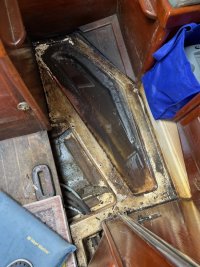
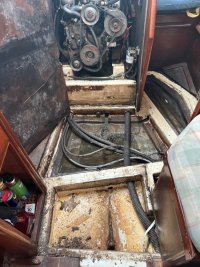
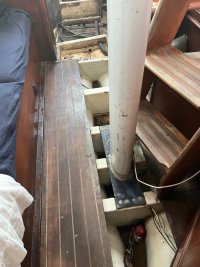
I attach a few shots of my no longer owned 35-3 when I was doing some repair to the cabin sole. Low and behold some perhaps decades old water in the grid by the nav station, and incomplete draining in front of the engine. It was nasty but all cleaned up fairly easily, and I am sure that latent moisture was a factor in why the sole needed some repair.

Although there seem to be many similarities in structure to Christian's 38, the 35-3 hose routing is different (and I think not as serviceable). I wonder what's going on under the sole of my 32-3...
 

Attachments

  • IMG_4844.jpg
    IMG_4844.jpg
    187 KB · Views: 17
  • IMG_5051.jpg
    IMG_5051.jpg
    204.4 KB · Views: 17
  • IMG_5052.jpg
    IMG_5052.jpg
    144.3 KB · Views: 17

Captain Pete

Member II
And jut for comparison sakes, below is the grid structure and hose leads of a Beneteau First 42 of similar vintage. Much shallower bilges (a small sump for the bilge pump is under the table leg) but access is easy as all floor boards lift up. I think the TAFG may be more robust.
 

Attachments

  • IMG_5829.jpg
    IMG_5829.jpg
    154 KB · Views: 16
Top