Guest viewing is limited

E381 bottom barier coat question

Angel D.

Member III
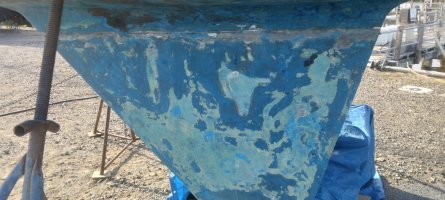
Well friends , been on blocks for a few days and got some old tranducers out. Fill the empty holes with thickened resin and glass outside with good cloth . Wile in the process of sanding i come to the conclution that 3/8in of old bottom paint is just crazy thick and under i found a good amount of blisters.
Yesterday and today been all scraping and sanding and have days ahead of doing more.
My question now is how much is a layer of barier worth for this E381.
5 layers would be fantastic if I can swing it . planning to work on two colors (gray and white) to alternate layers and know whats been done.
Will need to order materials and need to know quantity .

Thanks in advance !
Angel A.
 

Prairie Schooner

Jeff & Donna, E35-3 purchased 7/21
Hi Angel,

You must be exhausted. I remember well doing that project. My arms and back ache just thinking about it and and I was able to spread it out over three months.

This link has a lot of good perspectives about barrier coating:
On page two I posted links for a lot of additional threads on the subject.

You're probably too tired to read much of it. I'll attempt to condense, and hope that others will jump in.
There are at least two viewpoints. Some folks think barrier coat isn't necessary at all and can even be a cause of blisters. Just put your bottom paint right on the bottom gelcoat. Others are big fans of adding lots of barrier coat after thorough stripping. You will find those back and forth discussions in that thread and both sides are compelling. Especially if you add barrier coat, it seems critical to have a thorough drying out period if at all possible.

We stripped to bare bottom and put on three coats of Total Boat epoxy barrier coat. Then we put on the bottom paint. But our boat had been on the hard since late October and the epoxy didn't go on until early May. Lots of time to dry out.

If yours were my boat and I didn't have time to properly dry it out, I would seriously consider not putting any barrier coat on at all. Pay special attention to Ray's contributions @Pete the Cat ; and as I recall, Loren makes some good points for no barrier coat.

The blister repair is another question. Fortunately, we didn't have to deal with that. I'd advise you to make a few exploratory grinds in a few different locations on the hull. Some folks find relatively mild cases and others find pockets full of water or gooey resin.

We made our decision and it looked good when we hauled last October. A light sanding this spring didn't show any trouble spots. But I still feel like a test laboratory.

Stock up on ibuprofen or acetaminophen!!!
Good luck.
 

Prairie Schooner

Jeff & Donna, E35-3 purchased 7/21
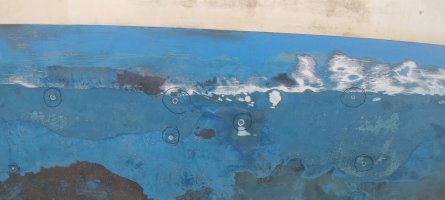
This is the senario
It's hard to discern their depth or nature from the photo, but I don't think those are too bad. If there aren't a lot more, that's not that many, to my mind. It's nothing as bad as the boats in this thread:

I'd grind them out enough to be sure I got any compromised fiberglass, fill with thickened epoxy, and sand them out. Those areas might benefit from a coat of epoxy primer.
 

Angel D.

Member III
They are not too bad , over all less that the size of a half ten cent coin. Its like she is a teeneger with some pimples lol. A dorp or two of water when dig them.Guess is luck to catch them on a early stage. Play some Frank Sinatra greatest hits for her this morning and got down there. She is getting the love she deserves .
 

David Vaughn

E31 Independence - Decatur AL
Blogs Author
I agree with Jeff.
On Kotona, we had several blisters larger than what you have and upon grinding discovered most of them had at least some delamination. Fortunately it wasn’t too deep and one or two layers (three on the worst ones) of new glass was enough to fill them.
But like you said catching them early is a good thing.
 
Top