Guest viewing is limited

Engine overheat sensor question

mherrcat

Sustaining Partner
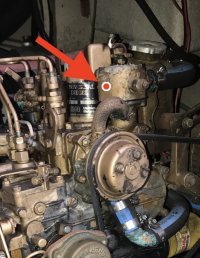
Considering the addition of an overheat temp switch to the thermostat housing on M18 engine. I believe the thermostat for that engine is 180-degree. At what temperature should the switch "close" to indicate an overheat condition? What is the normal operating temperature of that engine?

I saw another thread where a Cole Hersee #84251 switch was installed, but that switch "closes" at 195-210 degrees, which seems like it would be triggering the alarm unnecessarily. The Cole Hersee #84248 closes at 245-265 degrees.
 

Christian Williams

E381 - Los Angeles
Senior Moderator
Blogs Author
Yes that gizmo is really appealing. Measures heat at the exhaust elbow.

Certainly easier than dicking around with the typical engine-block sensor on my boat, which was quite difficult access.
 

mherrcat

Sustaining Partner
Maybe I'm missing something. Wouldn't you want to measure the temperature of the engine coolant?

Catalina Direct sells a kit to add this switch that includes a replacement thermostat housing with the additional hole already drilled and tapped. But they want $340 for it. Seems like having a machine shop drill and tap a hole and buying a $20 temp switch would be cheaper.

Universal M18 Diesel copy.JPG
 

Pete the Cat

Sustaining Member
I have the Aqualarm installed on my exhaust elbow. I recommend it. If you think it through, it will give you the earliest indication something is not flowing right in the raw water coolant system. I might miss something like your entire oil system emptying into the bilge, but the oil pressure alarm should pick that up. Actually, the freshwater coolant temp seems like it is a lagging indicator of catastrophic failure but very useful over time in seeing developing longer term future issues that need attention. Hope that makes sense.
 

Kenneth K

1985 32-3, Puget Sound
Blogs Author
Look at these guys: https://aqualarm.net/index.php?main_page=product_info&products_id=157

Lots of options. Most of aqualarm's sensors trigger at 200F. Most of our diesels have 160F or 180F thermostats, so, if you hit 200 degrees, the engine is overheating but no damage has been done yet.

I used the block temp sensor shown in the link above, but attached it to the side of the exhaust/coolant manifold.

Also, if that’s a recent photo of your engine in post#4, it looks like you have the old, problematic alternator mounting bracket which was recommended for replacement on M-18 and M-25 engines: https://pbase.com/mainecruising/universal_alternator_bracket&page=all
 
Last edited:

mherrcat

Sustaining Partner
The alternator bracket was replaced two weeks ago. I posted some observations about mounting that bracket on the M18 engine but no one commented. Had to have a longer adjusting arm fabricated.

There is a bolt-on Aqualarm heat sensor that was attached to the manifold, but I'm thinking, based on most of the options I'm seeing, that attaching a sensor to the exhaust elbow is the better place for it.

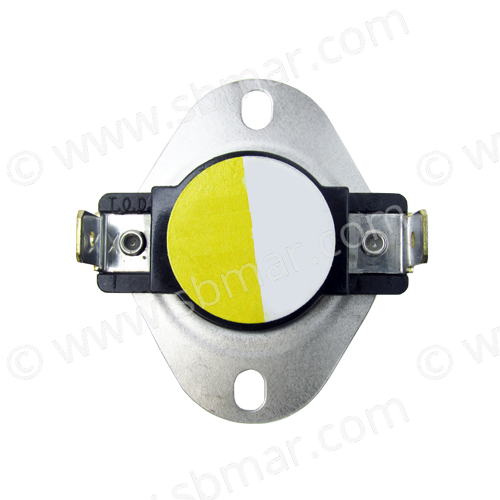
I think I am going to get this. It can be mounted to the back of the exhaust elbow just above the exhaust hose outlet. Just need to drill and tap a couple of #10 holes to mount it.


Exhaust Elbow heat sensor.jpeg
 
Last edited:

Kenneth K

1985 32-3, Puget Sound
Blogs Author
The alternator bracket was replaced two weeks ago. I posted some observations about mounting that bracket on the M18 engine but no one commented. Had to have a longer adjusting arm fabricated.
Great!

There is a bolt-on Aqualarm heat sensor that was attached to the manifold, but I'm thinking, based on most of the options I'm seeing, that attaching a sensor to the exhaust elbow is the better place for it.
Opinions will probably differ on this, but I think the manifold or thermostat housing is the best place for an engine overheat detector. Both the manifold and the thermostat housing capture the temperature of the coolant flowing throughout the engine. That's the best indicator you can get for overall engine temperature. Plus, you know that the normal temperature should be 160 or 180 degrees (based on the thermostat) because this is a temperature regulated system.

Exhaust gas temperatures are much higher than this, probably in the 500-800F range. Yeah, the exhaust will be cooled a bit going through manifold, and again, going through the cooling elbow, but it's not a regulated system like the engine, so who's to say what the proper exhaust elbow temperature should be. And I wouldn't be particularly worried about an "overheating" elbow as long as the engine itself were still within normal limits (though I wouldn't expect that disparity to remain for very long).

I'd rather have temperature information coming right off the block or the manifold. But, yeah, an overtemp sensor that triggers at 180F is likely problematic with a 180F thermostat, but probably OK with a 160F thermostat.
 
Last edited:

mherrcat

Sustaining Partner
Opinions will probably differ on this,
:oops:

I’m not a mechanic or a mechanical engineer, but…

I’ve seen a few videos and read some posts on other forums saying that a raw water circulation failure will show up first in the water injection side of the exhaust elbow, and show up later in the coolant system, possibly too late to prevent engine damage. Which is what Pete the Cat said earlier. There are several products that take their temp reading from just behind/downstream of the exhaust elbow. And the exhaust temps at that point were mentioned as anywhere between 140 to 170-ish, not 500+F.

I guess there's always the possibility of coolant loss, but it seems the chances of a loss of raw water circulation would be the more common fault: blocked raw water intake, raw water impeller failure, impeller vane stuck in heat exchanger...

Is there any study that shows comparative temp readings between the two systems? Or is where you place the switch all just conjecture? “You believe what you want to believe.”

I'm leaning toward the exhaust elbow as the monitoring point.
 

Kenneth K

1985 32-3, Puget Sound
Blogs Author
a raw water circulation failure will show up first in the water injection side of the exhaust elbow, and show up later in the coolant system,
Yeah, that sounds pretty reasonable (for a raw water circulation problem).

possibly too late to prevent engine damage.
That part could only makes sense if you assume there is no block temperature warning circuit. That was kind of my point. I don't really care how hot my exhaust elbow gets as long as my engine stays at 180 F. If it gets hotter than that and triggers the block temp alarm at 200F, I shut the engine down. Where does the supposed ‘too late to prevent damage’ claim come from?

There are several products that take their temp reading from just behind/downstream of the exhaust elbow. And the exhaust temps at that point were mentioned as anywhere between 140 to 170-ish, not 500+F.
Here’s the old exhaust elbow I pulled off my engine. It’s pretty clear that parts of the elbow get much much hotter than 170 degrees. So the temperature that the heat sensor is subject to depends on - where you mount the sensor, - exhaust gas temperature (how hard the engine's working), - the temperature of the raw water, - and the flow rate of the raw water.
IMG_0856.jpeg
That’s a lot of variables, so I wouldn‘t know how to guess what the proper trigger temperature should be for an elbow-mounted warning probe. But the engine block has a thermostat regulated cooling system, so it should never vary by more the 10-20 degrees (despite changes in those other variables), and I know the trigger should be about 200 degrees. Folks will make other arguments about putting the probe on the exhaust hose (downstream of the elbow), but that still involves more variable than measuring block temp.

I guess there's always the possibility of coolant loss,
Or a thermostat that’s stuck closed.

but it seems the chances of a loss of raw water circulation would be the more common fault: blocked raw water intake, raw water impeller failure, impeller vane stuck in heat exchanger...
Yeah, that seems many times more likely than an engine-coolant related problem.

I'm leaning toward the exhaust elbow as the monitoring point.
Well, that puts you well ahead of the (I don’t know, 80%??) of old sailboats that have no warning system beyond the temperature gauge. It’ll be a smart upgrade!
 
Last edited:

bigd14

Sustaining Partner
Blogs Author
I will be trying to manage this issue too. The Volvo D1-30 has an overheat alarm (which went off during sea trials), but it’s the same pitch and much quieter than the shallow water alarm on the Raymarine instruments, so none of us really heard it or recognized it very easily. The Volvo runs at about 194 normally so trying to figure out alarm temps will be challenging, but I need some kind of loud obnoxious noise or flashing lights to warn of this.
 

mherrcat

Sustaining Partner
Below is a link to one of the videos I watched regarding an exhaust elbow sensor. Interesting test at the end when they shut off the raw water intake to see how quickly the sensor responds to a rise in temperature. It was seconds.


mherrcat

Sustaining Partner
Here is a excerpt from an article on installing alarms on various engine systems. The excerpt is from the section on installing a coolant high temp alarm:

The other issue with the common 205 deg F coolant temperature switch is that it’s set point is on the cusp of an overheat and you may be already be in the damage zone if there is any delay in it closing and triggering the alarm.

Here is the link to the entire article:


Kenneth K

1985 32-3, Puget Sound
Blogs Author
I watched the video. It's pretty convincing. If I didn't have the block temp sensor, or if I felt the need for an earlier-warning system, I'd install one.

I thought the article was a little shakier. I considered it more of a targeted advertising piece than an objective article about engine warning systems. And, to accept his premise that, "its set point is on the cusp of an overheat and you may be already be in the damage zone," you had to have already accepted his previous premise that the "[Cummins] factory system can be too little too late in the event of an overheat as these high output engines have no extra iron to absorb the overheat."

He's stepping on a lot of toes there. I'd want to hear a rebuttal from the Cummins engineers, or at least an experienced Cummins mechanic before taking this guys word for it.

But I've picked on your research methodology enough already. At least you did your research. I looked at zero YouTube videos and no website other than https://aqualarm.net.

Here was my research: I grew up as a kid in the 70s. My dad always had a thing for cars with big engines. He traded in the Pontiac station wagon with a 427 V-8 (about 400 hp) for a Chevy Suburban with a 454 (about, 300+ hp, with the newer emissions standards). My first car was a 1976 Nova. Every one of those engines (70s technology being what it was) overheated to the point of steam boiling out of its radiator cap at least once or twice while we owned them.

Water boils in an open pot at 212F. Under a 13lb pressure cap, it should boil at 246F. When the "water" is mixed with anti-freeze/coolant, the temperature should be even higher. Needless to say, all of those engines got extremely hot, under active driving conditions, before they blew steam and coolant out of their radiator caps and were brought to a stop. And yet, they all went on to drive tens of thousands of miles and many years afterwards.

My ultimate assessment was this: If a big-block V8 with four times the moving parts and 15-20 times the horsepower of my M25 can withstand a 250F overheat, I'm completely, 100% comfortable with a 200F block temp warning sensor on my little motor.

You're completely free to come to other conclusions.

I wish you luck with your project.

 
Last edited:

mherrcat

Sustaining Partner
The only time I had an overheat situation with the M18 was when I didn’t add enough coolant after removing the heat exchanger. I bled the system but apparently, due to the installed expansion tank, I needed more. The manifold mounted (surface mount) Aqualarm switch closed and tripped the alarm. By that time hose connections were spewing coolant in several places.

I still have the surface mount switch. And will probably reinstall that, plus the elbow switch, and tie them together. If either trips the alarm a quick look at the temp gauge should indicate if it is a coolant problem or a raw water problem. No?
 

Joliba

1988 E38-200 Contributing Member
Several years ago I decided to add an alarm for low oil pressure and for coolant overheating in our Universal 5432 (M-40) engine. There was an existing oil pressure light on the engine panel and a coolant temperature gauge on the panel, but no alarm. What I wanted was an audible alarm for both. I bought an inexpensive alarm buzzer that I mounted behind the engine panel inside the cockpit lazarette. I wired the oil pressure sensor to the buzzer and bought an inexpensive Cole Hersee temperature switch for the coolant temperature. I tested the temperature switch in a pot of water on the stove using a IR temp sensor "gun" to verify the water temperature when the switch closed. It was consistently 202 degrees F. Since I use a 185 degree F thermostat in the engine, that seemed to be a good temperature to warn of overheating before damage occurs.

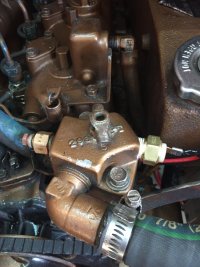
As the existing temperature gauge was mounted on the thermostat housing, I decided to mount the new temperature switch on the thermostat housing as well. Perhaps this is not the best spot because a faulty thermostat that is stuck closed might block the coolant flow and cause an overheated engine that would not be sensed at that location with no flow. Nonetheless, that is what I did. I wired the Cole Hersee switch to the ground circuit of the buzzer also. To install the switch I simply drilled and tapped the aluminum thermostat housing and screwed it in with some high temperature thread sealant.

Now, if the alarm sounds, either the oil pressure is low or the engine coolant temp is over 202 degrees F. The buzzer sounds routinely whenever I turn on the engine switch for startup, until the engine is running for a few seconds and the oil temp comes up as it should.

Here is a photo of my installation. The temperature gauge sensor is on the left. The alarm switch is on the right.after installation.JPG
 

Pete the Cat

Sustaining Member
Look at these guys: https://aqualarm.net/index.php?main_page=product_info&products_id=157

Lots of options. Most of aqualarm's sensors trigger at 200F. Most of our diesels have 160F or 180F thermostats, so, if you hit 200 degrees, the engine is overheating but no damage has been done yet.

I used the block temp sensor shown in the link above, but attached it to the side of the exhaust/coolant manifold.

Also, if that’s a recent photo of your engine in post#4, it looks like you have the old, problematic alternator mounting bracket which was recommended for replacement on M-18 and M-25 engines: https://pbase.com/mainecruising/universal_alternator_bracket&page=all
Aqualarm sensor is attached to the exhaust elbow. The will run hotter than the coolant temp before the engine is actually over heated. You are not much overheated at 200 F in the exhaust elbow. On most boats, it would be a very early warning something is not right in the raw water circuit.
 

phildogginit

Member II
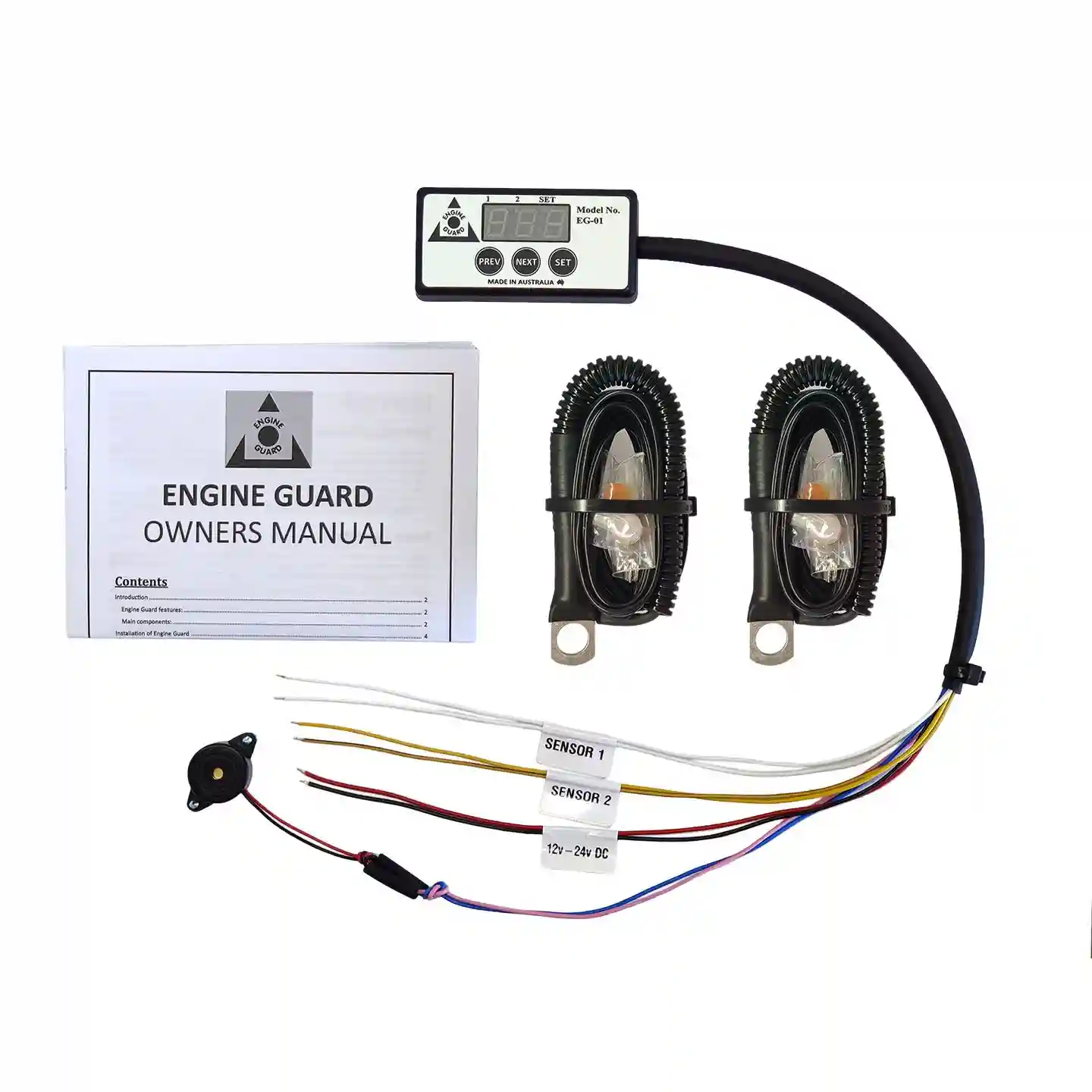
I installed one of these

I installed one sensor clamped to oil filter , one on manifold next to engine lift hook. There is a digital display and an audible alarm in the cockpit. It works nicely
 
Top