Guest viewing is limited

Furler Purchasing advice

Nick J

Contributing Partner
Moderator
Blogs Author
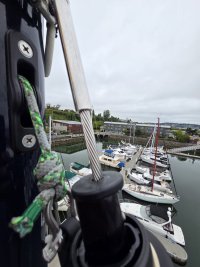
I got up the mast this weekend to work on the wind instrument (whole other frustrating issues with a 2 year old B&G) and took a pic of the final configuration20250802_094812.jpg
The top ended up 1.5 inches below the swage. I have room in the drum to raise it another inch, but i think this is ok.

I had to cut my spliced-in soft shackle off because it was too close to the new exit block. Not the end of the world, just a little less cool factor.

20250712_105932.jpg
 

Kenneth K

1985 32-3, Puget Sound
Blogs Author
Have you evaluated your exit block for the suitability of climbing the mast? In the factory setup, the axles are trapped in place by the welded-in sheave box. So even if a sheave failed, the axle would still hold the halyard in place. Just wondered if you've evaluated the failure modes for the exit block (that is, if you'll be using it to ascend the mast).
 

bgary

Advanced Beginner
Blogs Author
failure modes for the exit block

In my experience (*) if a block like that fails it's a sudden drop of about 6 inches, and then a heated conversation with the deck about why they can't lower you on the same halyard you went up on. Punctuated with conjecture about whether the sharp aluminum edge at the bottom of the opening is going to cut the line you're on if they don't hurry up...

(*) it'll come out in therapy, some day....
 

Prairie Schooner

Jeff & Donna, E35-3 purchased 7/21
In my experience (*) if a block like that fails it's a sudden drop of about 6 inches, and then a heated conversation with the deck about why they can't lower you on the same halyard you went up on. Punctuated with conjecture about whether the sharp aluminum edge at the bottom of the opening is going to cut the line you're on if they don't hurry up...

(*) it'll come out in therapy, some day....
both :oops: and :D
 

Nick J

Contributing Partner
Moderator
Blogs Author
Have you evaluated your exit block for the suitability of climbing the mast? In the factory setup, the axles are trapped in place by the welded-in sheave box. So even if a sheave failed, the axle would still hold the halyard in place. Just wondered if you've evaluated the failure modes for the exit block (that is, if you'll be using it to ascend the mast).

Ken, sorry for not responding sooner, I've been out of town sailing with 59 North from Ketchikan to Victoria followed by a trip through the San Juans to Victoria again aboard our boat to drop my wife off for her leg from Victoria to San Francisco!

Yes, I did consider the failure mode of this block, but not for climbing the mast. I was focused on the halyard load under sail. I think there are 2 basic failure modes for this block:

1. the axel or sheave breaks - if this happens and the block stays in the mast, the line will ride on the edged of the block which is contoured and does not have a sharp edge. It would not be fun if you're suspended by the line, but you should have no problem lowering a person or a loaded sail. In contrast, if this happened on the original sheave, the line would be riding on the sharp cut-out opening and could potentially cut the line.

2. the screws or rivets break and the block falls out of the mast -the block has a recessed shoulder that rests on the mast cut out, so the load isn't actually on the screws. Under load, the block should remain in place. If it doesn't, the line would ride on the mast cut out and could create a problem.

After spending some close personal time with both the original sheave box and these new exit blocks, I'm confident both are well designed and built. I have no problem hoisting a sail or climbing on either one.

to avoid my own personal therapy session like Bruce mentioned, my mast climbing setup includes an ascender, Grigri, and 150' dedicated climbing rope I rig each time I go up the mast. The rope is only used for this purpose and is kept in the cabin. When I rig it, I keep the extra 50' in the cockpit that I run through a clutch, around the halyard winch and self tailer, and secured to a cleat. If I did end up on the buisness end of the climbing rope with a broken block, I would still be able to lower myself. If the Grigri didn't work or I was unable to operate it, anyone on deck would be able to lower me using the cabin top winch and extra 50' of rope. It's a bit more work for the climber, but I prefer to be self sufficient and not have to rely on anyone on deck.

During the trip with 59 North, I got the opportunity to go up the rig of their Farr 65. They go the more standard route of using the primary winches to hoist a climber. With all 11 Crew on deck, massively oversized halyards and rigging, and secondary halyard, their system seemed safe as well.

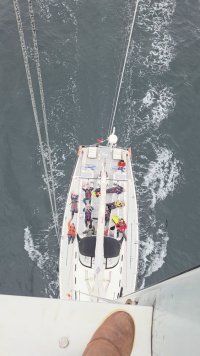
IMG_2746.jpg20250805_103842.jpg

On a different note, I finally figured out what happened to my wind instrument. The top cap was loose and allowed water to get into the circuit board compartment. It pooled at the bottom where the wind speed transducers are located. One of them is completely corroded which explains why I was still getting some reading, but it wasn't accurate. I ordered a new circuit board. Hopefully we'll have a working wind instrument soon.

 

Kenneth K

1985 32-3, Puget Sound
Blogs Author
Ken, sorry for not responding sooner, I've been out of town sailing with 59 North from Ketchikan to Victoria followed by a trip through the San Juans to Victoria again aboard our boat to drop my wife off for her leg from Victoria to San Francisco!
Sounds very cool! How did you hook up with that crew??? Sounds like an awesome trip.

.... the block has a recessed shoulder that rests on the mast cut out, so the load isn't actually on the screws. Under load, the block should remain in place.
Yeah, that sounds better. I was thinking the weak link would be the threaded holes in the aluminum, but if they're not supporting the halyard loads, then no problem.

to avoid my own personal therapy session like Bruce mentioned, my mast climbing setup includes an ascender, Grigri, and 150' dedicated climbing rope I rig each time I go up the mast.
Yeah, after many trips up my mast this summer, I started to rely more-and-more on dedicated climbing ropes versus the halyards. I left one attached to a carabiner up at the mast-head. Using a tag-line draped over the top spreaders, I can drag it to the front or back of the mast for use as a climbing rope or a temporary headstay/backstay (useful at least until I replace the old SS backstay with a new one).
IMG_20250710_195820824_HDR.jpg

During the trip with 59 North, I got the opportunity to go up the rig of their Farr 65. They go the more standard route of using the primary winches to hoist a climber. With all 11 Crew on deck, massively oversized halyards and rigging, and secondary halyard, their system seemed safe as well.
Yeah, compared to the size of your shoe, that looks like a massive spreader. That must have been some height from the top!
 
Top