Guest viewing is limited

Kenyon SS Gooseneck Base Question

Loren Beach

O34 - Portland, OR
Senior Moderator
Blogs Author
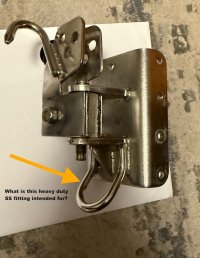
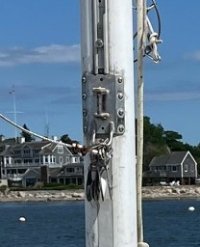
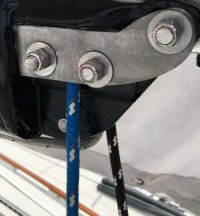
I just removed the boom and then the the heavy duty SS base from our mast. It's been about 20+ years since I last inspected the parts. Main reason was to be sure that the 3/8 pivot pin was not wearing too much, as I could see that the rotating part was a couple of degrees off of vertical. Lots of force on these parts under sail, from vang tension, etc.

With all parts off and cleaned up the wear does not look too bad, and a shipwright friend who is also a machinist will have a look at the parts next week.

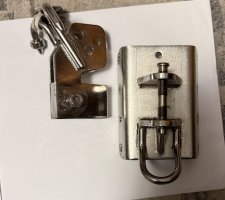
Looking at some (scarce) Kenyon parts info/pix online. I so not see any replacement with the very heavy welded SS loop on the bottom. There was never anything that might attach to this on our boat, from the time we bought the boat in '94. The triangular gusset below the lower plate would seem to be needed for strength and alignment.
But.... what was (is) the loop of SS intended for?

BTW, all 8 of the screws came out cleanly, after being bedded thoroughly in an "insulating" layer of sealant since I last took this part off in the late 90's when I was repairing a broken vang attachment plate. That required opening up boom interior with the hidden outhaul tackle -- rather fussy to restore those parts, I recall.

At the least, and seeing some wear in the SS rigging pin, it will get replaced. As for correcting any small 'oval-ing" of the holes, expert opinion will be sought out shortly.

Please... let me know what that angled heavy ring fitting was for. Guesses encouraged!

Thanks,
Loren
 

Attachments

  • Gooseneck Base, Kenyon.jpeg
    Gooseneck Base, Kenyon.jpeg
    149.5 KB · Views: 29
  • Kenyon Base, another view.JPG
    Kenyon Base, another view.JPG
    79.8 KB · Views: 29

Prairie Schooner

Jeff & Donna, E35-3 purchased 7/21
I'm probably not thinking this through well, but on some non-E boat could the mount have been attached to a car and that bail used to pull the whole boom down as a cunningham?
 

Loren Beach

O34 - Portland, OR
Senior Moderator
Blogs Author
Thanks Vikings! While the tang could never be used to "pull down" a bolted-in-place bracket mounting, it could have very well been intended to give an option for attaching a turning block when the boat building customer wanted a house-top main sheet system.
Note that the Olson's have a main sheet led to a traveler on a bridge deck.

Mystery appears to be solved! Now I idly wonder if a super hard core racer would grind it off their Olson to save weight... ;)

Next we need to figure out how ancient Vikings got those horns to stay attached to their helmets during battle!!

ps: the vertical SS pin in reply 3, looks to be worn similarly to ours.
 

bigd14

Sustaining Partner
Blogs Author
the vertical SS pin in reply 3, looks to be worn similarly to ours.
I haven’t dug into the rigging on the 34 yet, but I recall my 30+ had a similar issue. I determined it wasn’t too bad so left it alone.
 

Prairie Schooner

Jeff & Donna, E35-3 purchased 7/21
. . . While the tang could never be used to "pull down" a bolted-in-place bracket mounting, . . .
What I had in mind was this being a generic part used by a number of different boat manufacturers and a different boat might have had a sliding car for the the goose-neck mount. But I've only seen sliding boom mounts on smaller boats. Doug's suggestion of an anchor point for turning blocks is far more likely.

Late-winter musings.
 

Seth

Sustaining Partner
I'm probably not thinking this through well, but on some non-E boat could the mount have been attached to a car and that bail used to pull the whole boom down as a cunningham?
That only works for a sliding gooseneck like some of the very old and smaller Ericsons. These are fixed goosenecks
 

Captain Pete

Member II
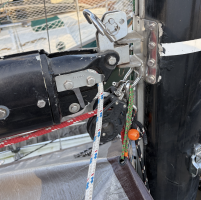
My 32-3 has it so that's how I used it. Maybe it creates more friction than running the main sheet straight down to block at base of mast. Without prior experience with the boat nor instructions I rigged it the way it seems to make sense.
 

Attachments

  • IMG_2650-2.jpg
    IMG_2650-2.jpg
    18.4 KB · Views: 18
  • iphone 61424 2965 2.JPG
    iphone 61424 2965 2.JPG
    71.6 KB · Views: 19

Christian Williams

E381 - Los Angeles
Senior Moderator
Blogs Author
I think the tang in question is for goosenecks that don't have integral sheaves for reef, outhaul and topping lift, as mine does.

gooseneck 18457.jpg
 
Last edited:

Seth

Sustaining Partner
The factory-original blueprints for the 32-3 actually depict the mainsheet running through a block hanging from that gooseneck tang. The 32-3 boom also came equipped with integral reef/outhaul sheaves and lever line "jammers" near the gooseneck.

View attachment 54739
True, but they weren’t always built per the drawings. There were factory options selected by dealers, variations in supply chain which affected final parts, and of course the majority of dealers added hardware ir changed some rigging features themselves. The drawings represent the very base design-they are not “as built” drawings. Cheers
 

Christian Williams

E381 - Los Angeles
Senior Moderator
Blogs Author
The photo shows the lever cams which many of us have removed. They were intended, I think, to secure reef lines in the absence of a reefing winch. Or perhaps to hold tension once a winch had been used.

In the old days the reefing winch was on the boom, and reefing required going forward. Today most people most people lead the reef lines back to cabin-house winches, where a handy clutch can hold tension, and with a luff downhaul, reefing and shaking out a reef can be done without leaving the cockpit.

No reason to remove the levers unless they tend to jam up the reef lines, which occasionally happened to me. .
 

Loren Beach

O34 - Portland, OR
Senior Moderator
Blogs Author
Time for some closure.
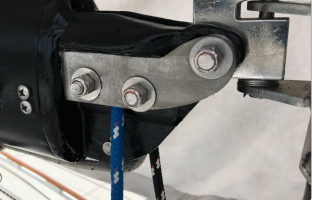
Yesterday my ship wright/machinist friend took a look at our Kenyon swivel and declared that the slight oval-ing where the SS pin had worn the holes in the welded-on SS "ears" was not significant given the age of the parts. Instead of just replacing the old Kenyon pin, which does have a few thousands of wear, he pulled a long-enough SS bolt out of his parts bin. It has a solid shank long enough to get thru the lower hole, complete. Then the threads were cut off appropriately just below the nut.
He wanted a bronze piece between the part of the shank that still shows a bit of thread and the top of the nut, so machined a "long washer" out of a piece of bronze rod. Always Amazing to me what can be done on a lathe in ten minutes! The two nuts were suggested as a way to eliminate having to pin the one nut, and are locked/jammed.
We all went out to lunch, I paid. Gladly. :egrin:
My pulled pork sandwich seemed extra delicious!

AND, to those who posted up pix and descriptions of their Kenyon goosenecks (plural= geese necks?) Thanks Very Much! :)

(Edit: please ignore the typo's in my captioning.)
 

Attachments

  • Gooseneck Repair, Kenyon.JPG
    Gooseneck Repair, Kenyon.JPG
    322.4 KB · Views: 23
Last edited:
Top