Guest viewing is limited

Stumped by a fellow sailor's question today

Frank Langer

1984 Ericson 30+, Nanaimo, BC
Hi,
As I'm known on our docks for often having answers to maintenance questions, I got asked today, and was stumped!
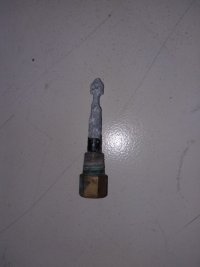
He was trying to replace the engine pencil zinc in his heat exchanger, and found only a small stub left, the rest presumably broken off inside the heat exchanger. His questions were: 1) Is a partial pencil zinc inside the heat exchanger enough to cause the engine to overheat? 2) If yes, can he remove the heat exchanger cap to find the broken part, as long as his raw water intake is closed, or will that cause him to lose coolant? 3) Will it dissolve on its own over time? 4) Is there anything else he should know about this?
As I've never lost part of my pencil zinc, nor had the cap removed, I couldn't help him, but I told him I'd ask the experts here. :)
Thanks for any advice I can pass along to him.
Frank
 

peaman

Contributing Partner
1) Is a partial pencil zinc inside the heat exchanger enough to cause the engine to overheat?
2) If yes, can he remove the heat exchanger cap to find the broken part, as long as his raw water intake is closed, or will that cause him to lose coolant?
3) Will it dissolve on its own over time?
4) Is there anything else he should know about this?
1) A partial pencil zinc in the heat exchanger, alone, should not generally be cause for overheating. However, it will restrict raw water flow to some extent, so it's a matter of degree. Are there other partial zincs in there? Is there mineral build-up adding to flow restriction?
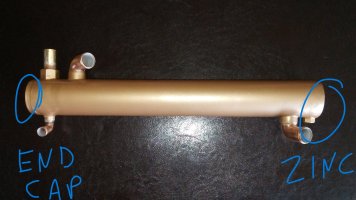
2) With the raw water intake closed, removing the heat exchanger end cap at the zinc end should permit extraction of an errant bit of zinc as well as permit inspection of the heat exchanger tubes. Removing the end caps should not open the "fresh water" or coolant circulation, so there should not be any coolant loss.
3) It should dissolve over time.
4) That's a tough one.
 

Joliba

1988 E38-200 Contributing Member
I completely agree with peaman. This is a common occurrence.
A few years after we bought our boat, we removed the heat exchanger for the first time to clean it well, repaint it, and replace the end-cap gaskets. We discovered a small collection of broken-off partial anodes piled in one corner inside, courtesy of the previous owner.
A couple years ago I noticed that a one-year-old pencil anode (magnesium for fresh water) had deformed such that I was unable to remove it through the small opening on the exchanger for replacement. I just left it in place for another season. The following year I noted that the anode had partially broken off. I found it by removing the end cap. I also removed the entire heat exchanger at that time, as it had been many years since the first cleaning (and the end cap is nearly inaccessible when the heat exchanger is mounted.)
Our engine has never overheated due to these issues.
 

Joliba

1988 E38-200 Contributing Member
I completely agree with peaman. This is a common occurrence.
A few years after we bought our boat, we removed the heat exchanger for the first time to clean it well, repaint it, and replace the end- cap gaskets. We discovered a small collection of broken-off partial anodes piled in one corner inside, courtesy of the previous owner.
A couple years ago I noticed that a one-year-old pencil anode (magnesium for fresh water) had deformed such that I was unable to remove it through the small opening on the exchanger for replacement. I just left it in place for another season. The following year I noted that the anode had partially broken off. I found it by removing the end cap. I also removed the entire heat exchanger at that time, as it had been many years since the first cleaning (and the end cap is nearly inaccessible when the heat exchanger is mounted.)
Our engine has never overheated due to these issues.
 

Frank Langer

1984 Ericson 30+, Nanaimo, BC
Thanks! I'll pass that on as well, and might thereby regain my reputation as being knowledgeable on many maintenance issues. :)
If he wants to try to retrieve the broken pencil zinc in the heat exchanger, can he simply remove the end cap near the pencil zinc insert if his seacock is closed to find it, or does he need to drain the coolant first. It's a fresh water cooled universal engine.
Thanks again!
Frank
 

Joliba

1988 E38-200 Contributing Member
Thanks! I'll pass that on as well, and might thereby regain my reputation as being knowledgeable on many maintenance issues. :)
If he wants to try to retrieve the broken pencil zinc in the heat exchanger, can he simply remove the end cap near the pencil zinc insert if his seacock is closed to find it, or does he need to drain the coolant first. It's a fresh water cooled universal engine.
Thanks again!
Frank
He should not need to drain coolant. But a new gasket for the end cap is advisable and readily available from several online sellers.
 

Kenneth K

1985 32-3, Puget Sound
Blogs Author
1) Is a partial pencil zinc inside the heat exchanger enough to cause the engine to overheat?
As peaman said.

2) If yes, can he remove the heat exchanger cap to find the broken part, as long as his raw water intake is closed, or will that cause him to lose coolant?
Retrieve the zinc?--depends on the heat exchanger. On my OEM 2" exchanger, the zinc is on the opposite side from the inspection port, so in this case you can't retrieve a broke zinc.
20170505_162351.jpg

The inspection/cleanout cap opens the end of the raw-water loops, but (like others have said) the coolant loops are sealed and separated, so no coolant will be lost. A lot of gunky seawater will spill from the endcap though, and it will make a mess if not caught.

In theory, it shouldn't matter whether the raw water intake is closed or not because the vanes of the raw water impeller are designed to form a water-tight seal inside the pump (which would block the flow of water to the exchanger). It would be silly to tempt fate however and not close it. By the way, this is the very reason that, A) the raw-water injection point needs to be above the water-line, or, B) a siphon-break must be installed if it is not. I.E., if both the raw-water intake is open AND the vanes of the pump leak, you can fill your engine with water when the engine is not running.

3) Will it dissolve on its own over time?
You would think it would, but I've seen pictures on this site of 3-4 old, undissolved zinc fragments inside of a cleanout cap. Maybe if the walls of the exchanger are coated with enough gunk, there's not enough electrical conductivity to anodize the zinc.

4) Is there anything else he should know about this?
I read once that coating portions of a zinc (heat exchanger or prop zinc) with nail polish can prevent that part of the zinc from corroding. I usually do this when installing a pencil zinc. Seems to work to some degree.
20210714_170043.jpg
Like Joliba said, sometimes the zinc swells (due to corrosion) inside the exchanger to the point where you can't extract it from the threaded port. When this happens, you might be able to get the swollen corrosion to slough off by rotating it gently as it contacts the walls of the exchanger on its way out. Inside of the swollen flakes, there can still be a solid core of zinc, depending on how much of the zinc is still intact.
 
Last edited:

JSM

Sustaining Member
3) Will it dissolve on its own over time?
The purpose of a zinc anode in a heat exchanger is to protect the heat exchanger from galvanic corrosion. By being more electrochemically active, the zinc anode sacrifices itself, or corrodes, to protect the other metal parts of the heat exchanger. This is especially important in systems that use saltwater, as it prevents the other, more valuable metal components from corroding away.
 

peaman

Contributing Partner
You would think it would, but I've seen pictures on this site of 3-4 old, undissolved zinc fragments inside of a cleanout cap. Maybe if the walls of the exchanger are coated with enough gunk, there's not enough electrical conductivity to anodize the zinc.
The loose pieces of old zinc actually protect the new zinc to a degree, and vice versa. However much zinc is in the system, it will only be consumed at a rate dependent on the other metals which won't change. So for this reason, missing bits of zinc should eventually be dealt with.

I read once that coating portions of a zinc (heat exchanger or prop zinc) with nail polish can prevent that part of the zinc from corroding. I usually do this when installing a pencil zinc. Seems to work to some degree.
A knowledgeable friend advises to use nail polish or other paint on a shaft zinc to coat the narrow bit just outboard of the two bolts. By slowing corrosion there, one might avoid losing a zinc prematurely as a result of that strip giving way with the loss of that screw.
 

Frank Langer

1984 Ericson 30+, Nanaimo, BC
Thanks for all your replies! Today my dock mate sailor persuaded me to help him solve this dilemma, and our findings may be helpful if someone has a similar experience. with a Universal diesel engine.
We decided to not drain the coolant or undo any hoses from the heat exchanger as that is alot of work, risks coolant drips in the engine room, and leaks in the future. We did undo the clamp holding the heat exchanger to the engine bracket to allow it to move a bit and become slightly more accessible.
He was able to remove the end cap bolt easily and the end cap fell off in his hand--no corrosion or need for PB Blaster! Using a trouble lamp and a small mirror, we could see several pieces of the old pencil zinc right near the end of the heat exchanger. There was not enough room for a small needle nose pliers, so he tried to persuade the pieces out of the end using a small wire. As he alternately pulled a piece out a bit, then inadvertently nudged it back in a bit we were getting frustrated with lack of progress. I suggested he remove the new pencil zinc that he had installed recently and insert the wire through that hole to poke at the old pieces, and that worked--tedious, but they gradually all fell out the end of the heat exchanger.
He had not taken time to buy a new gasket (despite the advice here and on line that this would be necessary to prevent leaks), so he reinstalled the old gasket, trying to align the bulged areas of the gasket with the three holes in the heat exchanger, and snugged the bolt.
After repositioning the heat exchange on the engine with the hose clamp, we started the engine and ran it for 15 minutes, checking for any leaks and watching engine temperature--it all looked good!

This was a good learning experience for me as I have never had a broken pencil zinc, and it was nice to be able to help a fellow sailor. This is definitely a reasonable job to do without hiring a mechanic, though the required contortions in the engine compartment left the owner feeling quite sore--nothing a good scotch wouldn't solve!

Thanks again for all the advice--it gave me the information and courage to suggest that I could help him solve the problem.

Frank
 

Elrod

Member I
A bit of additional related info. Tried to replace the zincs in my exchanger this spring ( 1985 32-3). Could not get the zincs to go all the way in and thought there must be a broken bit left in as only a stub had come out. Noticed the two mounting brackets on the exchanger had broken loose so time to take it out completely for repair. My exchanger luckily has removable plates at each end. Radiator shop was able to clean, re-solder brackets and replace gaskets AND end plates. Guy said that the end plates have a slight crown to them which when over tightened and over time will flatten and not adequately press around the perimeter. Also learned that there are various lengths of zinc and I had been trying to install one that was just too long. All good now, and having looked at cost of replacing the exchanger, glad to have my old one in good to-go condition.
 
Top