Windlass Installation for Ericson 32-III [Master Thread]

lindaloo

Member II
While you want to keep the structure good and solid, avoid the temptation to overdo it.

When sailing close hauled, especially when cracking on in a stiff breeze, I am amazed at how tremendously tight the genoa sheet is, and how small the washers are backing up the primary winch bolts/nuts. I know it is set in solid (uncored) fiberglass in the cockpit coaming, but still.

The weight of 5/16" chain and 35lb anchor hanging up and down in 100ft is about 140lb. Even allowing up to 500lb pull to break the anchor out of sticky mud under power, you are well within safety margins (compared to the primary).

The grain of the balsa blocks in a cored deck is usually vertical, the best orientation for compressive strength. The chain locker lid is so thin however that this may not be the case. I would still not suggest overdrilling the holes as preserving the upper skin is vital to layup integrity. Use Neil's method to hog out some balsa and then fill with thickened epoxy. I like to paint balsa with unthickened epoxy first so it wicks into the core. Do this for a few minutes till it stops wicking, then add the filler to the cup.

If you wanted to beef up anywhere, make the "wings" bigger maybe 5" square, to spread the upward force component over more hatch surround.

Rob
 

lindaloo

Member II
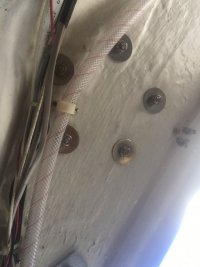
I just came back from my boat and took a photo of the washers holding the primary winch down. My Barient 27's have five bolts with what appears to be a 1" washer on each. And the fiberglass is cored, maybe 1.5" total, with a layer or two of mat on the underside.

Neil's use of 3/8" Extren backing reinforcement is plenty strong. Since the chain gypsy is down low, the forces on the windlass retaining bolts are shear, (in the horizontal).

All this to say that if your primary winch is strong enough, you do not have to worry about perceived weakness of balsa core under the windlass. Neil's installation and writeup sets a very high standard. Salutations.82D1D89B-001C-47DF-AA08-E18113E4023A.jpeg
 

carljsalvo

New Member
That would be very practical (and logical)
If one can get at the hose clamp, then the shell that comprises the anchor well in the 32-3 could be removed reasonably easily (to check/maintain bow deck hardware attachments) - if you can break the 5200 seal under its lip.
That would be very practical (and logical)
If one can get at the hose clamp, then the shell that comprises the anchor well in the 32-3 could be removed reasonably easily (to check/maintain bow deck hardware attachments) - if you can break the 5200 seal under its lip.
Hi nquigley,

First, I'd like to thank you for doing a GREAT job on both your windless job and the document you wrote describing it. What I'd be most interested in is you describing in either words or even pictures the "actual path you used to run the windless cables back to both the battery box and where you placed the breaker. Thank you in advance for anything you could provide as I venture forward on this job in my new (to me) E32-3.
 

nquigley

Sustaining Member
Hi nquigley,

First, I'd like to thank you for doing a GREAT job on both your windless job and the document you wrote describing it. What I'd be most interested in is you describing in either words or even pictures the "actual path you used to run the windless cables back to both the battery box and where you placed the breaker. Thank you in advance for anything you could provide as I venture forward on this job in my new (to me) E32-3.
Hi Carl,
From bow to battery bank …
The solenoid was mounted near the top port side of the forward bulkhead (cables went through a hole to the windlass in the anchor well). I build a simple, easily removed, plywood box to go over to solenoid to protect it and the wires from stuff I might want to stow (jam in) there.
Then the red and black cables were just laid along the port side shelf in the forepeak. Then, they went through a new hole in the bulkhead at the aft end of that shelf… into the head (from memory, I think it went into a cupboard in there). Then, inside the cupboard to, and through, the main saloon bulkhead, coming out at the forward end of the port side shelf in the main saloon, then lying on that shelf aftwards. As I recall, I routed the cables through the short partition separating the nav. station from the saloon shelf (new hole). I think it was a bit of a dogleg to get into the nav area. I mounted the high-amp breaker on the outer side wall of the nav area - I can’t recall if it was in the upper or lower shelf area. Then the wiring went from the breaker, through the little bulkhead at the aft end of the nav shelves, into the area behind the distribution panel. As I recall, the cables were then passed down through a gap behind the hull inner shell and the hull, and into the top side of the battery box (2 new holes), connected to the starter battery.
I sold the boat at this time last year (I now have a very different boat - Westsail 32). I hope my memory is accurate. Oh, and I upsized the cables one size above what the windlass’ specs said so I could switch it for the next size up windlass in case the model I chose turned out to be too weak. But, it was fine in the end (Maxwell RC-6)
The cable is very expensive per foot - maybe see if your local West Marine will tell you when wire/cable will next go on sale, or shop around (Defender, others?)

Cheers,
Neil
 

carljsalvo

New Member
Neil,
Hi Carl,
From bow to battery bank …
The solenoid was mounted near the top port side of the forward bulkhead (cables went through a hole to the windlass in the anchor well). I build a simple, easily removed, plywood box to go over to solenoid to protect it and the wires from stuff I might want to stow (jam in) there.
Then the red and black cables were just laid along the port side shelf in the forepeak. Then, they went through a new hole in the bulkhead at the aft end of that shelf… into the head (from memory, I think it went into a cupboard in there). Then, inside the cupboard to, and through, the main saloon bulkhead, coming out at the forward end of the port side shelf in the main saloon, then lying on that shelf aftwards. As I recall, I routed the cables through the short partition separating the nav. station from the saloon shelf (new hole). I think it was a bit of a dogleg to get into the nav area. I mounted the high-amp breaker on the outer side wall of the nav area - I can’t recall if it was in the upper or lower shelf area. Then the wiring went from the breaker, through the little bulkhead at the aft end of the nav shelves, into the area behind the distribution panel. As I recall, the cables were then passed down through a gap behind the hull inner shell and the hull, and into the top side of the battery box (2 new holes), connected to the starter battery.
I sold the boat at this time last year (I now have a very different boat - Westsail 32). I hope my memory is accurate. Oh, and I upsized the cables one size above what the windlass’ specs said so I could switch it for the next size up windlass in case the model I chose turned out to be too weak. But, it was fine in the end (Maxwell RC-6)
The cable is very expensive per foot - maybe see if your local West Marine will tell you when wire/cable will next go on sale, or shop around (Defender, others?)

Cheers,
Neil

Hi Neil,

First, THANK YOU. This is so exciting. Sitting here on my E32 dreaming I'm going to go back to this thread & you're going to have replied!! And just like xmas morning, I arrived here and YOU had replied! What a gift. Best gift yet this boating season. Appreciate ALL your efforts documenting your windless installation experience, it's been so helpful! I'm off with the courage and determination of not going this adventure alone because of your efforts. BRAVO ZULU! Stay in the groove and enjoy that new boat. I'll bet she's a beauty. Carl
 

vanilladuck

E32-3 / San Francisco
Blogs Author
I'm looking at adding a windlass to my E32-3. I'm curious: @Bolo @nquigley (and anyone else with an E32-3), it's been a few years since your installs. How is your windlass setup working out for you?

More specifically:
  1. What kinds of anchorage conditions have you dropped and raised your hook?
  2. Has anything related to your ground tackle setup had any issue?
  3. Is there anything you'd change or have changed?
Thanks for sharing your installs and experience!
 

nquigley

Sustaining Member
I used my anchor almost every night for about 4 weeks while on the rivers between Knoxville TN and Mobile AL (~850 miles) - very benign conditions). Then I used it for about 3 weeks while cruising coastal SE Alabama and NW Florida - tidal and wind shifts overnight, max wind about 20kt - again, not much of a real test. But the system worked flawlessly each night (Rocna Vulcan 33lb anchor on all-chain).
I sold the boat to James Coe a year ago - he’s been using the boat quite often in and around Mobile Bay - maybe he will jump on and give a report on his experience experiences.
(I now have a much different situation… manual windlass with 45lb Vulcan on 3/8” chain, for a 19,000 lb full-keel 32-footer … but I haven’t anchored out yet - )
 

Bolo

Contributing Partner
I'm looking at adding a windlass to my E32-3. I'm curious: @Bolo @nquigley (and anyone else with an E32-3), it's been a few years since your installs. How is your windlass setup working out for you?

More specifically:
  1. What kinds of anchorage conditions have you dropped and raised your hook?
  2. Has anything related to your ground tackle setup had any issue?
  3. Is there anything you'd change or have changed?
Thanks for sharing your installs and experience!
I installed a Lofrans MANUAL windlass. Went the manual route because I don't anchor that much on the Chesapeake Bay, although I'm planning to do more. The Bay bottom is mostly mud so anchoring is usually easy with the biggest problem being a dirty anchor and chain that I wash off with a hose, pump and seacock that the previous owner installed. I can't say that I've had any sort of issues with the manual windlass. Yes, it does take a bit longer to haul the anchor in but there is no battery, cables, switches, connectors to break and that makes the manual windlass very reliable. I've seen many world cruisers, especially solo sailors, using a manual windlass. I've included a video I made a while back of the windlass in use and although it was taken in a day with little wind I've used it in much more blustery conditions and had no trouble hauling the anchor in and I've done it solo. So here's the link and I hope it helps.

UPDATE: Here is the link I posted detailing my windlass installation. https://ericsonyachts.org/ie/ubs/installing-a-manual-windlass-on-a-e32-3.982/
 

vanilladuck

E32-3 / San Francisco
Blogs Author
Thank you both! @nquigley I noticed you had installed a chain stopper forward of the Maxwell electric windlass. I'm thinking I will need to do something similar (I'm also looking at a Maxwell; the RC8-8 because I have 5/16" B43 HT chain).

@Bolo did you consider a chain stopper? Or, is the manual windlass enough to hold the chain while breaking the anchor free?

@Bolo I'm also fascinated by your washdown system. Does it pickup seawater or is it plumbed to the internal fresh water tanks in your boat? If seawater, where does the pickup go?
 

vanilladuck

E32-3 / San Francisco
Blogs Author
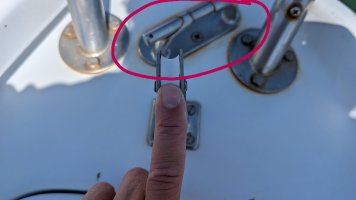
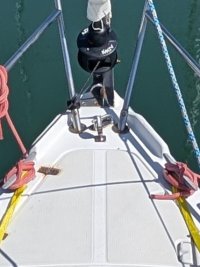
Also, I've been trying to identify this little oval shackle-loop thing on the bow of Rumour...

PXL_20250905_204930463.MP.jpg

The shaft on the top unscrews and creates an opening large enough for the anchor rode. I'm thinking it might be a fairlead for the anchor rode to get to the cleats on port and stbd?

Here's a zoomed out view:

PXL_20250901_181614187.MP.jpg
 

nquigley

Sustaining Member
I was forced to get a Vulcan anchor instead of a conventional rocna roll-bar one because of the short distance between the chain lock and the bow roller: I needed an anchor with as short a shaft as possible. The Vulcan is a great anchor anyway.
I also installed a washdown pump on the anchor well bulkhead. It had a length of hose on the intake side, long enough to dangle in the water beside the bow and a short collapsible garden hose and nozzle on the outbound side.
 

nquigley

Sustaining Member
Also, I've been trying to identify this little oval shackle-loop thing on the bow of Rumour...

View attachment 55562

The shaft on the top unscrews and creates an opening large enough for the anchor rode. I'm thinking it might be a fairlead for the anchor rode to get to the cleats on port and stbd?

Here's a zoomed out view:

View attachment 55561
Could it be a chain lock, with the sliding bolt passing through a link of the chain when needed?
 

Loren Beach

O34 - Portland, OR
Senior Moderator
Blogs Author
A nice looking "closed chock" with the option of being able to pull the pin back and drop a line into it. That's my guess. Boats sometimes have them at deck edge where there is risk of a warp or rode popping up n out when the boat rolls or surges.
 

Bolo

Contributing Partner
Thank you both! @nquigley I noticed you had installed a chain stopper forward of the Maxwell electric windlass. I'm thinking I will need to do something similar (I'm also looking at a Maxwell; the RC8-8 because I have 5/16" B43 HT chain).

@Bolo did you consider a chain stopper? Or, is the manual windlass enough to hold the chain while breaking the anchor free?

@Bolo I'm also fascinated by your washdown system. Does it pickup seawater or is it plumbed to the internal fresh water tanks in your boat? If seawater, where does the pickup go?
I didn’t see a need for a chain stopper because the manual windlass internal gearing sort of acts like one. It’s very robust although I’ve never pulled the anchor up in stormy wave conditions I still don’t think it wouldn’t be a problem. My rode is about 40’ of chain and 150 of rope, which works in the bay, so using a chain stopper wouldn’t work that well anyway IMHO. When I anchor the 40 feet of chain is always played out and then a certain amount to rope depending on the depth and wind conditions. I tie the rope rode off to the forward cleat. The wash down system was installed by a P.O. A breaker switch at the Nav station panel energized the diagram pump which is located in the locker under the head sink where a small seacock and ball valve are too with a hose from there that goes to the anchor locker. So bay water is used to wash the anchor down. On my previous boat, a Hunter 285 which didn’t have a wash down, I used a bucket with a rope attached. It worked but took more time. Chesapeake Bay mud can be dark and sticky, hard to wash off an anchor sometimes even with a wash down hose. But that kind of mud also means good holding so I’m not really complaining.
 
Top