Retired from newspapers and television, currently sailing Thelonious II, a 1984 Ericson 381.
There are many solutions to the hard dinghy storage issue. You see dinghies on the foredeck, on davits off the stern, canted over the transom, lashed to swim platforms, suspended from the bow like sausage, hung from the mast vertically as if they'd made a terrible mistake, left home in the garage, chained to public racks or left to share the slip like the good companions they are. But that doesn’t work for long because of marine growth and rain.
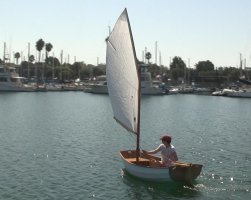
The best part of a hard dinghy is that it’s enjoyable to row, and sailing it you can feel every puff.
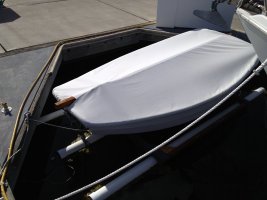
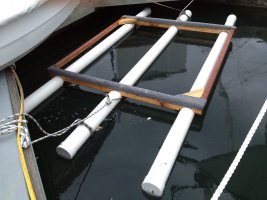
I wanted the 7-foot 6-inch Eastport Pram available to use, not stored. There was room enough in a 35-foot slip. A raft made sense, just enough buoyancy to keep the 60-pound boat off the water. The result is made from 3-inch PVC drain pipe, which is hardware-store cheap.
The crossbars are 2X4s, the sides are half that dimension, and the PVC is mated to the wood with webbing and stainless steel screws (no holes in the pipe). Add two elbows and some carpet held down with stainless staples. There's no cradle because you need to be able to slide the boat on or off any side of the raft. I made the cover from Sunbrella (“linen” color), with a shock cord margin. The oars and sail kit store under the cover. The mast acts as a ridge pole.
We've found it works better to keep the raft at the bow end of the slip, so Thelonious can come in and out. To go for a sail I pull the dinghy onto the dock and launch from there.
The lightweight Eastport pram is easy to build, takes up very little space, rows well and is delightful to sail. It's not really self-rescuing, but does float high when swamped. It's also much more fragile than fiberglass and can't carry more than two people and a dog. More at Chesapeake Light Craft in Annapolis.
Sailing:
Building:
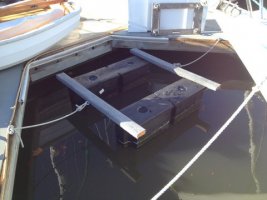
Update: By 2014, the white PVC tubes had developed long trailing lines of disreputable weed and glop which was offensive to the eye. So I tossed the whole rig and built a suspension bridge across the floating dock. This innocent and unobtrusive solution, however, was deemed unAmerican by LA County, who feel strongly that no permanent structure be afixed to their property. So I made a new raft out of real dock floats, which I should've done from the beginning, because they're only about $60 each from West Marine, with no shipping charges. Apparently black floats are not as attractive to marine growth as white, and after two months there is very little weed or barnacle.
The dolly leaning against the dock box is for pushing the dinghy down the dockwalk for launching at any empty slip.
Update the next year: Dockmaster says dinghy float must go. "Everybody wants one, they are not permitted, and you're setting a bad example."
The best part of a hard dinghy is that it’s enjoyable to row, and sailing it you can feel every puff.
I wanted the 7-foot 6-inch Eastport Pram available to use, not stored. There was room enough in a 35-foot slip. A raft made sense, just enough buoyancy to keep the 60-pound boat off the water. The result is made from 3-inch PVC drain pipe, which is hardware-store cheap.
The crossbars are 2X4s, the sides are half that dimension, and the PVC is mated to the wood with webbing and stainless steel screws (no holes in the pipe). Add two elbows and some carpet held down with stainless staples. There's no cradle because you need to be able to slide the boat on or off any side of the raft. I made the cover from Sunbrella (“linen” color), with a shock cord margin. The oars and sail kit store under the cover. The mast acts as a ridge pole.
We've found it works better to keep the raft at the bow end of the slip, so Thelonious can come in and out. To go for a sail I pull the dinghy onto the dock and launch from there.
The lightweight Eastport pram is easy to build, takes up very little space, rows well and is delightful to sail. It's not really self-rescuing, but does float high when swamped. It's also much more fragile than fiberglass and can't carry more than two people and a dog. More at Chesapeake Light Craft in Annapolis.
Sailing:
Building:
Update: By 2014, the white PVC tubes had developed long trailing lines of disreputable weed and glop which was offensive to the eye. So I tossed the whole rig and built a suspension bridge across the floating dock. This innocent and unobtrusive solution, however, was deemed unAmerican by LA County, who feel strongly that no permanent structure be afixed to their property. So I made a new raft out of real dock floats, which I should've done from the beginning, because they're only about $60 each from West Marine, with no shipping charges. Apparently black floats are not as attractive to marine growth as white, and after two months there is very little weed or barnacle.
The dolly leaning against the dock box is for pushing the dinghy down the dockwalk for launching at any empty slip.
Update the next year: Dockmaster says dinghy float must go. "Everybody wants one, they are not permitted, and you're setting a bad example."