Retired from newspapers and television, currently sailing Thelonious II, a 1984 Ericson 381.
It's pretty easy to see if the three glow plugs of the M25 engine are working. Push the button, then feel the plugs on the engine block. They should be hot or at least warm. Two of mine were cold. Replacements [NGK Y103K Sold by Amazon.com LLC] are only about $7 each. [This isn't a very reliable test. See last paragraph]
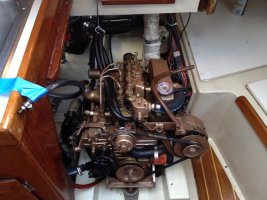
On the E32-3, engine access is very good. Even so, the glow plugs are nestled behind the exhaust manifold and require a bit of patience to remove.
I tied away the water hoses, removed the air filter and disconnected the fuel return for some extra working room.
The 12mm deep-socket wrench I picked up on the way to the boat proved pretty useless, since it will only fit over one of the plugs. But a 12mm spanner works fine when held at the correct angle. I don't know what the appropriate torque is for these plugs--after spraying with PB Blaster mine seemed to be little more than hand-tight. [Answer: 7-11 foot pounds, or 1-1.5 M Kgs]
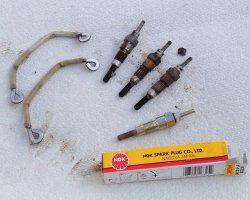
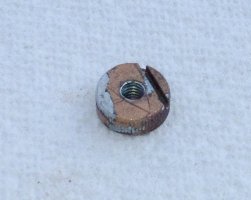
The central plug is the hardest to get the wrench on, and the throw is only an eighth-turn. The nut impacts the manifold unless you screw it down. These "nuts" are obviously not intended to be tightened hard, since they're round, with a knurled edge like a coin. They come with a non-locking aluminum contact washer, and bear a tangent slot I'm unfamiliar with.
The glow plugs are energized by a gray wire with blue trace from the engine harness. There are aluminum jumpers between the plugs, each wrapped in insulating fiber. My connections were well varnished by time, so I polished them up with sandpaper before installing the new plugs.
They go in as they came out. Because of insufficient clearance, the nut won't fit on the central plug once it's installed. You have to bend the threaded shaft a little with a screwdriver to get the nut on.
For that plug only, it would probably be easier to put on the jumpers and washers and nut before inserting the glow plug.
Added: I did eventually test the old glow plugs with a bench battery. By the count of 15, each glowed as expected. Therefore, my issue was apparently wiring. I did this job as part of a general upgrade to the harness and engine panel, and since it's easy and inexpensive, might as well change the plugs while in there making a mess anyhow. One easy way to test suspect plugs is to run a temporary heavy wire from the positive lead of the house battery to the tip of the plug. It ought to get hot pronto.
On the E32-3, engine access is very good. Even so, the glow plugs are nestled behind the exhaust manifold and require a bit of patience to remove.
I tied away the water hoses, removed the air filter and disconnected the fuel return for some extra working room.
The 12mm deep-socket wrench I picked up on the way to the boat proved pretty useless, since it will only fit over one of the plugs. But a 12mm spanner works fine when held at the correct angle. I don't know what the appropriate torque is for these plugs--after spraying with PB Blaster mine seemed to be little more than hand-tight. [Answer: 7-11 foot pounds, or 1-1.5 M Kgs]
The central plug is the hardest to get the wrench on, and the throw is only an eighth-turn. The nut impacts the manifold unless you screw it down. These "nuts" are obviously not intended to be tightened hard, since they're round, with a knurled edge like a coin. They come with a non-locking aluminum contact washer, and bear a tangent slot I'm unfamiliar with.
The glow plugs are energized by a gray wire with blue trace from the engine harness. There are aluminum jumpers between the plugs, each wrapped in insulating fiber. My connections were well varnished by time, so I polished them up with sandpaper before installing the new plugs.
They go in as they came out. Because of insufficient clearance, the nut won't fit on the central plug once it's installed. You have to bend the threaded shaft a little with a screwdriver to get the nut on.
For that plug only, it would probably be easier to put on the jumpers and washers and nut before inserting the glow plug.
Added: I did eventually test the old glow plugs with a bench battery. By the count of 15, each glowed as expected. Therefore, my issue was apparently wiring. I did this job as part of a general upgrade to the harness and engine panel, and since it's easy and inexpensive, might as well change the plugs while in there making a mess anyhow. One easy way to test suspect plugs is to run a temporary heavy wire from the positive lead of the house battery to the tip of the plug. It ought to get hot pronto.