Retired from newspapers and television, currently sailing Thelonious II, a 1984 Ericson 381.

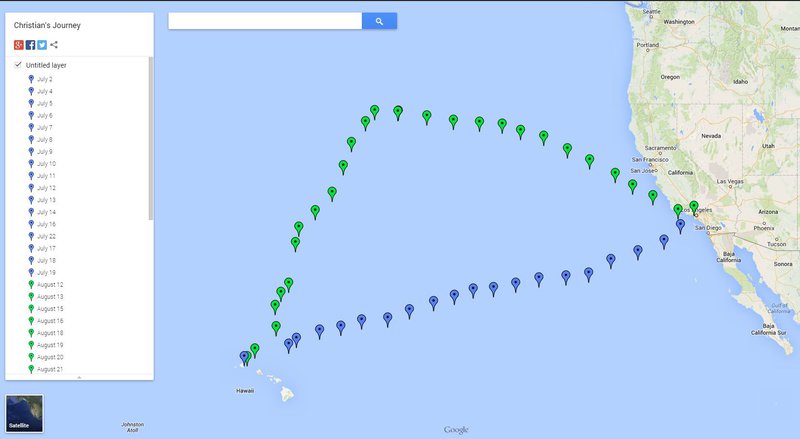
Course chart (Open link, click on pins for noon logs): https://www.google.com/maps/d/viewer?mid=zS4_qGkiBS8k.ktYmkzLT_ZnA
This summer's 6,000-mile cruise to Kaua'i gives an insight into wear and tear on a boat over time. I was 48 days at sea--20 out, 28 for the return--sailing 24 hours a day, half of it in winds of 20 knots plus. For me, a realistic typical year's sailing is maybe 20 days at four hours a day, or 80 sailing hours. The cruise put on more than 1100 hours.
So, although I came back at least 10 years younger (and would go again tomorrow, were it not for this ankle bracelet), some of Thelonious's gear aged 10 years or more.
Stitching failure entire length of foot tape of 130 genoa. This was from periodic flogging as a consequence of singlehanding. When you broach while asleep, it takes a while to suit up and respond. The genoa is a two-or-three year-old UK Tape Drive, much of it Mylar, and designed for bay sailing not the trade winds.
I had the foot resewn in Kauai. On the way home the entire 25-foot leech came apart, which I repaired with a sewing awl.
Mainsail beat up by constant reef/unreef. Chafe on several slide attachments. Hard winching of reef lines caused subtle permanent stretch. One small hole worn where boom touched shroud during a wild night of rolling. I should have always loosened first reef after second reef was in (for days at a time), but you get lazy. My brand new main is now effectively about six years old.
Joker valve failure. I had the Y-valve wrong and filled the holding tank with sea water the first few days out. The violent motion of the boat caused several toilet issues. My boat has no holding tank pump-out system, and I quickly learned that the head is not plumbed with the recommended vent loops. Therefore, leave the valves open on port tack in a seaway and you can sink. I didn't sink. But I checked the valves a lot.
Winch issues. I didn't service my Barients because they were serviced two years ago at great expense by the PO. I have always flushed them with fresh water weekly. However, one big self-tailer and the main halyard winch started to slip 10 days out. Cranking in a genoa with a winch that sometimes doesn't hold fast gives you an appreciation of winches. I learned to baby them, and usually with a tap the pawls would engage.
Whisker pole lift attachment failure. Easy to fix, after you catch the flying lift line and unrig the pole in 25 knots and 8-foot seas.
Bilge pump issue. I rewired the Rule 1500 (always on) electric pump because it cycled endlessly as the shallow bilge sluiced all over the boat. We were bow down, running. I had forgotten to bring my manual dinghy bilge pump to pump out the three buckets of water that the electric pump cannot reach. My son brought me a West Marine dinghy pump for the trip back, which solved the problem completely. This pump, by the way, is a $30 piece of junk that is loathed by every person who has purchased it. The diatribes against it on line are accurate. Webb Chiles set off with one sailing around the world this summer on his latest odd choice of boat, and his blog excoriates the thing in entertaining terms. But we do need some sort of dinghy pump, since our shallow bilges otherwise turn even a dry boat into Penobscot Bay at low tide.
Main Halyard. I was astonished to see my husky main halyard shackle come undone halfway down the mast as I was hauling down for a reef during a rain squall. I will in future always have a screw-in shackle, rather than the push-and-turn pin shackle which was standard equipment. It took six hours to regain the lost halyard, which wrapped itself around the upper stays in just three or four 60-degree rolls.
Genoa sheets too short. Well, golly, I guess I don't know everything after all. With the whisker pole extended to 16 feet, my sheets were not long enough. I had to add line to them, with knots that had to go around the self-tailing winches. Just another adjustment to make, but a silly one.
Fuel Filters. I installed a new Racor 200-series a few days before departure. I had five spare 30-micron R20P filter cannisters, but since the new assembly came with a 3-micron filter, I left that filter on. It clogged halfway to Hawaii. Changing filters takes a long time on a pitching, yawing, rolling boat in which the entire engine area must be unpacked of gear before access. Obviously a 3-micron is not necessary as a primary filter if you have a 3-micron on the secondary. The contents of my fuel tank during this cruise were shaken like a James Bond martini day and night, and filter changes are to be expected even with a 30-micron primary. Before departure I personally wiped out the interior of my tank until it resembled a dinner plate just out of the dishwasher; however, although there was not much dirt except a light surface scum, I could not get past the baffle to the other 50 percent of the tank. Overall, it is difficult to overestimate the effects of continuous motion on a cruising boat day and night over a protracted time period. It has many results. One is the probability of changing filters, which I did twice more.
Wheel Steering gear. I know my steering gear intimately, but there was nothing I could do to prevent the slow loosening of the top bearing under the unremitting rudder movements of trade winds running. On the 32-3 the top bearing of the rudder post is a deck plate just aft of the pedestal. The fitting is bolted through the deck. The nuts of those bolts are hard to access from below, and even hefty lock washers could not resist loosening under 24-hours-a-day rudder movement. I hove to once, moved everything out of the afterberth (two anchors, food, chain and so on), and managed to tighten them some. Singlehanders much prefer a tiller, and I certainly now see their point. But the mechanism of my 30-year-old Yacht Specialties system --chain, wire , sheaves and radial--did survive the test. Can't say the same for the pedestal.
The Pedestal. My boat came with a rotted out aluminum pedestal. I had a new base welded on by a machinist. His shop was full of lamps. He said he would make invisible welds. And they were, whic is just what you want on a lamp. The entire pedestal fell apart in my hands in rough seas while departing Nawiliwili. I managed to hold it together and return to harbor, where I found a Hawaiian welder whose welds were not invisible. This set me back five days, allowing two hurricanes to arrive, which set me back a further seven days. However, it was a good thing the pedestal disintegrated 20 miles from shore. Offshore a jury rig would've been difficult. And if I'd turned back, it would have been into two hurricanes. Removing a pedestal and all associated gear is an 8-hour job. It is a good example of the benefits of doing your own work, since finding a boat mechanic in a destination port in summer can mean very long delays.
The engine. I need a new raw water pump now, the ancient Sherwood leaks--I think it's the shaft bearing. While becalmed in the North Pacific High I temp fixed the with latex rubber and hose clamps. The latex rubber sheets were to seal the dripless shaft seal if the rubber accordion failed; they are as handy as duct tape for the weird solutions required by a yacht's many odd-shaped leak-prone fixtures.
Satphone. It worked. I called home once a week and sent an email daily. UUplus is great.
Topping lift. Mine is fixed at the mast top and has a swaged loop at the lower end. The loop broke, but not before I had rigged a safety line. A loose 30-foot wire whipping about could instantly foul the entire mast and make lowering the main, or jib, or both, impossible. Which would require climbing the mast.
Climbing the mast. I had no practical way to do it in a seaway. This was an oversight. Mast steps are the answer.
Gear that performed well, out and return: The Sailomat; the propane stove; the new Balmar 100-amp alternator, which charged the two G27 batteries daily in about half an hour; the M25, an engine I love for its simplicity and gratitude that you are not driving a tractor; the hull, strong in a battering seaway with its Tri-Ax grid; and all my new or rebedded portlights and hatches. After 48 days I had no leaks and both port and starboard sleeping bunks were bone dry, if you can believe it.
And my jackline rig. I put my harness on and took it off only in the cabin. The six-foot tether was connected to a cockpit fitting just outside the companionway. This allowed access to everything in the cockpit, including the vane. To go forward, I doubled the tether to three feet and clipped on to the deckhouse jacklines, port or starboard. Overall, once I got used to it, this rig made wearing and using the harness routine and not all that bothersome.
And, I dare say, me. I intended not to break my arm or have any of the bruises and head-bonkings of Chichester, who on his earlier shorter voyages always seemed to have just been knocked unconscious by something or other, and to think nothing of it. I put my lack of bruises down to rehearsed movements. I always turned the same way in order not to foul my harness and tether. I taught myself where to put my feet and where to place my hands for all activities, so that even at night and while groggy, I rarely had a misstep or a close call. I always closed and locked the companionway and other hatches when working deck (to forestall fouls or falling through them); always wore deck shoes, always planned the steps of a task before starting it. Perhaps this was unnecessary when I was 25, and could do a lot of chin-ups. Now one wants to avoid athleticism, as it is no longer such a reliable solution, and confidence becomes more a mental than a physical factor.