Retired from newspapers and television, currently sailing Thelonious II, a 1984 Ericson 381.
A 12-minute demonstration video is here:
Self-steering vanes are hard to compare, since boat hull and steering characteristics can be very different. So in the end I choose one that I thought looked proportionally right for the stern of the Ericson 32-3: the 2014 Sailomat 800.
Stellan Knoos, a Stanford-trained aeronautical engineer and resident of La Jolla by way of Sweden, has been selling his patented take on the servo-pendulum vane for 40 years, with many incremental improvements, and the Sailomat has a satisfied following. Unlike the Monitor and others, the unit is anodized aluminum rather than stainless, which makes it relatively light--about 40 pounds, all up. Yes, you hear warnings (on the Monitor Web site) that stainless fasteners are incompatible with aluminum, implying that such a design will quickly start to smoke, then corrode in a flash and immediately fall off the boat. However, I looked closely at my mast and boom, and they are still there, at least for the moment. In a word, Tef-gel.
Installing the Sailomat is easy. The assembly attaches to the transom with a three-point bracket from which it can be removed for storage. If you're reading this you already know how pendulum vanes work. Dr. Knoos has steadily reduced the size of the bracket over the years, because there is not really much force on it since the steering oar is free to deviate, and an emergency disconnect is built in. Therefore, the bracket is not offensively large and doesn't even require a backing plate (large stainless washers suffice). You can keep the rest of the Sailomat home in the garage.
The photo at left below shows the unit "furled"-- the oar is folded up and the wind vane stored belowdecks. At right, it is ready for action. The extended oar is held in place by a Nylon shear pin. There is a second option for getting the oar out of the water, when motoring, say, and that is to simply pull it up and tie it to the pushpit. A hinge articulates the entire lower section.
Like many Ericsons, my model has an off-center boarding ladder built into the stern rail. The Sailomat can be mounted up to 18 inches off centerline, with little effect on performance. Even with the unit mounted pretty much on center, as mine is, the boarding ladder remains fully functional.
I used 5mm Spectra for the all-important steering lines, and expensive Harken blocks. Friction in the system degrades performance, so the setting up of the blocks is worth some thought. My rig comes pretty close to the recommended angles. Owners of the 32-3 will be charmed to hear that the bolts for the blocks on the port cockpit side happen to penetrate right where an important interior bulkhead is, and that installing them requires removing interior shelf and headliner and groping blind at arm's length with washer, lock washer and nut held with the fingertips. I feel I now know what it is like to artificially inseminate a cow who is not in a sexy mood.
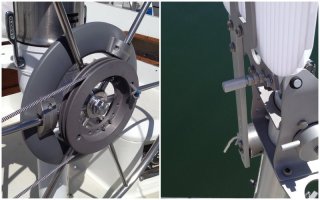
It was good to discover that the Sailomat line drum on the wheel cohabitates happily with my existing Raymarine SPX-5/P70 wheel pilot mechanism. The wheel pilot gear is on the forward side of the wheel, and the Sailomat on the after side. The stock Raymarine clamps do interfere with the new drum. However, it is a simple matter to trim an inch off each plastic clamp using a Dremel saw.
I've had the Sailomat out sailing twice, and it seems to work pretty well. Familiarity is important, and I'm not quite there yet. If there's any wind, it's a no-brainer. As the breeze fades away, so does, I'm sure, the performance of all pendulum steering vanes.
They rely on the boat moving through the water to provide the force to deflect the oar and amplify the signal from the vane. Therefore, no boat speed, no mechanical steering. That's where the Raymarine wheel pilot comes in.
In the end, today's candidate for a brand-new wind vane asks himself not so much how well it will work, since they all work or don't work according to boat and installation and sail trim, but--how does it look?
And for about the same money, of course, you can have a powerful, energy-hungry autopilot--and nothing at all hanging off the stern.
Thread on Monitor vs. Sailomat here (click for link) .
Demonstration of the Sailomat (12-minute video).
Self-steering vanes are hard to compare, since boat hull and steering characteristics can be very different. So in the end I choose one that I thought looked proportionally right for the stern of the Ericson 32-3: the 2014 Sailomat 800.
Stellan Knoos, a Stanford-trained aeronautical engineer and resident of La Jolla by way of Sweden, has been selling his patented take on the servo-pendulum vane for 40 years, with many incremental improvements, and the Sailomat has a satisfied following. Unlike the Monitor and others, the unit is anodized aluminum rather than stainless, which makes it relatively light--about 40 pounds, all up. Yes, you hear warnings (on the Monitor Web site) that stainless fasteners are incompatible with aluminum, implying that such a design will quickly start to smoke, then corrode in a flash and immediately fall off the boat. However, I looked closely at my mast and boom, and they are still there, at least for the moment. In a word, Tef-gel.
Installing the Sailomat is easy. The assembly attaches to the transom with a three-point bracket from which it can be removed for storage. If you're reading this you already know how pendulum vanes work. Dr. Knoos has steadily reduced the size of the bracket over the years, because there is not really much force on it since the steering oar is free to deviate, and an emergency disconnect is built in. Therefore, the bracket is not offensively large and doesn't even require a backing plate (large stainless washers suffice). You can keep the rest of the Sailomat home in the garage.
The photo at left below shows the unit "furled"-- the oar is folded up and the wind vane stored belowdecks. At right, it is ready for action. The extended oar is held in place by a Nylon shear pin. There is a second option for getting the oar out of the water, when motoring, say, and that is to simply pull it up and tie it to the pushpit. A hinge articulates the entire lower section.
Like many Ericsons, my model has an off-center boarding ladder built into the stern rail. The Sailomat can be mounted up to 18 inches off centerline, with little effect on performance. Even with the unit mounted pretty much on center, as mine is, the boarding ladder remains fully functional.
I used 5mm Spectra for the all-important steering lines, and expensive Harken blocks. Friction in the system degrades performance, so the setting up of the blocks is worth some thought. My rig comes pretty close to the recommended angles. Owners of the 32-3 will be charmed to hear that the bolts for the blocks on the port cockpit side happen to penetrate right where an important interior bulkhead is, and that installing them requires removing interior shelf and headliner and groping blind at arm's length with washer, lock washer and nut held with the fingertips. I feel I now know what it is like to artificially inseminate a cow who is not in a sexy mood.
It was good to discover that the Sailomat line drum on the wheel cohabitates happily with my existing Raymarine SPX-5/P70 wheel pilot mechanism. The wheel pilot gear is on the forward side of the wheel, and the Sailomat on the after side. The stock Raymarine clamps do interfere with the new drum. However, it is a simple matter to trim an inch off each plastic clamp using a Dremel saw.
I've had the Sailomat out sailing twice, and it seems to work pretty well. Familiarity is important, and I'm not quite there yet. If there's any wind, it's a no-brainer. As the breeze fades away, so does, I'm sure, the performance of all pendulum steering vanes.
They rely on the boat moving through the water to provide the force to deflect the oar and amplify the signal from the vane. Therefore, no boat speed, no mechanical steering. That's where the Raymarine wheel pilot comes in.
In the end, today's candidate for a brand-new wind vane asks himself not so much how well it will work, since they all work or don't work according to boat and installation and sail trim, but--how does it look?
And for about the same money, of course, you can have a powerful, energy-hungry autopilot--and nothing at all hanging off the stern.
Thread on Monitor vs. Sailomat here (click for link) .
Demonstration of the Sailomat (12-minute video).