Retired from newspapers and television, currently sailing Thelonious II, a 1984 Ericson 381.
The invitingly large locker under the port helm seat of the 32-3 is a natural place to store the sail cover and other canvas that comes off for sailing. It will also fit a stern anchor and line, fishing poles, a case of beer, 200 old issues of National Geographic, a trombone and the wig you wore to prom. However, as many of us have noticed, anything that fits down there is quite likely to eventually wind up tangled in the steering system cables, toward which gravity sends all of it. And out of sight out of mind.
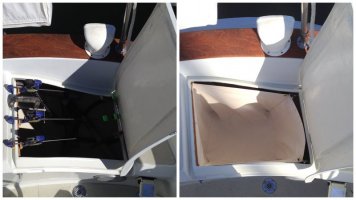
One solution is a bag installed in the opening to conveniently hold the covers but refuse entrance to other storage. I made one out of canvas duck, because I had it lying around and because it's a third the price of Sunbrella. Duck is a grand cloth, under-appreciated in the age of synthetics. Feels good in the hand, holds a shape, easy to sew, and stains and rots according to the best tradition. All right, yes, this is going to be yet another heroic account of my 40-year-old Singer sewing machine in action. What a device! All metal gears! Take it apart and what you see is Arnold Schwartzenegger stripped of his robot flesh--unstoppable, indestructible cogs and levers from another time! In this case, 1965, not 2065.
Bags are easy to make, but attaching this one in the gaping hole under the seat lid took two tries. No good place to drill in the fiberglass, so I epoxied in marine ply strips as fastener surfaces. The left side of the bag is screwed to the wood with finish washers. The right side attaches to two stainless eye-screws with cable ties. Snip the cable ties and the bag folds back over the other seat, permitting full access to the compartment and its critical through-hulls and steering gear. All the boat covers fit in the bag. And I now have a ridiculously large number of exterior covers.
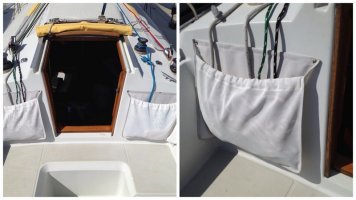
I intended to design my own cockpit line bags, but wound up buying the Sailrite kit. The kit dimensions happened to be exactly correct for my boat, and the Sailrite construction video is forthright. In a world where stock sailboats have the halyards and reef lines led back to the cockpit, sheet bags are just about a necessity unless you like tossing a hundred feet of line down the companionway so it can trip people down there, whiile not remaining free, which is why you did it, but in fact often fouling on the ladder and generally being in the way. Coiling it all up ain't good either, because halyards should be free to run, and leaving them in a pile on the cockpit floor is considered , well, messy.
These little bags hold a lot of line. You get to use edging tape, which is itself hugely exciting and adds one more skill to move you up in the seamstress hiring queue. I would not presume to correct Eric of Sailrite on his notion that snap fasteners can hold a working sheet bag on a bulkhead. Well, yes I would. Sheet bags need to be screwed down, they get yanked and stepped on and must withstand the real-world rigors of sailing. Pretty comfortable on the back, too, when leaned against, even when full of line.
Update, 2023: There's a new Sailrite line bag video here. My opinion continues that elastic is useless, and that the Sailrite attachment plan is innocent of real world experience. Cramming line into the bags puts great strain on the upper corners, which need to be heavily built up with layers of Sunbrella. And those dinky sticky-tabs in the video? Well, try them if you like. Better to screw the bags to the bulkhead. The bags only come off when polishing gelcoat, and screws go in and out fine.
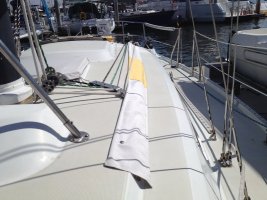
I've been cleaning and oiling my teak grab rails every three months or so (this is Southern California), and recently took them down to good bone and applied Deftoil. It's a rubbed finish similar to regular teak oil, but apparently has some varnish in it and may last longer. But UV will kill anything, so I joined the Club of Yachtsmen With Grab Rail Covers. It is not a club I longed to be a member of, since on the boats around me the damn things always seem to be falling apart or half-off or to need more fasteners than a mainsail cover in order to cling to nine feet of cabin railing. I just wanted something to ward off the sun. It never rains here anyway. Athough we do get some fallout from Fukushima.
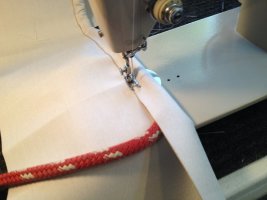
I took leftover Sunbrella Silver and hemmed some old line down the edges so the weight would make it lie flat on the deck. Two snaps only, one at each end--we'll see if that's enough. Seems to work. Looks pretty good. And continues my interesting design tradition of using Sunbrella Sunflower Yellow for the middle of covers, and Silver for the rest, which brings the occasional compliment from old Ukrainian men practicing their English.
Actually, in every case, it has been that I never have enough of either color.
....
Part 1-- http://www.ericsonyachts.org/infoexchange/entry.php?126-Sewmanship-1%96the-Sewing-Machine
Part 2-- http://www.ericsonyachts.org/infoex...2-Covers-for-Dinghy-Hatches-Pedestal-Mainsail
Part 3-- http://www.ericsonyachts.org/infoex...it-Shade-Main-Hatch-Cover-Interior-Upholstery
Part 5-- http://www.ericsonyachts.org/infoexchange/entry.php?199-Sewmanship-5-Weather-Cloths
One solution is a bag installed in the opening to conveniently hold the covers but refuse entrance to other storage. I made one out of canvas duck, because I had it lying around and because it's a third the price of Sunbrella. Duck is a grand cloth, under-appreciated in the age of synthetics. Feels good in the hand, holds a shape, easy to sew, and stains and rots according to the best tradition. All right, yes, this is going to be yet another heroic account of my 40-year-old Singer sewing machine in action. What a device! All metal gears! Take it apart and what you see is Arnold Schwartzenegger stripped of his robot flesh--unstoppable, indestructible cogs and levers from another time! In this case, 1965, not 2065.
Bags are easy to make, but attaching this one in the gaping hole under the seat lid took two tries. No good place to drill in the fiberglass, so I epoxied in marine ply strips as fastener surfaces. The left side of the bag is screwed to the wood with finish washers. The right side attaches to two stainless eye-screws with cable ties. Snip the cable ties and the bag folds back over the other seat, permitting full access to the compartment and its critical through-hulls and steering gear. All the boat covers fit in the bag. And I now have a ridiculously large number of exterior covers.
I intended to design my own cockpit line bags, but wound up buying the Sailrite kit. The kit dimensions happened to be exactly correct for my boat, and the Sailrite construction video is forthright. In a world where stock sailboats have the halyards and reef lines led back to the cockpit, sheet bags are just about a necessity unless you like tossing a hundred feet of line down the companionway so it can trip people down there, whiile not remaining free, which is why you did it, but in fact often fouling on the ladder and generally being in the way. Coiling it all up ain't good either, because halyards should be free to run, and leaving them in a pile on the cockpit floor is considered , well, messy.
These little bags hold a lot of line. You get to use edging tape, which is itself hugely exciting and adds one more skill to move you up in the seamstress hiring queue. I would not presume to correct Eric of Sailrite on his notion that snap fasteners can hold a working sheet bag on a bulkhead. Well, yes I would. Sheet bags need to be screwed down, they get yanked and stepped on and must withstand the real-world rigors of sailing. Pretty comfortable on the back, too, when leaned against, even when full of line.
Update, 2023: There's a new Sailrite line bag video here. My opinion continues that elastic is useless, and that the Sailrite attachment plan is innocent of real world experience. Cramming line into the bags puts great strain on the upper corners, which need to be heavily built up with layers of Sunbrella. And those dinky sticky-tabs in the video? Well, try them if you like. Better to screw the bags to the bulkhead. The bags only come off when polishing gelcoat, and screws go in and out fine.
I've been cleaning and oiling my teak grab rails every three months or so (this is Southern California), and recently took them down to good bone and applied Deftoil. It's a rubbed finish similar to regular teak oil, but apparently has some varnish in it and may last longer. But UV will kill anything, so I joined the Club of Yachtsmen With Grab Rail Covers. It is not a club I longed to be a member of, since on the boats around me the damn things always seem to be falling apart or half-off or to need more fasteners than a mainsail cover in order to cling to nine feet of cabin railing. I just wanted something to ward off the sun. It never rains here anyway. Athough we do get some fallout from Fukushima.
I took leftover Sunbrella Silver and hemmed some old line down the edges so the weight would make it lie flat on the deck. Two snaps only, one at each end--we'll see if that's enough. Seems to work. Looks pretty good. And continues my interesting design tradition of using Sunbrella Sunflower Yellow for the middle of covers, and Silver for the rest, which brings the occasional compliment from old Ukrainian men practicing their English.
Actually, in every case, it has been that I never have enough of either color.
Part 1-- http://www.ericsonyachts.org/infoexchange/entry.php?126-Sewmanship-1%96the-Sewing-Machine
Part 2-- http://www.ericsonyachts.org/infoex...2-Covers-for-Dinghy-Hatches-Pedestal-Mainsail
Part 3-- http://www.ericsonyachts.org/infoex...it-Shade-Main-Hatch-Cover-Interior-Upholstery
Part 5-- http://www.ericsonyachts.org/infoexchange/entry.php?199-Sewmanship-5-Weather-Cloths