
You are using an out of date browser. It may not display this or other websites correctly.
You should upgrade or use an alternative browser.
You should upgrade or use an alternative browser.
Racing a 35-2
- Thread starter Commodore_64
- Start date

THIS. 100% need a hydraulic backstay if you want any decent upwind performance. The other posters are right on several counts. If you can go back to the original chainplate location it will be better, but they are also right that the 135 doesn’t really benefit from the inboard lead-a 150/155 will. All that said , these are tender boats so with 5-6 people on the rail you will still be overpowered with the 150 at 12 knots true. If you stay with the 135, maybe live with the leads but set up a good lead for a 95-100% jib for anything over 15. The small jib properly led and a tight backstay will make a world of difference. Some other speed tips: 1). Sail the boat as flat as you can (crew on the rail),2). Get weight out of the back of the boat. They tend to frag their stern sections adding wetted surface. Keep all heavy things out of the ends; no anchor and chain forward, minimal gear in the aft lockers. Keep anything heavy on top of the keel. The boat tends to pitch in waves so keeping weight out of the ends is huge. Providence is a well sailed 35-2 in Chicago and has won more Mac races than I can count, as well as local racing as well. If prepared and sailed well, they are competitive in PHRF. Best points of sail are reaching and running, upwind you should think more about VMG and realize you won’t point with modern boats. Sail 5 degrees or so lower and keep it moving. Finally on course racing, remember they are relatively slow to accelerate out of tacks, so minimize tacking and always tack or gybe when you are at full speed for the conditions. EnjoyI have a hydraulic backstay. The mast does not bend much, but tightening the backstay also tightens the forestay to some extent when the jib shows signs of deforming when close hauled.
Gareth
Freyja E35 #241 1972
A jib top is also known as a “reacher”, and is a deep, high clewed genoa designed for angles from about 55-80 TWA. They are not meant for upwind sailing. The high clew and wider sheeting angle allows for a genoa staysail to be set in between the forestay and the mast. The early 35-2 brochures show this sail combination and it is very effective close and beam reaching up to 12-15 TWS.Art,
What do you mean by "jib top"? That's a new term for me. And a really big staysail? Interesting.
Jeff

Commodore_64
E-35 | Bellingham, WA
This is fantastic - thanks for the help!THIS. 100% need a hydraulic backstay if you want any decent upwind performance. The other posters are right on several counts. If you can go back to the original chainplate location it will be better, but they are also right that the 135 doesn’t really benefit from the inboard lead-a 150/155 will. All that said , these are tender boats so with 5-6 people on the rail you will still be overpowered with the 150 at 12 knots true. If you stay with the 135, maybe live with the leads but set up a good lead for a 95-100% jib for anything over 15. The small jib properly led and a tight backstay will make a world of difference. Some other speed tips: 1). Sail the boat as flat as you can (crew on the rail),2). Get weight out of the back of the boat. They tend to frag their stern sections adding wetted surface. Keep all heavy things out of the ends; no anchor and chain forward, minimal gear in the aft lockers. Keep anything heavy on top of the keel. The boat tends to pitch in waves so keeping weight out of the ends is huge. Providence is a well sailed 35-2 in Chicago and has won more Mac races than I can count, as well as local racing as well. If prepared and sailed well, they are competitive in PHRF. Best points of sail are reaching and running, upwind you should think more about VMG and realize you won’t point with modern boats. Sail 5 degrees or so lower and keep it moving. Finally on course racing, remember they are relatively slow to accelerate out of tacks, so minimize tacking and always tack or gybe when you are at full speed for the conditions. Enjoy

oldfauser
Member III
maybe today, but back when these boats were new, the "double head" rig was what was used upwind. The Ericson 46 was awesome and their rig was designed for a double head rig, as was the 35-2 and 32-2. The staysail sail area was unrated. The staysail also helped create the "end plate" effect that a normal 170 deck sweeper would create. We were as fast upwind with the double head rig as the Tartan 30's were with their 170% jibs in our C&C 30, and way faster when we cracked sheets to the 45 to 50 degree AWA. When the wind picked up, we would put up the #2, a 150%!.A jib top is also known as a “reacher”, and is a deep, high clewed genoa designed for angles from about 55-80 TWA. They are not meant for upwind sailing. The high clew and wider sheeting angle allows for a genoa staysail to be set in between the forestay and the mast. The early 35-2 brochures show this sail combination and it is very effective close and beam reaching up to 12-15 TWS.
The picture I posted (that i actually took) was a 35-2 on a windward leg of a race with a double head rig.
Art

There is an E-35-2 in the NW Offshore race that starts today, I should note. ("Aja")
 www.pacificnwoffshore.org
Scroll down the entrant list to find it.
www.pacificnwoffshore.org
Scroll down the entrant list to find it.
Entrants — Pacific NW Offshore
www.pacificnwoffshore.org
Sure. All depends on how the headsail is designed and the hull shape you are working with. I worked at Ericson starting at the end of the production run of the 35-2 and am very familiar with the double head rig on these boats and many others. On distance races it provided the better vmg upwind for this boat specifically (and similar ones) because it didn’t point as well as boats with higher aspect underbodies. Obviously not a good setup for buoy racing trying to tack both sails, and yes that setup worked on boats with similar underbodies on longer races by virtue of sailing a few degrees lower. Modern hulls would only use a JT with or without a genoa staysail underneath it when cracked off reachingmaybe today, but back when these boats were new, the "double head" rig was what was used upwind. The Ericson 46 was awesome and their rig was designed for a double head rig, as was the 35-2 and 32-2. The staysail sail area was unrated. The staysail also helped create the "end plate" effect that a normal 170 deck sweeper would create. We were as fast upwind with the double head rig as the Tartan 30's were with their 170% jibs in our C&C 30, and way faster when we cracked sheets to the 45 to 50 degree AWA. When the wind picked up, we would put up the #2, a 150%!.
The picture I posted (that i actually took) was a 35-2 on a windward leg of a race with a double head rig.
Art
oldfauser
Member III
i totally agree - not so good around the buoy's, and slower to tack! I was trying to answer the OP as to why the lower shrouds were mounted at the base of the cabin top and the uppers at the outboard rail, to facilitate the trimming of the genoa staysail.
and the picture of the 35-2 with the double head rig was taken during a long distance race on Lake Erie
and the picture of the 35-2 with the double head rig was taken during a long distance race on Lake Erie

With a double head rig, are running back stays needed for the staysail, or is the main backstay sufficient?A jib top is also known as a “reacher”, and is a deep, high clewed genoa designed for angles from about 55-80 TWA. They are not meant for upwind sailing. The high clew and wider sheeting angle allows for a genoa staysail to be set in between the forestay and the mast. The early 35-2 brochures show this sail combination and it is very effective close and beam reaching up to 12-15 TWS.
Great question! For some rigs on some boats, yes. For the 35-2, I would say not needed as this is a very stiff mast. Anything coastal should not be a concern. If I were taking a 35-2 far offshore, I would have them set up for use in certain extreme conditions, like sailing with just a staysail or staysail and reefed main in very large seas. But if using a double head rig in moderate weather closer to shore, I would say runners are not necessaryWith a double head rig, are running back stays needed for the staysail, or is the main backstay sufficient?
Thank you. I have a 32-3 with an inner forestay that was installed as an original option; it can be stowed with a bridle. I'm owner 3, but no running backstay came from PO #2, so we haven't used the staysail. Sounds like we could sail double-headed? Our 130 RF Genoa has a very high clew.Great question! For some rigs on some boats, yes. For the 35-2, I would say not needed as this is a very stiff mast. Anything coastal should not be a concern. If I were taking a 35-2 far offshore, I would have them set up for use in certain extreme conditions, like sailing with just a staysail or staysail and reefed main in very large seas. But if using a double head rig in moderate weather closer to shore, I would say runners are not necessary

I was up my 32-3 Kenyon mast several times last year. I discovered there are aft-angled slots installed just above the upper spreaders for running backstay hardware.but no running backstay came from PO #2, so we haven't used the staysail.

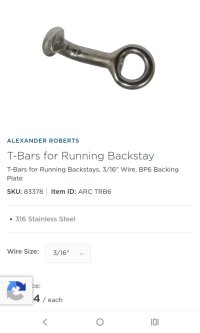
The 5/32 T-bars were the right size (3/16 was too large). $36/each from Rigging Only last year.
About 30 ft of line will get the rope back down to the aft deck, where I ended the line with a stainless steel ring. I just secure the ring with a bungee cord to a stanchion base. To tension the runner, add a tail to the ring and run it to a block and a winch. This way, without the tail, you don't have extra coiled-up line cluttering up the deck.
Last edited:
You'll be fine in anything except extreme conditions. If that photo showing the tangs for running backs is your boat, you might as well get some. Just use a good spectra or similar material, lead them as far back as you can on the outboard track and directly to the windward winch (or secondaries if you have them). No need for a block and tackle. The best way to guage the need is to rig up the staysail and high clewed genoa and go sailing. Sight up the mast and see if see the mast moving around. If so, then invest in runners. But, I don't think you will have any issues in most conditions. You definitely should have an adjustable backstay. As long as you can keep the headstay from moving around, for this mast I would not be too concerned. Hope this makes sense.Thank you. I have a 32-3 with an inner forestay that was installed as an original option; it can be stowed with a bridle. I'm owner 3, but no running backstay came from PO #2, so we haven't used the staysail. Sounds like we could sail double-headed? Our 130 RF Genoa has a very high clew.