• Untitled Document

    Join us on May 22nd, 7pm EDT

    for the CBEC Virtual Meeting

    EY.o May Zoom Meeting

    All EYO members and followers are welcome to join the fun and get to know the people you've met online!

    See the link below for login credentials and join us!

    May Meeting Info

    (dismiss this notice by hitting 'X', upper right)

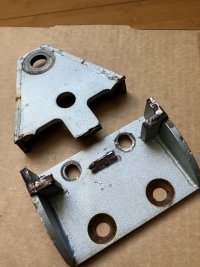
Broken motor mount bracket

peaman

Contributing Partner
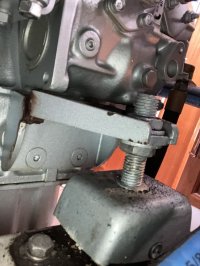
Just finished servicing my Universal M25XPB with plans to launch on Thursday. But then I discovered a broken motor mount bracket on the starboard front mount. The M25XPB has four mounts. I can order a replacement part ($509), and maybe I can take off the old and install the new, but what else needs to be done? If I have three good mounts that can probably be left undisturbed, is professional alignment required? Can the replacement safely be done in the water?

IMG_0937.jpegIMG_0936.jpeg
 

Afrakes

Sustaining Member
Just finished servicing my Universal M25XPB with plans to launch on Thursday. But then I discovered a broken motor mount bracket on the starboard front mount. The M25XPB has four mounts. I can order a replacement part ($509), and maybe I can take off the old and install the new, but what else needs to be done? If I have three good mounts that can probably be left undisturbed, is professional alignment required? Can the replacement safely be done in the water?

View attachment 55126View attachment 55127
Remove it and take it to a talented welder and have it fixed. Seems like the design could use some reinforcement.
 

JSM

Sustaining Member
I have read that this is a common problem and that the bracket has been redesigned. Looks like you could possibly.

1. Unbolt the bracket from the engine block.
2. Take out the lag bolts holding the motor mount in place.
3. Remove bracket and mount in one piece.
4. Reassemble the new bracket and mount (set at same height as when removed}
5. Slide new bracket and mount into place and bolt it all up. Be careful not to over torque the motor mount lags as they strip easily (ask me how I know !).
No reason that this cannot be done in the water and no alignment should be needed.
 

peaman

Contributing Partner
I have read that this is a common problem and that the bracket has been redesigned. Looks like you could possibly.

1. Unbolt the bracket from the engine block.
2. Take out the lag bolts holding the motor mount in place.
3. Remove bracket and mount in one piece.
4. Reassemble the new bracket and mount (set at same height as when removed}
5. Slide new bracket and mount into place and bolt it all up. Be careful not to over torque the motor mount lags as they strip easily (ask me how I know !).
No reason that this cannot be done in the water and no alignment should be needed.
Interesting. So on the Westerbeke site I found the piece, SKU# 200435, is the replacement part. How can I tell if that is the new, improved design, or if it’s no tougher that the original which broke?
 

peaman

Contributing Partner
Good replacements from IsoFlex. Discussed here:
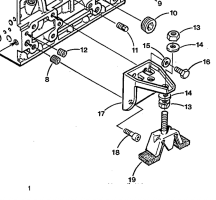
The broken part is an iron piece that spans from the engine block to the vibration isolator, not the isolator itself. Part number 17 in the image below.

Image 4-28-26 at 8.48 AM.png
 

bigd14

Sustaining Partner
Blogs Author
Oops I misread that. I also had some custom motor mount brackets made up by a local welder. I would take it to a local metal shop and see if they could fix it or duplicate it if Toad doesn’t work out. I had a weird experience with Toad Marine a few years back with an order that appeared to go through and billed my card but was never confirmed or sent. Had to dispute the charge and never heard back from them. Hope you have better luck.
 

bigd14

Sustaining Partner
Blogs Author
Also for the lag bolt issue you could use hanger bolts, which have combination lag screw and machine threads. Use epoxy to permanently secure the lag end in the engine bed and then use a nut and washers to hold down the motor mount.
 

JSM

Sustaining Member
Also for the lag bolt issue you could use hanger bolts, which have combination lag screw and machine threads. Use epoxy to permanently secure the lag end in the engine bed and then use a nut and washers to hold down the motor mount.
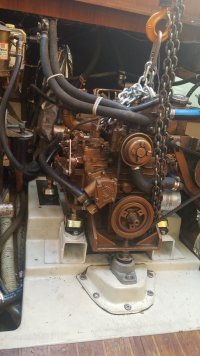
I solved that problem by welding nuts to the underside of some 1/4" steel plates. The plates got lag bolted to the engine bearers and the motor mounts are held in place with machine bolts.
 

Attachments

  • 20180310_135500.jpg
    20180310_135500.jpg
    122.7 KB · Views: 6

bigd14

Sustaining Partner
Blogs Author
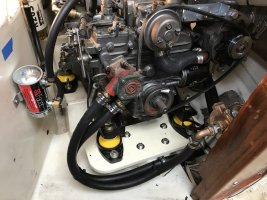
I did something similar on the front with a steel plate bolted to the bed and tapped for the mounts in the custom brackets but used hanger bolts on the aft end. Unbelievable difference in how smooth the engine is with the 4 new mounts from the original three point system.

1777390116343.jpeg
 

JSM

Sustaining Member
Unbelievable difference in how smooth the engine is with the 4 new mounts from the original three point system.
Absolutely the biggest improvement I've done to the boat. I still had some minor vibration issues that were eliminated after I installed a new trans and damper plate.
 

peaman

Contributing Partner
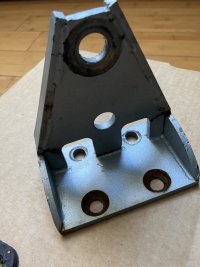
The broken part has been removed. It is made up of 6 individual steel parts welded together. The middle weld at the break was nothing more than a tack weld, with no penetration of the component parts. The engine was installed in my 1987 32-3 in 2020, less than a year before I bought it. I'm pretty sure this piece was broken pretty much from the time I bought the boat, but I have had no issues that I would attribute to a broken mount. The engine was only 1/16" lower at the location of the break, as the engine block overhangs the mount location, so the block was still getting support from the vibration isolator.

I have yet to decide what to do from here. I could order a new mount from Westerbeke, but if it is the same design as the original, I would be concerned about reliability. Further, installation of a new piece could be a challenge: the rectangular cutouts in the horizontal plate at the bolts are not quite long enough for a socket to fit on the bolt head. A shorter than normal socket would be needed in order to get full torque in tightening the bolts.

Another option would be to repair and improve the part that I have. In that case, I would consider moving the horizontal plate lower on the vertical plate at the engine block, so as to not restrict use of a normal socket on the upper bolts. I would also want to consider an additional vertical gusset below and perhaps also above the horizontal plate. The horizontal plate could be lowered 1/2" easily, as there is a bit more than 3/4" of stud between the top of the vibration isolator and the bottom of the horizontal plate.

Yet another option would be for fabrication of a new mount, with at least some of the improvements described above.

All comments, corrections and insights welcome. I especially would like to hear from @Kenneth K and @Pete the Cat since they seem to know how to deal with this sort of thing;).

IMG_0945.jpeg

IMG_0944.jpeg

IMG_0943.jpeg
 

Afrakes

Sustaining Member
The broken part has been removed. It is made up of 6 individual steel parts welded together. The middle weld at the break was nothing more than a tack weld, with no penetration of the component parts. The engine was installed in my 1987 32-3 in 2020, less than a year before I bought it. I'm pretty sure this piece was broken pretty much from the time I bought the boat, but I have had no issues that I would attribute to a broken mount. The engine was only 1/16" lower at the location of the break, as the engine block overhangs the mount location, so the block was still getting support from the vibration isolator.

I have yet to decide what to do from here. I could order a new mount from Westerbeke, but if it is the same design as the original, I would be concerned about reliability. Further, installation of a new piece could be a challenge: the rectangular cutouts in the horizontal plate at the bolts are not quite long enough for a socket to fit on the bolt head. A shorter than normal socket would be needed in order to get full torque in tightening the bolts.

Another option would be to repair and improve the part that I have. In that case, I would consider moving the horizontal plate lower on the vertical plate at the engine block, so as to not restrict use of a normal socket on the upper bolts. I would also want to consider an additional vertical gusset below and perhaps also above the horizontal plate. The horizontal plate could be lowered 1/2" easily, as there is a bit more than 3/4" of stud between the top of the vibration isolator and the bottom of the horizontal plate.

Yet another option would be for fabrication of a new mount, with at least some of the improvements described above.

All comments, corrections and insights welcome. I especially would like to hear from @Kenneth K and @Pete the Cat since they seem to know how to deal with this sort of thing;).

View attachment 55151

View attachment 55152

View attachment 55153

 

Kenneth K

1985 32-3, Puget Sound
Blogs Author
In the short term, I'd have the broken mount welded, with re-enforcement, and re-installed. In the long term, if your other three mounts are the same, you might want to come up with a plan for replacing them all at some point.

They always say to avoid corners in structural parts--a corner concentrates stresses and is where a part tends to fail. Although they did include gussets in the design, the gussets don't extend out far enough horizontally. Thus, the piece failed in the corner, right at the end of the gusset.

As manufactured, they couldn't extend the gusset further horizontally (shown in red, below), because the top piece angles inward. However, if you made a longer gusset and angled it inward, you could get it to support the top piece at a further distance out than the perpendicular gusset does (shown in green with the rotation arrow above it). Or, you could weld on a nearly full-length gusset in the center of the piece (also shown in green). The gusset don't have to be rounded. Triangular gussets would be easier to make. But, some of these changes might make it more difficult to access the mounting bolts.
IMG_0945.jpeg

I think your idea of lowering the horizontal plate 1/2" and adding gussets would work, as well. It just adds more work if you're altering your existing piece. But, if you're having a new piece made altogether, it would be just as easy to make one with the lowered plate.
 
Last edited:

peaman

Contributing Partner
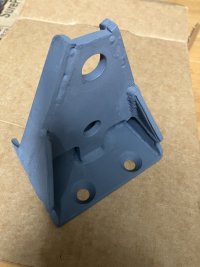
Horizontal plate lowered 1/2", triangular gussets added on each side. Not sure why countersunk hex-drive flathead bolts were used at bottom, when common hex head bolts would be much much easier to torque, install, and remove.
IMG_0947.jpeg
 
Top