Guest viewing is limited

E32-3 keel bolt compromise?

Christian Williams

E381 - Los Angeles
Senior Moderator
Blogs Author
IMG_8356.JPG......

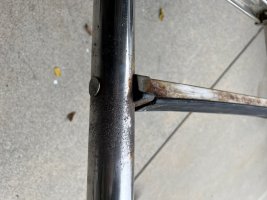
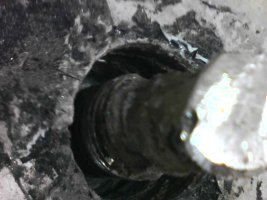
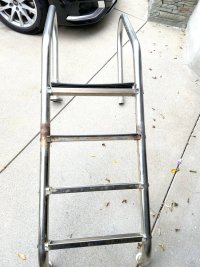
Here's a swimming pool ladder immersed for 23 years, half of that time in a saltwater pool. I took it out to replace the treads and polish it a bit.

The rust occurs at the waterline. There is no rust above, or below where it has always been submerged. The 2" stainless tube , according to the manufacturer, is "304 Stainless steel or 316L Marine grade stainless steel."

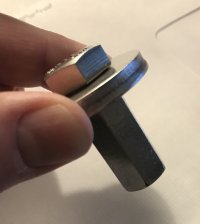
The rust polishes off, but there is pitting.
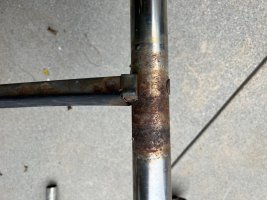
pitting IMG_8357.JPG...polish IMG_8358.JPG

Why is there rust at the waterline, but no rust in air or when fully submerged?

"Waterline corrosion takes place when there is an uneven supply of oxygen to areas of the same metal component. It is a type of electrochemical corrosion that affects metals such as steel and iron. When a poorly oxygenated area is adjacent to an area with a good supply of oxygen, an anodic/cathodic reaction occurs."

I can't help but note that this is the environment of keel bolts in a bilge, and also of the rudder post where it enters the water (and we have a member whose rudder post broke clean off there, while cruising far from home).

Not to keep us awake, just a parallel example of stainless steel in the real world. A saltwater pool has 1/10 the salt of an ocean. Does salt matter with this type of corrosion?
 

Pete the Cat

Sustaining Member
View attachment 47116......

Here's a swimming pool ladder immersed for 23 years, half of that time in a saltwater pool. I took it out to replace the treads and polish it a bit.

The rust occurs at the waterline. There is no rust above, or below where it has always been submerged. The 2" stainless tube , according to the manufacturer, is "304 Stainless steel or 316L Marine grade stainless steel."

The rust polishes off, but there is pitting.

View attachment 47117...View attachment 47118

Why is there rust at the waterline, but no rust in air or when fully submerged?

"Waterline corrosion takes place when there is an uneven supply of oxygen to areas of the same metal component. It is a type of electrochemical corrosion that affects metals such as steel and iron. When a poorly oxygenated area is adjacent to an area with a good supply of oxygen, an anodic/cathodic reaction occurs."

I can't help but note that this is the environment of keel bolts in a bilge, and also of the rudder post where it enters the water (and we have a member whose rudder post broke clean off there, while cruising far from home).

Not to keep us awake, just a parallel example of stainless steel in the real world. A saltwater pool has 1/10 the salt of an ocean. Does salt matter with this type of corrosion?
Well that is interesting and I look forward to others' opinions of what is going on. We have SS props and shafts becoming the standard these days where softer metals like silicon bronze were once dominant.
 

Sean Engle

Your Friendly Administrator
Administrator
Founder
Firstly I would remove the nut and fully inspect the threads under it. If the threads are good below the "hollow space" that's where it really matters. If you find a lot of corrosion and missing material under the nut then you may need to come up with a remedy.
Second that.
 

K2MSmith

Sustaining Member
Ericson over-engineered the keel attachment. check other boats to see the size and number of keelbolts in comparison to an Ericson.
 

vanilladuck

E32-3 / San Francisco
Blogs Author
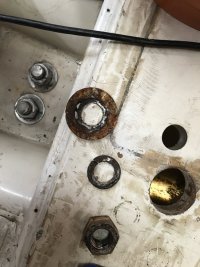
Well, Rumour is on the hard again for a haul out. Maintenance items include new prop, new motor mounts, bottom painting, glassing or fairing the keel-hull joint where a 'Catalina Smile' can be found, and dropping the rudder out to examine/fix as necessary. And, then this was added to the list:


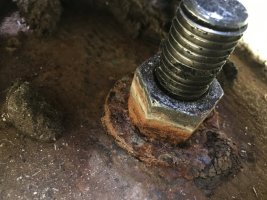
And, that's the same keel bolt in the video what was at the beginning of this thread. I think the 2-3 week haul out just became 2-3 months long... oh, and the boat has "Paint Sickness". All the bottom paint needs to be removed and a barrier coat added to the gelcoat. This is actually well-timed, because the keel-hull joint needs to be re-glassed.

Are we having fun yet! :p
 

peaman

Contributing Partner
That looked pretty tough. If this development brings on light-headedness, try to lay down on one of the settees in the salon and focus on your fabulously finished overhead. Recall what you went through to achieve that and know that refurbishing the keel joint is probably not so much of a challenge as you have met head-on before.
 

Pete the Cat

Sustaining Member
Well, Rumour is on the hard again for a haul out. Maintenance items include new prop, new motor mounts, bottom painting, glassing or fairing the keel-hull joint where a 'Catalina Smile' can be found, and dropping the rudder out to examine/fix as necessary. And, then this was added to the list:


And, that's the same keel bolt in the video what was at the beginning of this thread. I think the 2-3 week haul out just became 2-3 months long... oh, and the boat has "Paint Sickness". All the bottom paint needs to be removed and a barrier coat added to the gelcoat. This is actually well-timed, because the keel-hull joint needs to be re-glassed.

Are we having fun yet! :p
Just a word of experience about barrier coats. I bought my Tartan 37 at a much reduced price because it had thousands of blisters all over the bottom. I thought it strange as Tartans did not have a history of this problem common in other production builders--but the price was right and the rest of the boat was good. I had the bottom sanded and eventually the gelcoat stripped. Turned out the blisters were the result of the previous owner putting a preventive barrier coat over the still damp gelcoat. I eventually stripped all the gelcoat off and glassed and faired the bottom. Point is, that barrier coats over a wet gelcoat hull can be a problem, not a solution. Back in the day Nautor and others did not gelcoat below the waterline; but epoxy coated and faired their hulls for paint. Takes more time to do but that was their reasoning.
If that bolt is the last one aft, I don't think it is bearing much weight FWIW.
 

vanilladuck

E32-3 / San Francisco
Blogs Author
Point is, that barrier coats over a wet gelcoat hull can be a problem, not a solution.
@Pete the Cat, when you say "wet", do you mean the gelcoat resin is wet? Or that the boat has been in the water for years?

The current plan is to blast all the old ablative paint off and properly dry and prep the remaining gelcoat for an epoxy barrier coat.

If that bolt is the last one aft, I don't think it is bearing much weight FWIW.
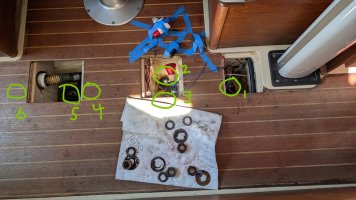
PXL_20260403_201413271.jpg

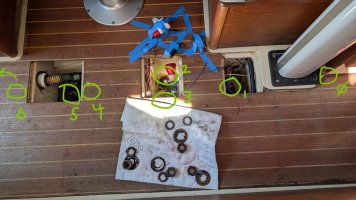
The bolts are labeled 1-6 from fore to aft.
Bolts 2 and 3 are abeam of each other.
Bolts 4 and 5 are fore/aft of each other.
The hourglassed bolt with no threads is #2 in this photo.
Bolts 1-5 are the same size.
Bolt 6 is actually off the screen to the left and it very small. Any shiny. But, that doesn't mean anything :p
 

vanilladuck

E32-3 / San Francisco
Blogs Author
That looked pretty tough. If this development brings on light-headedness, try to lay down on one of the settees in the salon and focus on your fabulously finished overhead. Recall what you went through to achieve that and know that refurbishing the keel joint is probably not so much of a challenge as you have met head-on before.
Thank you so much @peaman -- your supportive and kind thoughts have landed on thankful ears. I make a practice of laying down in the salon and staring at that ceiling often ;)
 

Kenneth K

1985 32-3, Puget Sound
Blogs Author
Hey Bryan, sorry you found some bad news on your keel bolts. FYI, there are six 1" and one 1/2" keel bolts on the 32-3. The forwardmost keel bolt is just forward of the mast. You have to insert an extension bar into the hole in the sole and place the socket into the TAFG from access in the forward port setee floor. You might have to remove that aft-facing door trim to fit the head of the socket wrench between the mast and the bulkhead wall.
20210115_133647.jpg 20210115_133712.jpg

The six 1" bolts, if torqued to 200ft-lb, exert about 72,000 lb of upward force or about a 15:1 safety factor (in the static case) for the 4800lb keel. The dynamic case is more difficult to analyze, but if the original design had a 3:1 or 4:1 safety factor, the loss of one bolt likely lowers those factors to about 2.5:1 or 3.3:1. However, the loss of one of the two "abeam" bolts likely has more significance than the centerline bolts. Still, you likely could have sailed to Hawaii with that failed keel bolt and never had known. These are well-built boats. The bigger problem is that you can't fully know the condition of the other five main bolts (or the smaller, 7th bolt) without dropping the keel.

In the blog post I did on keel bolts, member Red Squirrel found the same corrosion on one of his keel bolts. He found solid threads below the corroded ones and captured those threads with a coupler nut and another 1" bolt from above. You can see his post on pg 2 of my blog, here, https://ericsonyachts.org/ie/ubs/keel-bolt-torque-axial-loading.873/.

Bored out keel bolt hole.JPG Keel Shoulder nut.jpg
 
Last edited:

vanilladuck

E32-3 / San Francisco
Blogs Author
The forwardmost keel bolt is just forward of the mast. You have to insert an extension bar into the hole in the sole and place the socket into the TAFG from access in the forward port setee floor. You might have to remove that aft-facing door trim to fit the head of the socket wrench between the mast and the bulkhead wall.
Thanks so much for relaying this info @Kenneth K !

I've always wondered why that hole is there. The PO for the boat told me it was for sucking water out an inaccessible portion of the bilge. If it's inaccessible, why would it have water in it? (And if you've owned a boat long enough you'll understand both the insanity of that question and any answer given :geek:)

I understand removing the aft facing door trim.

"Forward port settee floor" -- would that be in the head? Or do you mean forward starboard floor?

If you have any more photos, I'd love to see them. In the meantime, I'll go read your blog post + comments
 

peaman

Contributing Partner
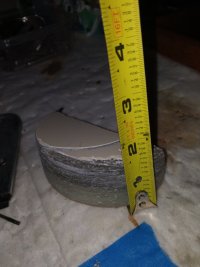
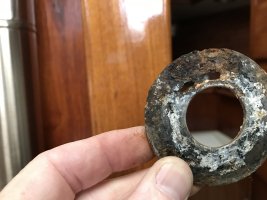
What material are the washers? One of them looked kind of like brass, like the one in the lower right corner of the pad in your newest image.
 

Kenneth K

1985 32-3, Puget Sound
Blogs Author
"Forward port settee floor" -- would that be in the head? Or do you mean forward starboard floor?
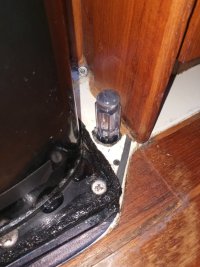
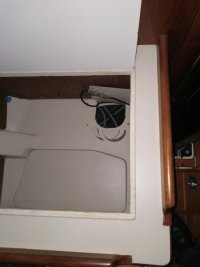
Here's a photo of the access in the setee floor:

20240126_172746~2.jpg

Mine had a poorly-cut rectangular shape I could barely get my hand into, so I enlarged the aft of the cutout with hole saws. You can see the cut remnants in the photo, just below the hole. Its insane how thick the TAFG is in this area (about 1-1/2").
20240126_173002.jpg

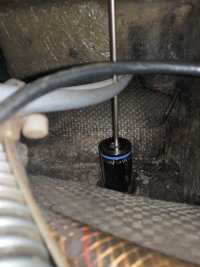
Here's a shot looking into the cutout, toward the center or the boat.
20240414_020210~2 (3).jpg
The "block" behind the keel bolt is a sponge I keep in that compartment to keep the keel bolt dry. I only get water in there when the shower bilge fills up to a fairly high level.
 

Pete the Cat

Sustaining Member
@Pete the Cat, when you say "wet", do you mean the gelcoat resin is wet? Or that the boat has been in the water for years?

The current plan is to blast all the old ablative paint off and properly dry and prep the remaining gelcoat for an epoxy barrier coat.


View attachment 54969

The bolts are labeled 1-6 from fore to aft.
Bolts 2 and 3 are abeam of each other.
Bolts 4 and 5 are fore/aft of each other.
The hourglassed bolt with no threads is #2 in this photo.
Bolts 1-5 are the same size.
Bolt 6 is actually off the screen to the left and it very small. Any shiny. But, that doesn't mean anything :p
The yard guys determined that the gelcoat (it is porous) had not fully dried before the previous yard put the barrier coat on. Sounds like you intend to dry it out. Mine took a long time because the dampness had been driven into the substrate.
 

Christian Williams

E381 - Los Angeles
Senior Moderator
Blogs Author
I would probably not drop the keel for that corroded bolt. I might put a bushing on it to regain grip on the upper threads.

To each his own.
 

bigd14

Sustaining Partner
Blogs Author
I think the washers were a less corrosion resistant stainless steel. My 30+ had lock washers. Luckily the threads were in good shape.


IMG_0165.jpeg
IMG_0358.jpeg


IMG_0357.jpeg
 

vanilladuck

E32-3 / San Francisco
Blogs Author
What material are the washers? One of them looked kind of like brass, like the one in the lower right corner of the pad in your newest image.
I'm not sure.. the brass-like color you see is rust and gunk. Total guess: high carbon steel or low quality stainless. After 41 years, who knows ¯\_(ツ)_/¯
 

vanilladuck

E32-3 / San Francisco
Blogs Author
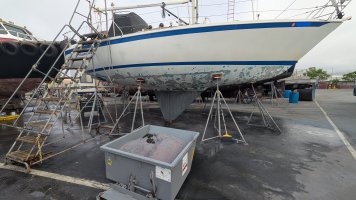
Current progress:

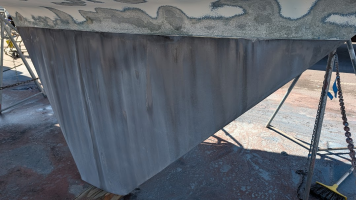
We sandblasted all the bottom paint and some of the gelcoat off the bottom. The gray spots missing white gelcoat are the result of blisters hidden beneath 41 years of ablative paint coats. The boat has what is colloquially called "paint sickness".

PXL_20260409_153238826.jpg

The hull-keel joint seems to be largely intact and sealed. I'm a little concerned seeing so much gelcoat blistering close to and *on* the joint. Looks can be deceiving, so we'll find out more when the keel is dropped.

1775853242649.png

I'm currently waiting for the rig to be unstepped. Likely to happen on Monday.
 
Top