
You are using an out of date browser. It may not display this or other websites correctly.
You should upgrade or use an alternative browser.
You should upgrade or use an alternative browser.
Removal of fuel tank in 32-3
- Thread starter peaman
- Start date

I just went through this. I bought a diesel transfer pump on Amazon and connected it to the line exiting the fuel filter. I used a combination of diesel jugs and 5 gallon buckets with lids also from Amazon that have a smaller screw on lid in them. Pumped out 22 gallons of nice clean fuel that will go back into the tank once it’s cleaned and access ports installed.

No reason. That might be a simple way to do it. It has to pump through two filters and a small hose, so it might take longer than a bigger, separate pump, but otherwise it would be fine.Is there a reason I couldn’t or shouldn’t just stick the return line in a can and run the pump in situ?

Captain Pete
Member II
This is a timely thread, as is the link to Christian's thread on installiing an access port.
Last fall, while on the hard, I noticed a smell - was that diesel? Time to monitor...
Is that some diesel in the bilge? More monitoring.
Is that diesel in the quarter berth under the tank? More monitoring
Maybe its that old return line, cut off an inch or so and reinstall. More monitoring.
Maybe its seeping out of the fuel guage which is a couple of inches lower than the top of the full tank. Remove some fuel (thankyou amazon for the robust fuel transfer pump). More monitoring.
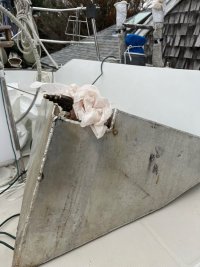
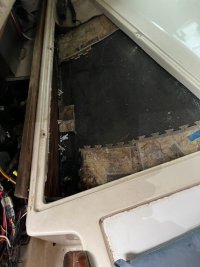
After all the monitoring, and wishful thinking for a simple solution, time to get at the tank. So Friday I pulled it out after transferring all fuel out to 5 gallon jugs (for future reuse). I had to cut the fill hose cuz that bugger wasn't budging even with heat and lots of cussing. Hopefully it will just need a connector and a small section of new hose rather than a complete new hose once this or whatever tank goes back in (that full hose replacement looks like a PIA). The rest of the removal effort was pretty easy with good access in the quarterberth.
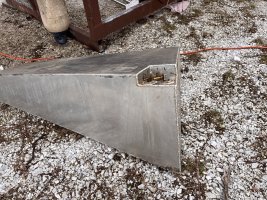
So far I find no obvious imperfections except perhaps a crack in the weldment in the lower corner. Need to evaluate further.
I intend to cut an access hole or rectangle in the tank.
And then clean out the sludge I can see through the fuel guage hole.
I am hoping with cleaning and access inside the tank maybe the JB Weld and/or epoxy/glass patch solution will work.
If not then probably to a local welder for some form of fix - maybe add a second bottom somehow?
Not sure I want the hassle of a new tank and the possible fitment challenges no matter how skilled and best intentioned the tank builder (assuming I can find one if needed).
Ah the joys of boat ownership. It comes with responsibility.
Last fall, while on the hard, I noticed a smell - was that diesel? Time to monitor...
Is that some diesel in the bilge? More monitoring.
Is that diesel in the quarter berth under the tank? More monitoring
Maybe its that old return line, cut off an inch or so and reinstall. More monitoring.
Maybe its seeping out of the fuel guage which is a couple of inches lower than the top of the full tank. Remove some fuel (thankyou amazon for the robust fuel transfer pump). More monitoring.
After all the monitoring, and wishful thinking for a simple solution, time to get at the tank. So Friday I pulled it out after transferring all fuel out to 5 gallon jugs (for future reuse). I had to cut the fill hose cuz that bugger wasn't budging even with heat and lots of cussing. Hopefully it will just need a connector and a small section of new hose rather than a complete new hose once this or whatever tank goes back in (that full hose replacement looks like a PIA). The rest of the removal effort was pretty easy with good access in the quarterberth.
So far I find no obvious imperfections except perhaps a crack in the weldment in the lower corner. Need to evaluate further.
I intend to cut an access hole or rectangle in the tank.
And then clean out the sludge I can see through the fuel guage hole.
I am hoping with cleaning and access inside the tank maybe the JB Weld and/or epoxy/glass patch solution will work.
If not then probably to a local welder for some form of fix - maybe add a second bottom somehow?
Not sure I want the hassle of a new tank and the possible fitment challenges no matter how skilled and best intentioned the tank builder (assuming I can find one if needed).
Ah the joys of boat ownership. It comes with responsibility.
Attachments
-
 IMG_6446.jpeg137.3 KB · Views: 13
 -
 IMG_6444.jpeg109.7 KB · Views: 14

Dave G.
1984 E30+ (SOLD)
Most likely you will find pinholes through the aluminum under the sludge when removed in the lowest portion of the tank under the pick up.So far I find no obvious imperfections except perhaps a crack in the weldment in the lower corner. Need to evaluate further.

Filkee
Sustaining Member
Yeah, I guess if the boat drinks about a gallon an hour when motoring, it’s not a terribly fast pump.No reason. That might be a simple way to do it. It has to pump through two filters and a small hose, so it might take longer than a bigger, separate pump, but otherwise it would be fine.
Dave G.
1984 E30+ (SOLD)
I think the pump(facet) will output about 20-24 gph @ 2 psi. I used mine to empty the tank down to the pick up, I only had half a tank(8 gallons) and took about 20 minutes. Got a little warm but worked fine.Yeah, I guess if the boat drinks about a gallon an hour when motoring, it’s not a terribly fast pump.
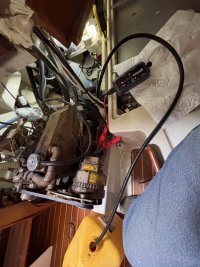
That's most of the reason for the fuel return line hose. The facet pump moves more fuel than the injector pump and fuel injectors can use (about 1/2 gal per hour), the rest is continually returned to the fuel tank through the banjo-fitting hoses, and the return hose.Yeah, I guess if the boat drinks about a gallon an hour when motoring, it’s not a terribly fast pump.


Filkee
Sustaining Member
Oh, yes…comments:
1. Bypass with the NOCO emergency starter battery worked, though pumping all the way through the return didn’t so I wound up putting the long return hose on the Racor and going straight from there. Got about 14 gallons out before the bubbles started coming. At first, nothing was happening, but then I thought to turn on the ignition (note:batteries are not currently in the boat, hence my McGuyver move).
2. Getting the hoses off wasn’t exactly easy, but easier than I expected. A little heat gun action got the vent off. Then, I pulled the tank FWD enough to get it standing on the edge of the opening and the rotated it 45 degrees. I then crawled along the edge and grabbed the hose with channel locks. Once I’d rotated it a few inches, I wormed my way back to the chart table, gave it a good tug and the fill came right off.
3. Many butt splices and screws collected down in those cracks. I’ll be able to restock the tool box.
1. Bypass with the NOCO emergency starter battery worked, though pumping all the way through the return didn’t so I wound up putting the long return hose on the Racor and going straight from there. Got about 14 gallons out before the bubbles started coming. At first, nothing was happening, but then I thought to turn on the ignition (note:batteries are not currently in the boat, hence my McGuyver move).
2. Getting the hoses off wasn’t exactly easy, but easier than I expected. A little heat gun action got the vent off. Then, I pulled the tank FWD enough to get it standing on the edge of the opening and the rotated it 45 degrees. I then crawled along the edge and grabbed the hose with channel locks. Once I’d rotated it a few inches, I wormed my way back to the chart table, gave it a good tug and the fill came right off.
3. Many butt splices and screws collected down in those cracks. I’ll be able to restock the tool box.

I pulled the tank FWD enough to get it standing on the edge of the opening and the rotated it 45 degrees. I then crawled along the edge and grabbed the hose with channel locks. Once I’d rotated it a few inches, I wormed my way back to the chart table, gave it a good tug and the fill came right off.
Most of us, and us only, can appreciate the contortions, innovation, knuckle nicks and spine twisties behind the laconic description.
Most of us, and us only, can appreciate the contortions, innovation, knuckle nicks and spine twisties behind the laconic description.
Filkee
Sustaining Member
Rightly recognized. The back pain and bleeding is a given. I know I can count on my editor to punch it up for the Style Section.I pulled the tank FWD enough to get it standing on the edge of the opening and the rotated it 45 degrees. I then crawled along the edge and grabbed the hose with channel locks. Once I’d rotated it a few inches, I wormed my way back to the chart table, gave it a good tug and the fill came right off.
Most of us, and us only, can appreciate the contortions, innovation, knuckle nicks and spine twisties behind the laconic description.
Got it to the shop today and ID’d a hole the size of a dime at the low point.

Are the hoses tagged with the red arrows what are referred to as “ the banjo fitting“ hoses? I note that yours are painted universal gold. Mine are black rubber, and the insurance surveyor commented that they “appear brittle” and he recommended they be replaced. Is replacing these a reasonable DIY project? I am replacing the lines from facet pump to secondary filter and from secondary filter to engine as soon as hoses arrive next week. Why is the arrangement called a banjo fitting?That's most of the reason for the fuel return line hose. The facet pump moves more fuel than the injector pump and fuel injectors can use (about 1/2 gal per hour), the rest is continually returned to the fuel tank through the banjo-fitting hoses, and the return hose.
View attachment 54856
he recommended they be replaced
I was able to reuse most of my old injector hose, excepting the return fuel line from injectors to tank. Turns out that the fitting on the fuel tank is much larger than on the injectors, so a Kubota fuel line won't fit anyhow. I made do with stock 1/4-inch fuel line for the return line (its wall thickness is twice that of Kubota's). A passing mechanic said he runs into the issue of different sized fuel hose fittings all the time. [Update: David Grimm reports that these return line hoses work on the 5432]

From this blog entry
I was able to reuse most of my old injector hose, excepting the return fuel line from injectors to tank. Turns out that the fitting on the fuel tank is much larger than on the injectors, so a Kubota fuel line won't fit anyhow. I made do with stock 1/4-inch fuel line for the return line (its wall thickness is twice that of Kubota's). A passing mechanic said he runs into the issue of different sized fuel hose fittings all the time. [Update: David Grimm reports that these return line hoses work on the 5432]
From this blog entry

peaman
Contributing Partner
Why is the arrangement called a banjo fitting?
A banjo fitting is shaped roughly like a banjo with a hole through the round part and with a tube for the neck. The Wikipedia entry has a couple of helpful illustrations. The banjo is secured with a bolt which has a hole through its center and another transversely through the bolt just under the head so that, when installed, will provide a flow path through the bolt, into the "body" of the banjo, and then out through the "neck" of the banjo into a connected hose. A specialized washer must be installed on each side of the banjo "body" to serve as a gasket to minimize leakage.
Thank you, Christian (and David Grimm). So, I assume it’s yes to the DIY question. Parts have been ordered.he recommended they be replaced
I was able to reuse most of my old injector hose, excepting the return fuel line from injectors to tank. Turns out that the fitting on the fuel tank is much larger than on the injectors, so a Kubota fuel line won't fit anyhow. I made do with stock 1/4-inch fuel line for the return line (its wall thickness is twice that of Kubota's). A passing mechanic said he runs into the issue of different sized fuel hose fittings all the time. [Update: David Grimm reports that these return line hoses work on the 5432]
From this blog entry
Thanks so much for the explanation! Wikipedia’s pictures added clarity.A banjo fitting is shaped roughly like a banjo with a hole through the round part and with a tube for the neck. The Wikipedia entry has a couple of helpful illustrations. The banjo is secured with a bolt which has a hole through its center and another transversely through the bolt just under the head so that, when installed, will provide a flow path through the bolt, into the "body" of the banjo, and then out through the "neck" of the banjo into a connected hose. A specialized washer must be installed on each side of the banjo "body" to serve as a gasket to minimize leakage.
This year’s self-study curriculum for this 32-3 owner is “fuel system.”
I couldn’t do this without the help of this forum, and if I could, I’m sure I wouldn’t enjoy it so much!

When I did the hose hookup on our then-new Betamarine in 2018, I struggled to get a fuel line to fit onto a barbed fitting on the engine because the engine was basically metric. I ended up grinding off most of the "barbs" on the little brass fitting.Turns out that the fitting on the fuel tank is much larger than on the injectors, so a Kubota fuel line won't fit anyhow. I made do with stock 1/4-inch fuel line for the return line (its wall thickness is twice that of Kubota's). A passing mechanic said he runs into the issue of different sized fuel hose fittings all the time.
(Just another unplanned outcome of the USA failing to adopt the metric system back in the 70's when it was proposed. I am used to feet and inches, but sometimes these "standards" differences are frustrating - and lead to owning two sets of wrenches and sockets.)