Lazy Jacks on a 28-2

Sidnewport

Member II
I bought A Harken 252 lazy jacks kit... Way overpriced, but.. Hey.. This is a boat. I was going to mount at the 22 ft 5 in they recommend for tall masts, but then I had a heart-to-heart with an Ai guru who lells me to put them below the spreaders.

Any experience with this?
 

Loren Beach

O34 - Portland, OR
Senior Moderator
Blogs Author
The higher you place the turning blocks, the lower the stress on them (and the pair of screws you tapped in the spar). As a compromise ours are above the lower spreader, but well below the upper one. Note that they will tap against the spreaders and/or spar as they try to vibrate in a breeze. ("Every solution bears the seeds of a new problem" as the old saying goes...)
 

Christian Williams

E381 - Los Angeles
Senior Moderator
Blogs Author
Run your eye over this thread:


Sidnewport

Member II
The higher you place the turning blocks, the lower the stress on them (and the pair of screws you tapped in the spar). As a compromise ours are above the lower spreader, but well below the upper one. Note that they will tap against the spreaders and/or spar as they try to vibrate in a breeze. ("Every solution bears the seeds of a new problem" as the old saying goes...)
I have not yet installed the lazy jacks, but it seems ther is no way... Please help me out here. The spreaders seem to be a real issue here. I realized that the 22.5 ft would be a problem because they would not clear the spreader tips by much and if thet were loose enough not to constrain the sail the coil snag on the spread tiips going downwind, so it appeared retractable jacks aare the answer.
The problem with retractable jacks is the when they are retracted Al's brought closr to tne mast, the lines coming down the mast will pass vert closet to the very sharp aft side of the spreaders, and the will get cut to shreads.
It was suggested to mount them to the spreaders themselves, but the supports for the spreaders at the mast is a 1/8 in aluminum bar that does not look like it would support much vertical stress.
I could mount them on the mast just under the spreaders, but them I would have to worry about the lower shrouds getting in the way, and lines crossing wires dous nor t seem to be a great thing, so the ionle place to mount them would be below the lower shrouds, but that would put them less than 13 ft above the boom, so they would not be very effective. So I am at a loss.

Has anyone dealt with this issue?
 

Loren Beach

O34 - Portland, OR
Senior Moderator
Blogs Author
I have never had the LJ lines snag on a spreader tip. On our boat and others (like the E-33RH in our club) the geometry of the support lines just does seem to allow that. Note that if your are out sailing for more than an hour or two, you will usually retract the LJ back to the gooseneck area while under sail. And I do agree about not "hanging" the potential weight of the boom from the spreaders - IMO they are not designed for down-force. And, there will -rarely- be times, ordinary or accidental, when the LJ are too tight and the mainsheet is honked down enough to darned near pull the upper block screws out of the spar. i.e. they get accidentally used as "topping lift" lines, and someone tries to chin him/herself on the end of the boom...!
 

Sidnewport

Member II
Yeah, I had planned on retracting the lines, but if they are tied at the mast, the direct line between the attachment point at the top and the gooseneck below runs very close to the sharp aft side of the spreaders. What is worse, the spreader shape, where it broadens at the mast, guides the lines forward and outwards directly to the sharp aft edge of the spreader.

So... mount below the spreaders. Not on the spreaders because of the lightweight attachment bar. Just under the spreaders and above the lower shrouds is ok when they are deployed, but the line will sit right up against the shrouds when they are retracted. If I lower them further, to mount under the shrouds, then they will have to be retracted, or they will push up against the shrouds when you go off the wind. So non-retractable above the shrouds, or maybe two blocks above the shrouds to keep the lines on either side of the shrouds. Or below the shrouds and be sure to retract them. Actually, even above the shrouds I would need a flexible block so that the line would not pull sideways when the boom eases. The standard cheek block that Nautos provides would bind when the sail is eased. So it appears that anywhere near the lower shrouds I would have to always retract the LJ when underway. That might be a good thing. Just stow the LJs before I attach the sail cover, and don't apply them again until you are going to lower the sail next time.

 

Christian Williams

E381 - Los Angeles
Senior Moderator
Blogs Author
(With a topping lift there is no big force on the jacks. Might not be so with solid vang.)

Forum wisdom is to put things off, meaning "improvement" is relative and often with compromise.

Lazy jacks are a complication. I really need them, because I rarely have a sprightly crew. They are there to hold the heavy full batten sail on the boom, for hoisting and lowering. But my whole previous life they were unnecessary, as there was always somebody ready to spring on deck as the sail came down and throw on a gasket until we got to the dock for neat sorting out.

I have tried slotted covers and retracted jacks, to permit a regular cover. I have tied off the jacks or left them up all the time--my present practice when sailing, so I can reef without assistance. They still complicate everything despite working well as advertised.

Does everybody need them? Would a stack pack be equally good (with its own complications)?

Every situation is different. but lazy jacks aren;t necessary until they are demonstrably necessary.
 

Dave G.

1984 E30+ (SOLD)
Retractable LJ's are IMHO the way to go. You need to have enough line to be able to pull the aft LJ lines along the boom and secure and tighten to the mast. I just pulled them forward wrapped the lines around the reefing horns, pulled it tight and tied off. This also allows you to use your existing sail cover too.
 

Sidnewport

Member II
Retractable LJ's are IMHO the way to go. You need to have enough line to be able to pull the aft LJ lines along the boom and secure and tighten to the mast. I just pulled them forward wrapped the lines around the reefing horns, pulled it tight and tied off. This also allows you to use your existing sail cover too.
Have you had any issues with the retractable lines cutting across the aft edge of the spreaders?
 

Acorn

Member I
I designed, and installed my own lazyjacks on my E 25+ about four months ago, and I highly recommend installing them above the spreaders. I believe rigging them that low would cause several issues, including undue stress on the hardware, and an unfavorable angle to catch your sail. Look at it this way-- how often have you seen lazyjacks installed below the spreader?

Our rigs are very similar. When I was researching my design, a common problem I was reading about was the lines catching on the battens.

To combat this, I ran the main lines through bullet blocks on lines run to the ends of the spreaders that are the same length as the spreaders. These pull the lazy jacks apart when the lazy jacks are up, and allow them to be tight to the mast when under sail. I installed pad eyes with clips on either side of the gooseneck for this purpose. I also spliced the two main lines together at the front of the mast, and through another bullet block, so that they can be raised, and lowered with a single line which will apply equal pressure to each side. I leave them up when the boat is docked, so that I don't have to use sail ties (which I believe will shorten the life of the sail by putting creases in the fabric).

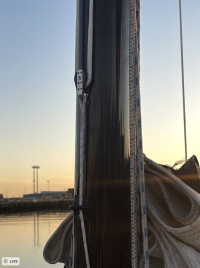
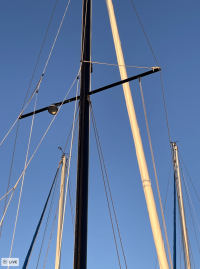
Here are some photos. Hope this is helpful.
 

Attachments

  • Screenshot 2026-02-09 at 1.52.07 PM.png
    Screenshot 2026-02-09 at 1.52.07 PM.png
    876.7 KB · Views: 5
  • Screenshot 2026-02-09 at 1.51.49 PM.png
    Screenshot 2026-02-09 at 1.51.49 PM.png
    773.4 KB · Views: 5
  • Screenshot 2026-02-09 at 1.51.26 PM.png
    Screenshot 2026-02-09 at 1.51.26 PM.png
    858.3 KB · Views: 5

Dave G.

1984 E30+ (SOLD)
Have you had any issues with the retractable lines cutting across the aft edge of the spreaders?
Not at all, and mine were 70% up the mast. They should be tight enough that they couldn't hit the spreaders at all. The practice I used was that I did not deploy the LJ's until I was ready to drop the main. So I didn't have worry about any chance of stressing them or looking at them under sail or fighting with them while raising the sail. They have a tendency to get hooked on the batten ends in anything but very light winds. I would deploy the LJ's drop the main and when back at the dock retract them neaten up the sail, sail ties, cover. Then the next time you go out you can raise the main without any interference from the LJ's. Rinse and repeat....
 

Sidnewport

Member II
I'm not sure how you avoid the spreaders when they are not deployed, since the blocks on the top are on the side of the mast, and the reefing hooks are just aft of the mast. It looks like the fatter part of the spreader right next to the mast would guide the lines forward and out, right onto the sharp edge, and slice them in no time. Are your blocks at the top way back aft on the mast? Most people have mentioned the lines do hit the spreaders, so I am confused why the lines don't get destroyed
 

Dave G.

1984 E30+ (SOLD)
Are your blocks at the top way back aft on the mast?
No, they are on the side of the mast. It's a "standard" position for most all boats with LJ's, that I have seen anyway. I don't recall anyone having problems with the spreaders slicing the lines. I used them that way for 6 years and didn't see any sign of line damage from the spreaders.
 

Acorn

Member I
I'm not sure how you avoid the spreaders when they are not deployed, since the blocks on the top are on the side of the mast, and the reefing hooks are just aft of the mast. It looks like the fatter part of the spreader right next to the mast would guide the lines forward and out, right onto the sharp edge, and slice them in no time. Are your blocks at the top way back aft on the mast? Most people have mentioned the lines do hit the spreaders, so I am confused why the lines don't get destroyed
On mine, the lines come up from the boom, through the cheek block, and back down forward of the spreaders. When you're raising, or lowering them, they're not under stress, so there's no significant rubbing on the spreaders. When they're deployed, even a few feet above the spreaders reduces the mechanical advantage of the pressure of the lines on the spreaders to negligible.
 

Christian Williams

E381 - Los Angeles
Senior Moderator
Blogs Author
Not much pressure on them, and Spectra is tough.

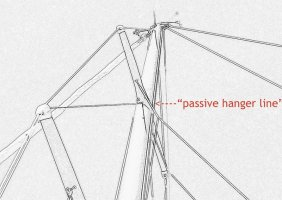
An alternative I like is to mount the top of the jacks one foot outboard on the underside of the top spreader. A short line ("passive hanger") extends. This helps keep retracted lines from rattling against the mast. It also opens the jack entry so a full-batten main fouls less when hoisting. Spreaders are fairly strong, we stand on their bases while climbing a mast.

1779471108462.png
 
Top