Took me too many years to realize that I actually like working on my boat. That is, when it isn't something that prevents me from sailing it! It helps that I am a mechanical designer and have been working on cars and motorcycles in my younger years. Then homes and yards later. But boats? It seems that the learning curve never ends. So you will need and use any skill you bring with you. And I include the business skills of barter, making connections, bargaining, negotiating, legalize as well as the obvious mechanical, electrical, wood working, fiber glassing, sewing, navigating, docking, etc. etc. Wow. makes me wonder why I do this. Someone smarter than me told me, "it's who you are". Sounds like some Yogi-ism (Yogi Berra). Best of luck and enjoy the ride of boat ownership!

You are using an out of date browser. It may not display this or other websites correctly.
You should upgrade or use an alternative browser.
You should upgrade or use an alternative browser.
Bilge Pump Wiring
- Thread starter Eric Gordon
- Start date

Eric Gordon
1975 E27 - Sea Star, Yanmar 3GM30F Dana Point, Ca.
After finally installing my bilge pump… I have turned to the wiring… And as previously mentioned here it is a rat’s nest, spiderweb, a monstrosity.
so what I’ve done, is begin removing any wiring that is not used, and will not be used… One by one.
This is a painstaking process, but necessary for me to understand what everything is hooked up to where it is, etc.
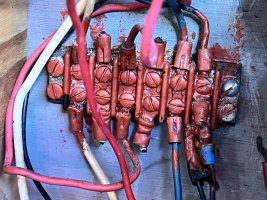
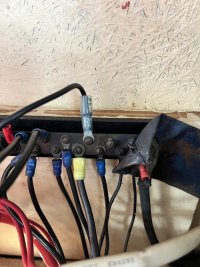
today as I was removing several cables related to instruments I don’t use or are broken I have run across a plethora of power busses some of which I have no clue what their purpose might be… So far I have found four of them on the boat… Please see pics
I think once I get rid of all the unnecessary wiring, I will build something which will replace these existing bars…install it and rewire (labeling liberally as I go).
so what I’ve done, is begin removing any wiring that is not used, and will not be used… One by one.
This is a painstaking process, but necessary for me to understand what everything is hooked up to where it is, etc.
today as I was removing several cables related to instruments I don’t use or are broken I have run across a plethora of power busses some of which I have no clue what their purpose might be… So far I have found four of them on the boat… Please see pics
I think once I get rid of all the unnecessary wiring, I will build something which will replace these existing bars…install it and rewire (labeling liberally as I go).
Attachments
-
 IMG_4533.jpeg299.1 KB · Views: 24
 -
 IMG_4528.jpeg148.2 KB · Views: 24
 -
 IMG_4529.jpeg154.8 KB · Views: 24

peaman
Contributing Partner
The second image, with all the black wires, is probably a ground buss. Without those connected to ground, things won't work. Once you disconnect all of the hot wires which serve no purpose, turn on everything you intend to keep, and then disconnect the ground wires one-by-one before disabling them. Or leave them all connected. Every circuit needs a ground, and addressing that can be a bit messy.
Eric Gordon
1975 E27 - Sea Star, Yanmar 3GM30F Dana Point, Ca.
Yes! I found SEVERAL black wires with multiple splices of other electronics (dont know what yet) attached to them. Again, nothing labeled. I think I would rather pay for the wire, and have each circuit with its own connection, for neatness and rather than try to save a couple of $$. Oh, and I assume the pinkish red painted buss is for waterproofing.The second image, with all the black wires, is probably a ground buss. Without those connected to ground, things won't work. Once you disconnect all of the hot wires which serve no purpose, turn on everything you intend to keep, and then disconnect the ground wires one-by-one before disabling them. Or leave them all connected. Every circuit needs a ground, and addressing that can be a bit messy.

We all have to decide whether to use expensive heat-shrink terminals when rewiring (photos show you have two that the installer never bothered to shrink).
I've noticed that Ericson didn't use heat shrink connectors, or heat shrink tubing, on anything. And 40 years later, none of my fittings seemed to care. So I recently stopped bothering with them, except where wires encounter moisture, as in the bilge. (My connectors that fail fail mechanically, not due to corrosion)
Not a recommendation, just a report from the field.
I've noticed that Ericson didn't use heat shrink connectors, or heat shrink tubing, on anything. And 40 years later, none of my fittings seemed to care. So I recently stopped bothering with them, except where wires encounter moisture, as in the bilge. (My connectors that fail fail mechanically, not due to corrosion)
Not a recommendation, just a report from the field.
Eric Gordon
1975 E27 - Sea Star, Yanmar 3GM30F Dana Point, Ca.
As I maneuver through the nooks and crannies of the boat, following wires that lead nowhere…or to unexpected bus bars, I run across this, probably 20-year old “repair” of stanchons….
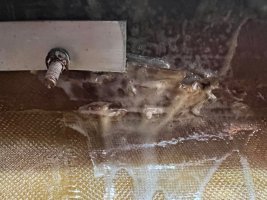
…which as you can see has dripped and drizzled its way down to cover some existing (probably circa 2001) wires here:
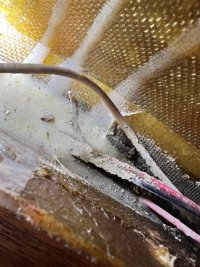
Obviously, I am replacing the wires, which lead to the v-berth lamp, and the forward running lights.
It simply amazes me, the things I’m finding.
…which as you can see has dripped and drizzled its way down to cover some existing (probably circa 2001) wires here:
Obviously, I am replacing the wires, which lead to the v-berth lamp, and the forward running lights.
It simply amazes me, the things I’m finding.

Out There
1988 E35-3 on Lake Erie
Dredging this back up...
I would like to add a float switch to my current diaphram pump and it is switched by a breaker at the panel. Reading @peaman's post #4 I should wire the float switch to the +pos wire between the fuse and the manual switch which I don't think can be done when the breaker is your "fuse" and switch. In this case will it work to wire directly from the battery via fused terminal block to the float switch and then continue to the existing pump?
I would like to add a float switch to my current diaphram pump and it is switched by a breaker at the panel. Reading @peaman's post #4 I should wire the float switch to the +pos wire between the fuse and the manual switch which I don't think can be done when the breaker is your "fuse" and switch. In this case will it work to wire directly from the battery via fused terminal block to the float switch and then continue to the existing pump?

Prairie Schooner
Jeff & Donna, E35-3 purchased 7/21
I took the circuit breaker out of the equation, as shown in post #29+/- of this thread.Dredging this back up...
I would like to add a float switch to my current diaphram pump and it is switched by a breaker at the panel. Reading @peaman's post #4 I should wire the float switch to the +pos wire between the fuse and the manual switch which I don't think can be done when the breaker is your "fuse" and switch. In this case will it work to wire directly from the battery via fused terminal block to the float switch and then continue to the existing pump?
Here's a look at the battery compartment.
We're the second owners of our 35-3 and it baffles me it never came with a float switch for the bilge pump.
peaman
Contributing Partner
To answer your question, yes, you should feed the float switch from a fuse wired directly from the battery.Dredging this back up...
I would like to add a float switch to my current diaphram pump and it is switched by a breaker at the panel. Reading @peaman's post #4 I should wire the float switch to the +pos wire between the fuse and the manual switch which I don't think can be done when the breaker is your "fuse" and switch. In this case will it work to wire directly from the battery via fused terminal block to the float switch and then continue to the existing pump?
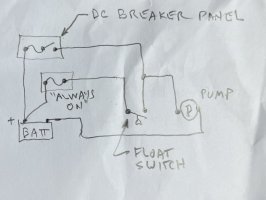
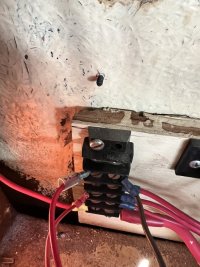
My sketch in post #4 was kind of rushed. The one below is a little more detailed. At my battery bank, I have a small fuse block which I use for "Always On" loads which cannot be switched off except by removing a fuse. The DC panel breaker feeds the pump directly for manual operation. The sketch doesn't show the pilot light on the DC panel, but it's useful to know that the pilot light will come on when the bilge pump is powered either manually through the breaker, or automatically by the float switch. I recently needed to replace my float switch, and to avoid having to remake several crimp connections, I decided to install a 4-post terminal strip high in the bilge for all connections, which really cleaned up the wiring and will make future pump or float replacement simpler.