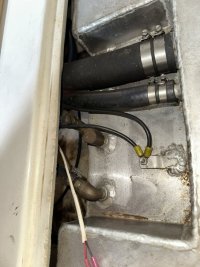
Diesel leak -- advice desired

N.A.

E34 / SF Bay
I just returned from a day out and found... a fair bit of diesel floating on top of my usual bilge water from the stuffing box. Not just a drop -- many ounces at least given the whole bilge area.

I looked for leaks -- fuel tank and its inlets/outlets, etc. No leaks seem to be under engine. None near fuel fill inlet. Racor is dry on the outside... Fuel tank not overly full -- last filled 5+ engine hours ago, and no issues in that time (multiple trips.) Bilge was dry at start of today's trip, so this is definitely brand new -- never seen this before.

Just not clear where it's coming from. Do tanks have breather hoses? It has been hot lately, so maybe that is related?

We'll be pulling up floorboards, etc., but the fuel lines are way back in hard to reach places...

So... any suggestions on where to look would be extremely welcome as we try to dig around looking... I expect some of you have run into leaks in weird places we might otherwise not think to look.

Boat is E34-2.
 

Loren Beach

O34 - Portland, OR
Senior Moderator
Blogs Author
I would start with all hose connections on or near the engine. If dry, then have a look at the bottom of the fuel tank for a pin hole leak. Have the fuel hoses all been replaced in the last 20 years?
Strong lighting and dry paper towels and cotton towels will be needed.
Good Luck!
 
Last edited:

bsangs

E35-3 - New Jersey
Which engine do you have @N.A.? And do you keep one of those absorbent pads underneath it? That would tell you right away if the leak was coming from the engine. On my Yanmar 3GM30F it was as simple as replacing an old o-ring on the secondary fuel filter (it has two). I'd think if you had a tank leak you would have seen it before now, unless it literally just occurred during your last trip. Good luck with the hunt.
 

JSM

Sustaining Member
In the past I have have lost small amounts of diesel when heeled over form the fuel gauge on top of the tank as the screws were loose and the gasket needed replacing.
Check all of your hose connections at the tank and also look beneath the tank and pathway from the tank to the bilge for signs of fuel migration to the bilge.
If your tank needs to come out it's a fairly simple job. Fuel can be pumped out via the fuel gauge hole and the tank fits thru the companion way.
Good luck !
 

Attachments

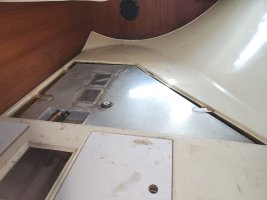
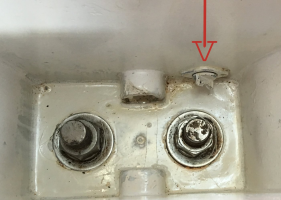
  • 20260325_114117.jpg
    20260325_114117.jpg
    163.1 KB · Views: 6

frick

Sustaining Member
in the 1971 E29, at year 36 my tank started leaking. It was a pin hole leak near a weld on the tank tie down system. I had a new tank made on Long Long Island for about 280 bucks. It was a drop in replacement so I was able to use the hoses (which had been replace years before when I switched from gas to diesel.

Another time, my yanmar lift pump started leaking and it filled in engine block with fuel. That was a mess to clean up.
 

Bless

New Member
I just returned from a day out and found... a fair bit of diesel floating on top of my usual bilge water from the stuffing box. Not just a drop -- many ounces at least given the whole bilge area.

I looked for leaks -- fuel tank and its inlets/outlets, etc. No leaks seem to be under engine. None near fuel fill inlet. Racor is dry on the outside... Fuel tank not overly full -- last filled 5+ engine hours ago, and no issues in that time (multiple trips.) Bilge was dry at start of today's trip, so this is definitely brand new -- never seen this before.

Just not clear where it's coming from. Do tanks have breather hoses? It has been hot lately, so maybe that is related?

We'll be pulling up floorboards, etc., but the fuel lines are way back in hard to reach places...

So... any suggestions on where to look would be extremely welcome as we try to dig around looking... I expect some of you have run into leaks in weird places we might otherwise not think to look.

Boat is E34-2.
if you have PINK anti freeze...that may be what it is??
 

N.A.

E34 / SF Bay
Thanks folks; deeply appreciated.

@bsangs -- engine is a Yanmar 3GM30F. Hoses may be original.

@Bless -- Thanks; had not even thought of that. Liquid feels oily, though -- I originally mistook it for oil -- so I suspect it is diesel. We'll double-check though.

We're headed down to the boat, but any further thoughts still appreciated -- if anyone does post, we'll see it: can check website (but not post myself) via phone from the boat.

Planned order of checks is:

1. Top of fuel tank (looked clean last night by flashlight): checking inspection ports, fuel sender/gauge, hose connections.
2. Check 'Fuel Fee Pump' to see if anything on it is leaking
3. Start checking everywhere else a hose connects on the engine (including the secondary fuel filter (thanks, @bsangs )
4. If all that fails, we start pulling up floorboards to try to track the flow of diesel into the bilge...

Again, any other suggestions re: places to look will help us as we dig around in there today.

PS: I don't have an absorbent pad under the engine right now, since there is so little room and I didn't want cloth in there to catch fire. I can put one in now and see if the leak is there (and will certainly be paying the price for not having one, in terms of cleaning the bilge*) but am still unsure about having one there all the time due to fire concern.

PPS * : How does one clean the bilge after this? I'm sure I can find a detergent (have 'Simple Green'), but detergent requires water to get out, and all that water will be diesel-y and thus toxic waste I have to take to the special center... tips appreciated re: that too. Assume wipe with rags as able, rather than flushing bilge, but tips on how best to do it (or what else to do) also welcome.
 

Christian Williams

E381 - Los Angeles
Senior Moderator
Blogs Author
I have had fuel leaks from:

Fuel gauge port on top of tank. Old gasket, loose screws.

Invisible spray from cracked fuel return line (between injectors). Only occurs when engine is running. Fuel drips down aft engine block, hard to see.
 

Christian Williams

E381 - Los Angeles
Senior Moderator
Blogs Author
clean the bilge

I would sop up with paper towels or fuel absorbent mats to get most out.

Use engine-oil extractor to suck out fuel that has gotten under the TAFG. Use TAFG access holes.

After that, flood bilge with detergent water and let bilge pump work. Some, er, discretion required in harbor (soapsuds), or pump out at sea.

We have all done some version of this, and had to repeat later as the TAFG releases further hidden treasure.
 

N.A.

E34 / SF Bay
@Christian Williams -- Thanks yet again.
  • Engine oil extractor: is that just a little pump for getting out engine oil? I have one with a long hose on it if that's what it is.
  • TAFG access holes -- assume these are obvious once the floorboards are up -- just holes int eh molding/fiberglass ribs?
 

Christian Williams

E381 - Los Angeles
Senior Moderator
Blogs Author
Sure, or any pump with a hose on it.

My boat has TAFG access holes in the bilge sumps, with screw-in plugs. But the holes apparently vary by model, and some people have drilled their own. Very hard to make the TAFG watertight, so we have to be able to drain it.

1780770997277.png
 

bigd14

Sustaining Partner
Blogs Author
I just replaced all the fuel hoses. The fill hose was original and showing signs of cracking. Between the lazarette and the space below the quarterberth is a very tight bend which could have developed a crack and be the source of the leak. The fill hose is slightly lower than the tank in this area so it’s constantly bathed in diesel. Feel around under there and see if you can feel any drips.

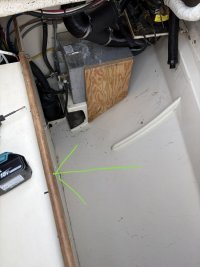
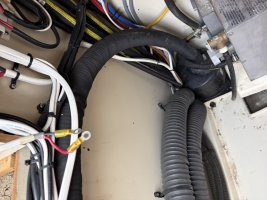
The fuel hose is hidden behind this panel in the lazarette which removes easily with about 10 screws. The holding tank may interfere but I removed mine so no issue there. Replacement of the fill hose wasn’t difficult, the hardest part was driving a new zip tie underneath the quarter berth to get the new hose as high as possible.

First photo, arrow points to removable panel.

Second photo, panel is removed, fuel fill hose and vent hose are hidden behind the blower hoses.

I got a fill hose that was more flexible than the normal ones and was very glad I did.


1780773555150.jpeg

1780773734538.jpeg
 
Last edited:

HerbertFriedman

Sustaining Member
Which engine do you have @N.A.? And do you keep one of those absorbent pads underneath it? That would tell you right away if the leak was coming from the engine. On my Yanmar 3GM30F it was as simple as replacing an old o-ring on the secondary fuel filter (it has two). I'd think if you had a tank leak you would have seen it before now, unless it literally just occurred during your last trip. Good luck with the hunt.
I have the original Universal M25X, The leak from the crack in the fill hose was not easily accessible but since the leak only occurred when I filled the tank, my guess was the fill hose. Sure enough when the tech pulled the hose, the crack was evident.
 

N.A.

E34 / SF Bay
Thanks both of you for the images -- really helpful. And I definitely had no idea about those TAFG plugs.

We're down in the bowels right now; looks like fuel residue under the tank, but no apparent

--> Is the fuel tank pressurized during operation?

There are 4 hoses attached to the tank... two big and two small (one with a stopcock on it -- assume that is the main fuel line to the engine.) Image below.

What are the other hoses? I assume 10 fuel fill, 2) vent line, 3) fuel line to engine, and 4) ???? (maybe a fuel return line? Is that under much pressure?) My Yanmar service manual is not very helpful here; fuel tank it shows is very different, with only one connection for gravity-driven flow.

Reason I ask is that there seems to have not been any/much additional leak overnight, so I am wondering if this only happens when engine running, maybe due to tank getting pressurized?

We are trying to clean it out and put a pad underneath, will run engine and see what shows up on the pad.

PS: Yanmar engine is original to this boat; boat is a later (1998) build by Pacific Seacraft. Fuel tank hoses look like this:
Fuel tank hoses E350.jpg
 
Last edited:

N.A.

E34 / SF Bay
Well, with luck the problem is identified:

Fuel tank is leaking slowly from forward lowest corner. Looks like drop may be forming about an inch to starboard, and running down to the low point. I now have an absorbent pad under there.

One confusing thing is that I pumped about 1.5 liters (quarts) of fuel (not water -- it separated in the (translucent) jug I used, so I could see the fuel vs bilge water), which is a lot more than just a few hours of dripping would seem to do... and the level in the bilge didn't seem to go up at all overnight (12 hrs)... so somehow maybe it must drip more when under way? We ran the egine in gear at the dock (2000 rpm; Yanmar full speed is 3000-3200) and the dripping did not seem to accelerate though... So a bit baffling.

But no leakage on/under engine (we put pad and checked that too.)

So off the the boatyard I go, I guess... I'll start a new thread on fuel tank leaks / fixing / options / suggestions.

Thanks so much for the help on this -- really appreciated. And enlightening how many people have had fuel leaks -- I hardly ever thought that could happen (though I knew where my stopcock was)... and yet apparently it's common.
 
Last edited:

Christian Williams

E381 - Los Angeles
Senior Moderator
Blogs Author
4) yes, return line. not much pressure. But be suspicious of the connections, since tank and engine nipples were different dimensions on my boats, and tempted jury-rigging.
 

bigd14

Sustaining Partner
Blogs Author
I think you have 3 and 4 reversed but the fuel return line could cause back pressure if something is plugged. Check the fuel vent fitting, maybe clogged or a wasp nest? Or maybe if it’s the tank it could leak more due to sloshing fuel when underway?
 
Top