32-3 Chain Plate Concern

windblown

Member III
Blogs Author
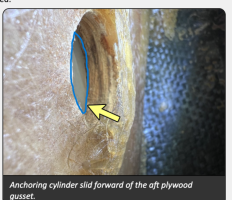
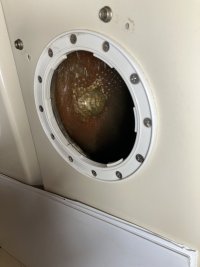
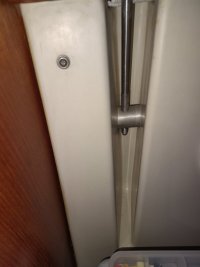
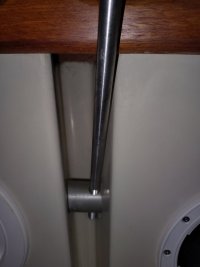
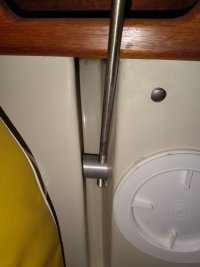
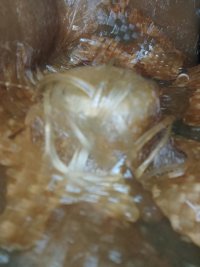
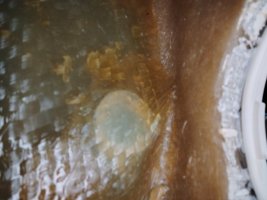
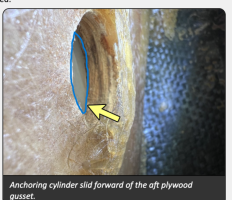
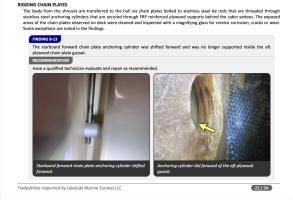
Our surveyor was very careful, which is a good thing, overall. He noticed that the forward-most rod leading from the deck down to the chain plates on the starboard side appeared to be farther forward in relation to the fiberglass structure than the others on the starboard side or than those on the port side. Closer examination showed that the cylinder into which the rod is screwed appears to have shifted forward in the plywood bulkhead. (Please excuse my terminology here; I'm not sure what some of the parts should be called, but the surveyor's description and pictures below should make it more clear.)
1773949951794.png
The image on the right makes it look like the cylinder is past the plywood gusset, but it is not. Also, the other end of the cylinder (forward) cannot be accessed for viewing; I assume that it rests against the bulkhead for the forward cabin. That bulkhead can be inspected from inside the hanging locker. I do not find any indication that the chainplate might be causing pressure on that bulkhead.

So, dear vikings, what say ye?
 

bigd14

Sustaining Partner
Blogs Author
Interesting. I seem to recall on my 30+ that the ends of the cylinder were glassed over to prevent just such an occurrence. Is there evidence of stress or damage to the gusset (I think they are called knees) where the cylinder pulled through it? There should be enough tension in the system to hold the cylinder in place unless the U-bolt chainplates have been replaced.

This would make me nervous. First I would try to determine how much bearing surface remains in the knee. I would then remove all tension from the tie rod, try to work it back into place, then re-tension it. If it still wants to move back to its current position once re-tensioned, I would try to remove the entire cylinder if accessible so you can see the bulkhead side and figure out why it crept forward that way. You could add a spacer to prevent it from moving forward or have a new, longer cylinder made.

Are you able to get any more photos of either end of the cylinder?

Edit: Full de-tensioning will likely require the ubolt chainplate to be removed, along with the rigging. Luckily it looks like this is the forward shroud which hopefully can be removed from the chainplate safely with the mast up (lash it to the toe rail or stanchion base?).
 
Last edited:

Kenneth K

1985 32-3, Puget Sound
Blogs Author
So, dear vikings, what say ye?
The surveyor's analysis would make sense to me IF that light green surface inside the wooden "gusset" hole was indeed the "anchoring cylinder."
tie rod.png
But it looks like fiberglass to me. I always assumed those cylinders were thick, hollow tubes, but I've never seen inside of one. Even if it were a solid cylinder, that's still doesn't look like what the picture shows.

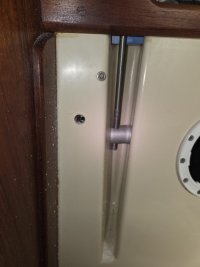
Also, I always assumed it was a single long rod (or tube), on the starboard side, that all 3 tie rods went through. Can you confirm that's not the case?
stbd.2.jpg
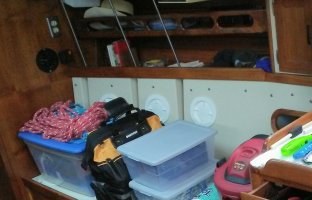
Next time I'm at the boat, I'll take a look inside those inspection ports to check.

I'd have no concern about drilling a small hole in that forward section of the molded sidewall to have a look inside with an endoscope.
 

Christian Williams

E381 - Los Angeles
Senior Moderator
Blogs Author
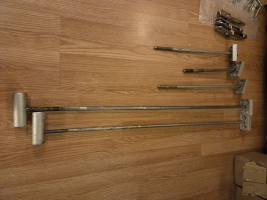
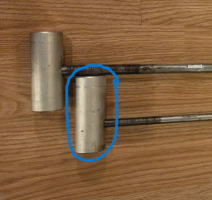
It's been a long time since my 32-3, but as I recall the chainplates had a deadman at the end--a cylinder like these.

1773972732480.png

You could see it through the inspection port installed by the factory. The deadman faced fore and aft, and I thought it was snug in a TAFG entrapment.

Well, not reliable memory. But what do you see when the inspection port is opened. Got a photo?
 

peaman

Contributing Partner
It's been a long time since my 32-3, but as I recall the chainplates had a deadman at the end--a cylinder like these.
That matches what I have. In the inspection ports, I can see a "dome" of fiberglass completely enclosing the end of the cylinder. Will check when I'm at the boat, but it seems to me that there is no way a cylinder could shift fore or aft at all.
 

bigd14

Sustaining Partner
Blogs Author
I wonder if this was just a factory miss where they forgot to glass the ends over. It would be easy to overlook. The 30+ definitely has separate solid aluminum cylinders same as Christian’s photo, not a single long one.

I also suspect there is no wood in those knees or gussets, I understand those to be part of the TAFG and wood is not suitable in such a high load area.
 

windblown

Member III
Blogs Author
The surveyor's analysis would make sense to me IF that light green surface inside the wooden "gusset" hole was indeed the "anchoring cylinder."
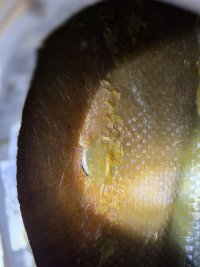
The area that you have circled in green is the aft end of the cylinder. I don't know how the surveyor captured this image; the physical gap between the fiberglass on the outside and the hole in the plywood is not wide enough for me to get a finger through to touch the cylinder--but I can get a screwdriver through to tap the cylinder. It is possible that there is some epoxy on the end of the cylinder.
View attachment 54814
But it looks like fiberglass to me. I always assumed those cylinders were thick, hollow tubes, but I've never seen inside of one. Even if it were a solid cylinder, that's still doesn't look like what the picture shows.
From what I have seen and felt, the cylinders are either solid, or they have some kind of end cap. I can definitely feel the flat surface at the end with a screwdriver tip, and it is feels like metal.
Also, I always assumed it was a single long rod (or tube), on the starboard side, that all 3 tie rods went through. Can you confirm that's not the case?
In our 32-3, there are three separate cylinders, one for each tie rod. Each cylinder runs into a hole in plywood at each end, and then the holes have been capped over with roving/fiberglass. On this section that the surveyor's camera captured, the orginal fiberglass apparently never completely covered the end of this hole; it bulges out toward the stern, almost as though the cylinder might have pushed out the glass before it hardened. There is no evidence of stress or damage to the fiberglass that I can discern.
I'd have no concern about drilling a small hole in that forward section of the molded sidewall to have a look inside with an endoscope.
Oh, I love the suggestion to drill a hole for an examination with the endoscope! Thank you!
 

windblown

Member III
Blogs Author
It's been a long time since my 32-3, but as I recall the chainplates had a deadman at the end--a cylinder like these.

View attachment 54816

You could see it through the inspection port installed by the factory. The deadman faced fore and aft, and I thought it was snug in a glass entrapment.
Deadman: a new term for me. Thank you. The aft end of this deadman can be seen through the access port that is between deadman 1 & 2. The surveyor's image captures that. There is no access port on the forward end. Next time I am at the boat, I will take Kenneth's suggestion and drill a hole to check out that end of this deadman with the endoscope.
Well, not reliable memory. But what do you see when the inspection port is opened. Got a photo?
Here's another photo from a different angle.
 

Attachments

  • 20260308_174932.jpg
    20260308_174932.jpg
    108.8 KB · Views: 16

windblown

Member III
Blogs Author
I also suspect there is no wood in those knees or gussets, I understand those to be part of the TAFG and wood is not suitable in such a high load area.
That's what I'm hoping. It doesn't seem that the tie rod could move any farther forward, because the TAFG "knees" would prevent that. The question would then be: is there enough of this deadman entrapped in plywood/and or fiberglass to assure that the chain plate is stable. If it's actually never moved, one might assert that 41 years of sailing with this rig as-is has been a reasonable test.
If there is evidence that deadman 1 has moved, the question of reliability is still open.
 

windblown

Member III
Blogs Author
That matches what I have. In the inspection ports, I can see a "dome" of fiberglass completely enclosing the end of the cylinder. Will check when I'm at the boat, but it seems to me that there is no way a cylinder could shift fore or aft at all.
This is where I hope we end up.
 

bigd14

Sustaining Partner
Blogs Author
I agree with Ken. if you loosen everything up as much as possible and try to shift the tie rod and deadman (I think we have agreed on the proper terminology!) aft with a pry bar and find you cannot, I would say don’t worry about it. It’s possible that the alignment of the hull, TAFG or deck was not quite right during assembly and thus the tie rod ended up offset forward in the gap between the knees. I have found many questionable construction details and bodged together bits over the years on three different Ericson models. These were truly hand-built boats.
 

Kenneth K

1985 32-3, Puget Sound
Blogs Author
Yeah, further along with what Doug is saying, if you look at the picture Christian posted, the deadman anchors don't look to be uniformly made. One has the tie-rod going right through the center, but the other one is offset. So, even if that lower deadman and tie-rod (below) appeared "centered" by visual inspection from the cabin, in reality, the deadman anchor would still extend further in one direction than the other.
1773972732480.png
 
Last edited:

Drewm3i

Marine Surveyor
I think you should take the surveyor's advice and look into it more--remove the inspection plate, look around with a light and see what you find. With the design Ericson used, as long as the chainplate anchor has fiberglass "gusset" to grab on to on both sides, I see no issue. From the pictures others have posted, it is clear that the threaded-anchor *may* be offset--if it is, this is likely much ado about nothing.

Does the threaded rod move when you yank on it in different directions/orientations?
 

Kenneth K

1985 32-3, Puget Sound
Blogs Author
as long as the chainplate anchor has fiberglass "gusset" to grab on to on both sides, I see no issue.
I think the surveyor's specific gripe was that the anchor needs to penetrate BOTH the plywood reinforcement and the fiberglass gusset.
 

peaman

Contributing Partner
The attached image shows how my cylinder ends were treated with the exception of two. One is inaccessible due to a bulkhead, and one is exposed with no covering fiberglass. The cylinder is solid. Each of the other ends is covered as shown with a couple layers of roving.IMG_0877.jpeg
 

Kenneth K

1985 32-3, Puget Sound
Blogs Author
FYI. Inspected my tie rods yesterday. The forward stbd one is slightly off-center, but not as much as Deborah's.

IMG_20260321_195504470.jpg

The aft two chain plates on the port side are displaced fully forward.
IMG_20260321_200423469.jpg
IMG_20260321_200323341.jpg
All of the deadman cylinder ends are glassed into place and wouldn't be able to move.
IMG_20260321_200516958.jpg. IMG_20260321_200640756.jpg
 

Loren Beach

O34 - Portland, OR
Senior Moderator
Blogs Author
If you turn each suspect rod enough to "loosen" it, see it you can gently pry the aluminum bar/anchor forward/aft as appropriate. Just count the number of "flats" you turn that Navtec rod, and write them info down so you can tighten it back up properly.
If the aluminum round-bar does move, consider dropping a half piece of heavy PVC tubing over it to lock it into a center position; and seize the added "spacer" in place.
(Advice and suggestions rendered from a safe distance, no guarantee.)
 

windblown

Member III
Blogs Author
Thank you all for the input and for the images and comparison with your vessels!
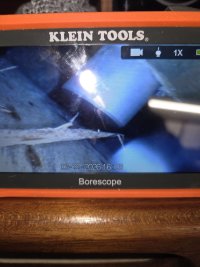
I drilled a hole for the beroscope today. I was surprised to find that the deadman in question wasn't really glassed in on that forward end!
20260322_162444.jpeg
Here's my new "access hole."
Please accept my apologies for this terrible image from the scope; I neglected to take an SD card with me, so this is my attempt to capture the scope image with my phone. I'll update this with a better image later this week, when I get back to the boat.

20260322_162828.jpeg
The splinter of wood on the left had me concerned, but it's much smaller that it appears in this image, and I was able to determine it was probably caused from the installation of the bolt coming through the bulkhead from the interior of the hanging locker. I'm not concerned about it. It will be clearer in the next image.

On the other side of this deadman (to aft), I was able to measure how far "into the hole" the deadman sits. In this this image that Ken annotated, the end of the deadman is less than 1/4" from the outer edge of the opening. It is still held by some plywood and glass.
1774225925445.png

After the winter cover comes off in another three weeks, I'll try some of the suggested adjustments to see if I can move tie rod and deadman aft.
 

bigd14

Sustaining Partner
Blogs Author
Definitely looks like the deadman is displaced forward, but whether it has been that way since it was installed or is a more recent shift seems important to determine. I will be really interested to see if you are able to shift it aft. It looks like the chainplate location in the deck above is centered between the knees so it seems unlikely that the deadman would just shift forward all on its own. I would guess it was installed that way. Are you able to drill a small hole the bulkhead and reach the forward end of the deadman without damaging or weakening anything important or outwardly visible? I am thinking if the deadman can be moved aft then you could glass it over through such a hole. Alternatively you could wedge something around the tie rod to keep it centered between the knees. That would be much easier!
 
Top