Guest viewing is limited
  • Untitled Document

    Join us on May 22nd, 7pm EDT

    for the CBEC Virtual Meeting

    EY.o May Zoom Meeting

    All EYO members and followers are welcome to join the fun and get to know the people you've met online!

    See the link below for login credentials and join us!

    May Meeting Info

    (dismiss this notice by hitting 'X', upper right)

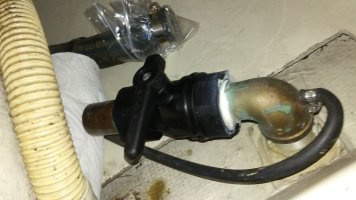
Broke the small fitting on the exhaust through hole.

JohnW

Member I
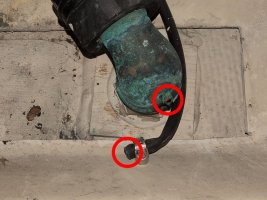
While fiddling with the raw water siphon break hose, I broke the small fitting on the elbow connected to the exhaust through hole. Is this an off the shelf part? Is it still available?

I thought about buying a 316SS 1-1/4" pipe fitting from McMaster then drill and tap for a 1/4" barb fitting (~$90), is this a viable solution or is there a better way.

I did a search of the forum, but couldn't find an answer. Where do you guys connect the other end of the siphon break hose to?

Luckily the exhaust through hole is above the water line. Any suggestions on how to remove the bronze elbow?

thanks,
John E32-3_ExhaustThoughHole.jpg
 
Last edited:

Prairie Schooner

Jeff & Donna, E35-3 purchased 7/21
While fiddling with the raw water siphon break hose, I broke the small fitting on the elbow connected to the exhaust through hole. Is this an off the shelf part? Is it still available?

I thought about buying a 316SS 1-1/4" pipe fitting from McMaster then drill and tap for a 1/4" barb fitting (~$90), is this a viable solution or is there a better way.

I did a search of the forum, but couldn't find an answer. Where do you guys connect the other end of the siphon break hose to?

Luckily the exhaust through hole is above the water line. Any suggestions on how to remove the bronze elbow?

thanks,
John

Hi John,

I pondered this when rebuilding our exhaust & cooling system. The vent you're referencing is discussed here and elsewhere in that exhaustive and exhausting thread. (sorry for the pun) It seemed to me this was originally a copper tube brazed into a bronze fitting. (a mixing of metals which could have galvanic problems)

Three options occur:

One, do a 1:1 replacement as you suggest. I don't see why it wouldn't work. Maybe something similar is available from a marine supplier that would save you the build time.

Two, install a separate small thru-hull for that small hose. It would involve drilling another small hole in the transom. Plug the little hole on the existing fitting by drilling out, tap, and plug with a bronze screw. This version will create a separate little stream of water out the back of the boat.

A third is install an anti-siphon valve, eliminating the weep hose. I opted against this because it involved a part that should be checked yearly in an inaccessible place.

Our exhaust fitting with little tube was solid enough to reuse as it was. I can see an advantage for the second option because, though it looks a little odd, at least you have a visual on whether it's plugged or not.

Jeff
 

Loren Beach

O34 - Portland, OR
Senior Moderator
Blogs Author
Two, install a separate small thru-hull for that small hose. It would involve drilling another small hole in the transom. Plug the little hole on the existing fitting by drilling out, tap, and plug with a bronze screw. This version will create a separate little stream of water out the back of the boat.
That was the stock design concept for the Olson 34 (with the Universal M25XP installed. When I replaced it with a Betamarine25, I was told that the separate discharge was not needed, so we did not do that. FWIW, a friend with an E-33RH, had his replumbed to a separate quarter inch discharge on one side of the stern -- always looks funny to me to see the small water stream "peeing" out when he's motoring. :)
 

bigd14

Sustaining Partner
Blogs Author
Two, install a separate small thru-hull for that small hose. It would involve drilling another small hole in the transom. Plug the little hole on the existing fitting by drilling out, tap, and plug with a bronze screw. This version will create a separate little stream of water out the back of the boat.
I have this arrangement on my 30+ and it works well.
 

JohnW

Member I
Hi John,

I pondered this when rebuilding our exhaust & cooling system. The vent you're referencing is discussed here and elsewhere in that exhaustive and exhausting thread. (sorry for the pun) It seemed to me this was originally a copper tube brazed into a bronze fitting. (a mixing of metals which could have galvanic problems)

Three options occur:

One, do a 1:1 replacement as you suggest. I don't see why it wouldn't work. Maybe something similar is available from a marine supplier that would save you the build time.

Two, install a separate small thru-hull for that small hose. It would involve drilling another small hole in the transom. Plug the little hole on the existing fitting by drilling out, tap, and plug with a bronze screw. This version will create a separate little stream of water out the back of the boat.

A third is install an anti-siphon valve, eliminating the weep hose. I opted against this because it involved a part that should be checked yearly in an inaccessible place.

Our exhaust fitting with little tube was solid enough to reuse as it was. I can see an advantage for the second option because, though it looks a little odd, at least you have a visual on whether it's plugged or not.

Jeff
Hi Jeff,

Thanks for the link to the discussion. The master thread is another very informative rabbit hole.

Option 3 is out. Both you and Calder's book recommend against it.

I thought about Option 2, however while inspecting the exhaust outlet yesterday I noticed the hose clamps were heavily corroded and one of them had already broken off. I ended up removing the entire exhaust hose. The muffler end came off easily while the outlet side was quite difficult to remove and had fused to the bronze hose coupling. I had to cut and peel the end off.

Now that the exhaust hose is out I will try to remove the Marelon ball valve and go with option 3. Hopefully a larger adjustable wrench and plenty of kroil will loosen the ball valve from the bronze elbow. The plan is to drill on Bridgeport then hand tap, though I don't know if the elbow wall is sufficiently thick.

On a side note, working on the E32-3 is incentivizing me to loose some weight. Had to awkwardly dive head first into the aft locker to work on the exhaust outlet. My belly kept getting caught on the ledge of the locker whenever I back out. What a psychologically embarrassing and physically painful experience.
 

Prairie Schooner

Jeff & Donna, E35-3 purchased 7/21
@JohnW

"Now that the exhaust hose is out I will try to remove the Marelon ball valve and go . . ."
I was trying to figure out what you meant by "ball valve" then looked at your picture more carefully. There's a ball valve before the exhaust thru-hull??!! Ours doesn't have one there and I've never heard of doing that. Intuitively, it sounds sketchy to me. I'll be interested if anyone else has thoughts on that. I think you can just leave the valve out of the equation.

". . go with option 3."
Is that a typo? Did you mean option 1?

". . Had to awkwardly dive head first into the aft locker to work on the exhaust outlet. . ."
Truth. Seriously, I never go into the caves without my cell phone within reach. By the end of spring commissioning I'm definitely more limber.

"The plan is to drill on Bridgeport . ."
Sweet. You must have a nice shop available.
 

bigd14

Sustaining Partner
Blogs Author
My belly kept getting caught on the ledge of the locker whenever I back out. What a psychologically embarrassing and physically painful experience.
This is no joke. I had an experience in the aft locker of the 30+ where I squeezed a little too far down headfirst, compressing my rib cage which then expanded back out and then was caught on that lip. I was truly stuck with nobody around. I had very little leverage. Once I realized my plight, I kind of freaked out and adrenaline kicked in and I managed to force my way back out, with badly bruised and abraded ribs. Really scary!
 

JohnW

Member I
@JohnW

". . go with option 3."
Is that a typo? Did you mean option 1?

Yes, it was typo. I meant Option 1.

As usual, execution differed from original idea. Instead of drilling and tapping a 316SS elbow, I bought a 1-1/4" Bronze T-fitting and a couple reducer bushings to fit the 1/4" barb connector for the raw water siphon break hose. I used Vibra-Tite 481 for the plastic to bronze fittings, and Loctite 565 for the bronze to bronze/brass fittings.

I also move the exhaust one thru hole aft, to the position as illustrated on the manual and will reroute the outer starboard drain to the old exhaust thru hole. Currently the outer starboard drain shares the same thru hole with the galley sink.
Ericson32-3_ExhaustRefit_20260510.jpg
 

JohnW

Member I
@JohnW - What's the reasoning behind the ball valve? I've never seen that, and it seems like it would restrict exhaust flow.

I don't know and I do not have the experience yet to deviate from what's already installed. One of the many mysteries of a 40 year old boat with 3 previous owners, without a ship log documenting all the changes throughout the years.
 

Christian Williams

E381 - Los Angeles
Senior Moderator
Blogs Author
My belly kept getting caught

It can be quite scary to crawl in among hoses with feet higher than head. Work is done while holding pushup position. Exit requires squirming backward uphill. I often have felt DOA already if rescue were ever required. "He died doing what he loved, the idiot."

I now leave a note in the cockpit that says "DNR." Not that they would bother, of course, since decomposition would likely be advanced.
 

Prairie Schooner

Jeff & Donna, E35-3 purchased 7/21
Last edited:

Kenneth K

1985 32-3, Puget Sound
Blogs Author
20171210_152915.jpg
I have one of those too. It came with the boat. I just assumed there was some boatbuilder rule about, "every through-hull having a shut-off valve." Maybe not. I close mine every winter, after winterizing the engine. I've wondered if that limits the salt-water-laden air contact with the exhaust valves, but probably not. And that would also depend on whether or not you drain the lift-muffler for the winter.

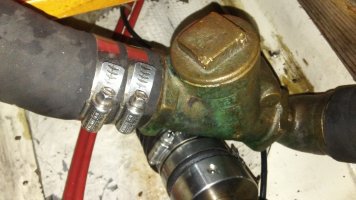
Another peculiarity occasionally posted here is the one-way check valve installed in the exhaust line:
20170125_210946.jpg
This was installed at the low point between the exhaust elbow and the lift-muffler. It seems someone was concerned about water backflowing into the engine. I removed it because of concerns about flow restrictions and the potential for it sticking closed.
 
Last edited:

Loren Beach

O34 - Portland, OR
Senior Moderator
Blogs Author
Regarding the install of a shutoff valve for the exhaust exit: I recall that back in the 70's some (not a lot, but "some") ocean crossing sailors would put one of these valves on their boat --- purpose was said to be to exclude a following sea in a rough or storm situation from having water repeatedly forced into the exhaust system and then on into the engine. They had various methods to remind them to open this up when they would again need to motor. (!)

Of course, back in those days there was likely much less electrical storage "load" since even LORAN was not yet common in use and the galley cooker was probably kerosene, and perhaps the lighting was also kerosene. They may have been able to sail a lot further before needing to charge up a battery with the engine. (?)
I see nothing wrong per se with conservative thinking, and speculate that some prior owner was planning and studying about sailing to Tahiti, and was equipping his Ericson according to what he believed was needed. Then again, much of that old advice was from owners of heavy displacement boats like the WestSail, where they slogged slowly thru dirty weather with big seas constantly pummeling their boat.

Speculation offered with no guarantee or warranty. :)
 
Last edited:
Top