Guest viewing is limited

Do-It-Yourself Rigging Check

Christian Williams

E381 - Los Angeles
Senior Moderator
Blogs Author
This is Jerry Henwood, who in a 45-minute seminar on rigging checks is not to my mind all that irritating, which is more than can be said by other such lecturers.


His points caused me to have yet another look at my own rig, where I was surprised to find several remaining split rings to be replaced with cotter pins "of as large a size as possible." I haven't personally climbed the mast lately (well, ever on this boat), but I intend soon to bring my video camera, with tripod, and zoom in on the spreaders, T-connections, and sheaves. I have found in the past that that can reveal issues requiring a professional inspection.

I recently took off the genoa for repair, and was able to confirm, and then replace, the monel safety wire on the screw-pin halyard shackles (twist-pin or snap shackles are all wrong for working halyards).

Eyeballing our own rigging requires deep suspicion and a magnifying glass, and is only an interim maintenance check. A qualified rigger needs a periodic look, I believe, since I have missed so many issues myself over the years despite an unusually high regard for the mirror.

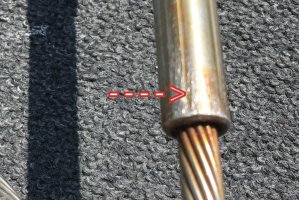
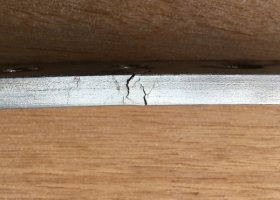
Here is a T-bolt from the 32-3, which a rigger discovered from a bosun's chair. And an example of a near-invisible hairline crack that requires immediate replacement of any swage.
t-bolt crack.jpg...IMG_0589.JPG

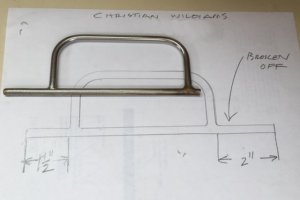
The backstay chainplate of the 381 was obvious (although the surveyor never saw it). Interesting view from the side, I think you'll agree.
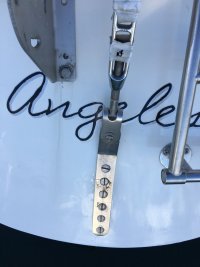
backstay chainplate break .JPG...3-chainplate side.JPG

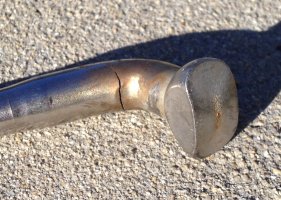
Our standard gooseneck is cast aluminum, elderly, and subject to failure at the stress points. The simple pin for the anchor locker illustrates how any weld is subject to deterioration over time. We are told to view all welds with suspicion.
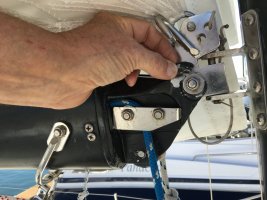
gooseneck break aluminum casting.JPG...1-anchor locker lid.jpg
 
Last edited:

cowlum

Member I
I removed and rebuilt my mast a couple years after a bought it. It was apparent once it was on the ground that the head stay rigging pin was without a cotter pin. It had been held in with pressure only probably since one of the previous owners had the furler installed. Possibly if someone had applied too much pressure to the jib halyard it may have just slipped out.
 

supersailor

Contributing Partner
Scary. I found something similar on Terra Nova but with different systems. Every below the waterline through hull hose connection had two clamps and only one was tightened and this was done by a "Professional". Double check everything.
 

Loren Beach

O34 - Portland, OR
Senior Moderator
Blogs Author
IMO.... a contentious & attentive amateur and a Professional can do equal quality work. The Pro can do it a tenth of the time. Trick is find a qualified pro... !

(A local ship wright just did the re-install of our new steering cable & 'bicycle' chain assembly yesterday. I helped with tools and the part where it was good to have a person in the cockpit to help lower the cables down to the person below. Tom has done a lot of these over the years and I saw a lot of little production details that I had not thought of before.)
 

David Grimm

E38-200
One of the first things mentioned in this video is know the make of your mast. I was a little embarrassed not having a clue. Does anyone know who made the mast on Ericsons? In particular my 1986 38-200? I looked for a label or stamp but came up with nothing .
 

Christian Williams

E381 - Los Angeles
Senior Moderator
Blogs Author
Probably a Kenyon. Not every mast of the era was tapered like Kenyon. Rig rite has dimensions of many brands of spar, which I used to prove to myself that my boom was a Kenyon section.

Yeah, far as I know Kenyon didn't put on an obvious makers's mark. Also, some were color anodized (black) and some were painted (white?).
 

Loren Beach

O34 - Portland, OR
Senior Moderator
Blogs Author
A rather durable Kenyon "K" vinyl logo circle on our spar, altho it may have worn off. I will try to remember to look.
 

southofvictor

Member III
Blogs Author
Found this thread today and really enjoyed the video in Christian’s original post. A simple and practical primer on rig inspection.
My search was prompted when another 38-200 joined us at the dock at Marina Puerto Escondido this week and one of the fist things I noticed was a different mast section. While our mast doesn’t have any logos on it I’m pretty sure it’s a Sparcraft FM-460 section. His mast is a Kenyon and much more oval section than our more rectangular one. Interesting to see such different masts on our boats given that the hull numbers aren’t too far apart.
 

N.A.

E34 / SF Bay
Some of us have Lefeill spars (some of the Pacific Seacraft-built Ericsons, anyway).

And a rigger came to look at my boat Friday and... discovered that if the rigging hadn't failed the way it did, it was waiting to fail another way. My take-home from this, aside from upping the quality of my own inspections (which honestly would never have caught the failure that happened), is to have a real rigger* inspect at least every 5 years.

* NOT the boatyard. They inspected every 2-3 years and missed all of this too. And the yard is one of the ones around here that people trust. In the future I am asking someone whose only job is rigging.
 

bigd14

Sustaining Partner
Blogs Author
What was the other point of potential failure? And was there any other damage from the thru bolt coming loose?
 

southofvictor

Member III
Blogs Author
In the future I am asking someone whose only job is rigging.
We won a free rigging inspection from Port Townsend Rigging last year. The detail and thoroughness was impressive. I took four pages of notes. Well worth paying for in the future.
 

N.A.

E34 / SF Bay
The other issue is a crack in a swage.

Unclear if the bolt is OK; rigger says he thinks it probably is, but it's way up there. He says what I can see is just a sleeve the bolt goes in, that prevents mast compression when the bolt is tightened. Bolt must still be inside somewhere. I'll know when he gets it off, but his guess is that the nyloc nut came off -- apparently there is no castellation/pin to hold it, though I think he said they usually peen the end a bit (seems like that would mess up the bolt; maybe I misunderstood.) I did look up there not long before it failed, so if the nut was backing off it wasn't very obvious. Of course, 36 hours bouncing around in a significant swell may have changed the story. No obvious other damage, but again, mast not down yet.
 
Top