
Guest viewing is limited
- You have a limited number of page views remaining
- 23 guest views remaining
- Register now to remove this limitation
You are using an out of date browser. It may not display this or other websites correctly.
You should upgrade or use an alternative browser.
You should upgrade or use an alternative browser.
No Water From Engine Exhaust (Master Thread)
- Thread starter K2MSmith
- Start date

K2MSmith
Sustaining Member
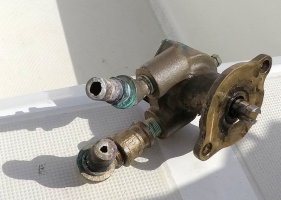
My wife ( aka “the nuclear power plant design engineer - ret.” ) suggests that the L fitting may be flow restricted by design . The inside appears to be clean but inflow / outflow connected by a smaller hole inside. This is to prevent over pressuring the downstream component ( the elbow ) . So she said I should be cautious about putting any old fitting on it . ’mmmm

The fitting that came on my Yanmar mixing elbow is straight.
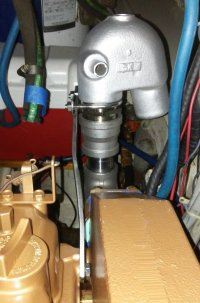
I don't think the hose fitting is a "designed" flow restriction. As water passes from the hose to the mixing elbow it enters a larger ID water jacket at the top of the elbow.
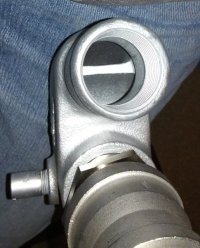
When the cooler seawater hits the hot exhaust elbow, it vaporizes and leaves behind mineral deposits. With an L-shaped hose fitting, much of this is happening at the bend in the fitting itself. That is where my OEM fitting was blocked.
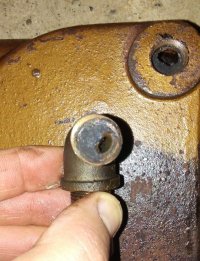
A straight fitting should clog less quickly, however that may just mean that more mineral buildup is occuring inside the water jacket.
If there is a design element to the L-shaped hose fitting, I'd guess that is it: To cause the flash-boiling and buildup to occur outside of the water jacket, in a fitting that is easily removable.
I don't think the hose fitting is a "designed" flow restriction. As water passes from the hose to the mixing elbow it enters a larger ID water jacket at the top of the elbow.
When the cooler seawater hits the hot exhaust elbow, it vaporizes and leaves behind mineral deposits. With an L-shaped hose fitting, much of this is happening at the bend in the fitting itself. That is where my OEM fitting was blocked.
A straight fitting should clog less quickly, however that may just mean that more mineral buildup is occuring inside the water jacket.
If there is a design element to the L-shaped hose fitting, I'd guess that is it: To cause the flash-boiling and buildup to occur outside of the water jacket, in a fitting that is easily removable.
K2MSmith
Sustaining Member
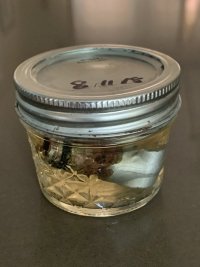
Conclusion: the L-fitting was clogged. Soaked in vinegar for 48 hours and then cleaned it with a bottle brush . An iPhone light is good for this task . Took about an hour to clean. You can shine light in one end and see how clear it is in the other . The fitting has no built in restrictions . It was narrowing due to the buildup . Reassembled everything and now I have 2-3 times water flow that I had before it clogged completely, but I didn’t know what was normal flow because I think it’s been partially clogged since I bought the boat . I’m looking forward to lower engine temperatures when I motor out next time .
Thank you all for your generous assistance and support. It is very much appreciated !
Thank you all for your generous assistance and support. It is very much appreciated !

Good to be reminded. Our engine plumbing is full of 90-degree turns, which typically suffer salt buildup, if nothing else. And it's easy to clear.
Pete the Cat
Sustaining Member
A 5/16" socket works well on most hose clamps. I use a socket on the end of an electric screwdriver or compact drill driver. This speeds up the process a lot and makes it easy. This setup is cheap when compared to taking things to the boat yard. After 40 years, I have learned to invest in the specific tools for various jobs on my boats so that I am not reluctant to pull things apart and inspect and service them. It is also possible that you have a blocked connection to the exhaust elbow water injection site--the injection point in the elbow is vulnerable to clogs. Might be time to pull that off if problems coninue. Heat exchangers need regular service and exhaust elbows are meant to be inspected replaced periodically. Worked on mine today when replacing the zincs.Thanks for the info and thread Christian. That address for the radiator shop you used in LA (Blanco Brothers) looked familiar and as it turns out its just a few blocks from my mother-in-law’s house in Koreatown. The Drake tool looks like an oversized dental pick. Not sure how to use it, but it‘s cheap enough to order. (and all the tools I’ll ever need will cost must less than a trip to the marine diesel mechanic). You’re right about getting a small socket wrench..I ended up buying a small 3” 90 degree ratchet screwdriver wrench, but I think just a small 1/4 socket wrench would work better (which I don’t apparently have)... Add an LED headlamp to the list, especially with my poor near vision.
E38--Heat Exchanger Blockage Resolved
I haven't been sailing since the January 7 fire, but since our temporary apartment is walking distance from the slip, I can at least run the engine every week or so to keep its intestinal fluids moving. When I did, a few days ago, nothing came out of the exhaust except hot air. Nothing. Not a...
Housekeeping:
 ericsonyachts.org
No water exiting my engine.
Hi all, hoping for some help with this. There isn't any water exiting my boat. I have a Yanmar 3GM30F engine. The seacock for raw water will open and close. The raw water strainer is clean. The impeller looks good (see pictures) yet still no water coming out the back of the boat. Does anyone...

Aqua V
Member I
A "Vent Loop"... simple but will clog at the vent at the apex of the loop. The one in the fitting looks old style and bronze, the cap covers a unique seal lets air in, blocks water keeps siphon lock in check. In your case the cap also includes the hose fitting for exit. Had to install new ones for the head sink plumbing and the exhaust system on a new M25, my old M15 had a different set-up. The plastic ones have a directional vane which you have to pay attention to... I know the old vent loops had A fiber gasket with a hole and mine were gunked up, cleaned them so well I destroyed the seals.Here is the usual setup (pic stolen from goldenstate):
View attachment 43304
The left hose comes from the heat exchanger. The right goes to the injection elbow. Between the 2 larger hoses is a T-fitting from which the smaller anti-siphon vent hose originates.
SIPHON-BREAK
For installations where the exhaust manifold/water injected exhaust elbow is close to
or will be below the vessel’s waterline, provisions must be made to install a siphon-break
in the raw water supply hose to the exhaust elbow. This hose must be looped a
minimum of 20” above the vessel’s waterline.
Failure to use a siphon-break when
the exhaust manifold injection port is at or below the load waterline will result in
raw water damage to the engine and possible flooding of the boat.
If you have any doubt about the position of the water-injected exhaust elbow relative
to the vessel’s waterline under the vessel’s various operating conditions, install a
siphon-break.
NOTE: A siphon-break requires periodic inspection and cleaning to ensure proper
operation. Failure to properly maintain a siphon-break can result in catastrophic
engine damage. Consult the siphon-break manufacturer for proper maintenance.
Cheers and good luck!
A siphon break is any device or connection that allows air to enter to a hose/pipe to break the low-pressure pull of water in the down-sloping hose side of the hose."Vent Loop" vs SIPHON-BREAK
A vented loop is a type of siphon-break where a device near the apex admits air into the loop. That device is often either, a) a second hose that's vented to the atmosphere, or, b) a one way check valve.
As there are no moving parts to (a) it is less likely to clog, stick, or become blocked than (b).
Aqua V
Member I
Thank-You,,, I meant to include a disclaimer in my post, this is my first boat and still learning, that's why I'm here. The head plumbing includes a hose to a small vent in the hull, the sink does not. Is the hose configuration recommended?A siphon break is any device or connection that allows air to enter to a hose/pipe to break the low-pressure pull of water in the down-sloping hose side of the hose.
A vented loop is a type of siphon-break where a device near the apex admits air into the loop. That device is often either, a) a second hose that's vented to the atmosphere, or, b) a one way check valve.
As there are no moving parts to (a) it is less likely to clog, stick, or become blocked than (b).
Last edited:
Not sure what your question is. If the head plumbing was built with a loop vented to a hose, then Ericson considered that the "recommended" configuration. If something in your head plumbing is not working, you can either replace what Ericson did, or try to find a better way of re-plumbing things. If you have a specific problem, I'd post it in detail here--others have probably had similar issues and can weigh-in on fixes. If it's working as-is, I'd leave it alone, but you are doing the right thing by inspecting and learning how these systems work.The head plumbing includes a hose to a small vent in the hull, the sink does not. Is the hose configuration recommended?
A sink doesn't need a vented loop as no siphon is developed--it's just a gravity drain. However, even this can be a problem. Some have reported that under heaving heeling, sea water can fill and overflow the (now tilted) head sink if the drain seacock is left open. This is not a problem for the galley sink because the galley sink drain is located closer to the center of the hull.
Last edited:

Data point: the factory did not plumb in a syphon break for any of our head hoses.
The engine exhaust did have the peculiar-to-Universal (?) syphon break with a quarter inch hose back to the transom from a high point in the engine bay where it was T-ed into the water injection towards the muffler.
Regarding the head sink drain... we did manage to flood the head countertop with water splashing up from the basin while rail down in choppy seas during the first season. Lesson learned -- about closing the sea cock for that one sink on a "brisk" day!
The engine exhaust did have the peculiar-to-Universal (?) syphon break with a quarter inch hose back to the transom from a high point in the engine bay where it was T-ed into the water injection towards the muffler.
Regarding the head sink drain... we did manage to flood the head countertop with water splashing up from the basin while rail down in choppy seas during the first season. Lesson learned -- about closing the sea cock for that one sink on a "brisk" day!
Aqua V
Member I
Apologies gentlemen, my boat is not an Ericson its a Pearson 32 see my signature with a M25 vice the production M15, long story. Doing research on M25 installs and linked here, discovered it was full of M25 goodies! I've found the technical advise on this site much more active and diverse.
I had relocated the bilge pump and modified some sink plumbing (stbd), this is where I encountered one vent loop (bronze) and a siphon break and replaced the whole loop with a plastic version. The head plumbing (port) vented loop is also bronze and up at deck level with a fitting on the top with a hose to a small hull fitting. I've have not touch this. Both set-ups are agaisnt the hull, overflow hoses down into a sump into the bilge.
As much as I want to get this boat in the water, keeping above said water is pritoty one.
I'm now considered a "Grey Beard" in my profession, still shaving peach fuzz in here! Just getting a taste of the knowledge base in here!
I had relocated the bilge pump and modified some sink plumbing (stbd), this is where I encountered one vent loop (bronze) and a siphon break and replaced the whole loop with a plastic version. The head plumbing (port) vented loop is also bronze and up at deck level with a fitting on the top with a hose to a small hull fitting. I've have not touch this. Both set-ups are agaisnt the hull, overflow hoses down into a sump into the bilge.
As much as I want to get this boat in the water, keeping above said water is pritoty one.
I'm now considered a "Grey Beard" in my profession, still shaving peach fuzz in here! Just getting a taste of the knowledge base in here!

bsangs
E35-3 - New Jersey
That's too funny. Had that happen once also, and after spending 30 minutes checking ABOVE the head sink for where the water was intruding (since it wasn't pooled in the sink), the light bulb went on. Was quite a relief actually. It's always comforting when you realize these things happen to salty vets like yourself. Kind of like having to go the principal's office with a friend instead of going solo.Regarding the head sink drain... we did manage to flood the head countertop with water splashing up from the basin while rail down in choppy seas during the first season. Lesson learned -- about closing the sea cock for that one sink on a "brisk" day!