Olson 34 - B&G Instrument Install - Speed Transducer Question

mschrager

Junior Member
Finally started this project, updating all old Raymarine ST60 Seatalk network to a B&G NMEA network. Our masthead wind instrument broke, the old system had some sketchy wiring, and it was time. I purchased the Triton 2 Speed/Depth/Wind Pack wired that comes with DST810 Speed Transducer as well as a series of other goodies for the new setup.

We installed the Triton 2 Displays into the original instrument hood, V60B AIS/VHF back in the cockpit, and a few other bits like a Wifi adapter and Precision Micro compass all with "relative" ease mind a few headliner pains.

When we went to update the transducer from the old unit to the new DST810, the new units diameter was too large to fit into the current through-hull. The unit currently in the boat has no markings or numbers. The cable does denote Airmar. I measured the diameter, and it came to 1 1/4" for just the unit with the paddlewheel. I am really hoping to not have to update my through-hull after just hauling the boat and redoing the bottom a few months ago...

Two options I thought of:
1.) Keep the old Transducer in place, and connect it to my NMEA network. I have no idea if this unit can "talk" NMEA. It has the right number of wires coming out (5) with colors: red, brown, yellow, green, white. Ideal solution, but can it talk NMEA 2000? Anyone done this?

2.)Get the right size transducer to fit into the current setup. Any recommendations here?
 

Attachments

  • IMG_1712.jpeg
    IMG_1712.jpeg
    77.1 KB · Views: 16
  • IMG_1718.jpeg
    IMG_1718.jpeg
    89.3 KB · Views: 16

Slick470

Sustaining Member
I went through something similar when I upgraded our instruments from Autohelm ST50's to B&G Tritons. We opted to just go ahead and replace the transducer housing. It was a bit of a pain to cut out the old one but it wasn't too bad as far as boat projects go. The hole in the boat was big enough to support the larger transducer housing so I didn't need to make it bigger. We also had a separate depth transducer so had a hole to fill. That was definitely the bigger project.

As far as will the existing sensor work with the newer NMEA 2K system. My understanding is it will not directly connect without a some sort of converter.
 

peaman

Contributing Partner
Raymarine's Seatalk is proprietary and distinct from their "SeatalkNG". The latter is generally compatible with NMEA2000 ("N2K") networks. The former, "Seatalk" can work within an N2K network with a converter from either Raymarine or ActiSense.

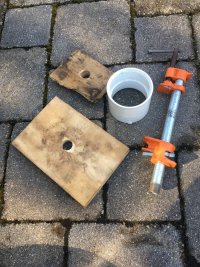
To be clear, when you describe your "through-hull", are you referring to the plastic sleeve that the sensor fits in, or are you referring to the actual hole through your hull? If it is the former, removal and replacement of the sensor sleeve may be fairly easy if the boat is out of the water. I did that myself with an ad hoc combination of plywood, PVC fittings and a Pony Clamp (see images). The hole in my hull was exactly the right size for installation of the new sleeve for my new B&G DST810 transducer, with no modification required.

Image below shows a 2" PVC coupler which has been slotted to serve as a wrench for removal of the nut which secures the transducer sleeve in the hull. The orange-handled wrench is commonly available at auto parts stores for use in removing oil filters, etc, a purpose which it serves very well. The handles were tied tightly due to the very difficult access provided at the through-hull location in the 32-3. Once the nut is removed from the sleeve on the inside of the hull, extraction can proceed.
IMG_2905.JPG

Image below shows the components for the transducer sleeve extractor. The 3" PVC coupler must be a bit larger than the outer (lower) flange on the transducer sleeve. Extractor will cause the sleeve to drop down into the PVC coupler shown.
IMG_2906.JPG

Image below shows the stack-up of the components for extraction. The fixed part of the Pony clamp and the larger plywood piece are placed on top of the transducer sleeve inside of the hull, while the PVC coupler, small plywood, and the crank end of the Pony clamp are outside of the hull. Once installed, steady pressure with the clamp should draw out the transducer sleeve. In my case, a urethane-like adhesive sealant had been used, which will gradually yield under steady applied pressure.
IMG_2907.JPG
 
Last edited:

Dave G.

1984 E30+ (SOLD)
I'm guessing the new transducer came with a through hull fitting ? You will need to pull the boat remove the old through hull and replace with the new one. I would think the new through hull will fit in the current hole in the hull. I would try hooking up the old transducer first and see what happens. Probably different connectors though too. I'm not sure what the above PVC pipe rig is but I used channel locks to remove the ring, a razor knife to cut away sealant/4200/5200 or top and bottom? Large hammer and a piece of 2x4 to pound the thru out of the hull. Or if you can get your foot on it give it a couple good stomps, it'll break loose. You can get a Seatalk to SeatalkNG "kit" but not sure that will help with sensor to instrument communications. You would also need a SeatalkNG to NMEA 2k adapter. It'll cost a few hundred bucks in parts to find out if it will work.
 

Slick470

Sustaining Member
I ended up using a hack saw blade (or maybe a sawzall it's been too long) to put a couple cuts in the old housing then using large channel locks to crush it and pull it out. Relatively quick and painless. Pretty sure ours was in there with 5200 or something similar so it didn't want to come out by pushing. The depth transducer wasn't designed to be used with a temp plug like the speed was, so it didn't have a separate housing. Whatever it was sealed with was still pliable, so it just pushed out with out too much effort.
 

peaman

Contributing Partner
I'm not sure what the above PVC pipe rig is but
Choice of method is highly dependent on access. In my case, and probably other 32-3 owners, you can see the transducer sleeve or you can touch it with one hand, but you cannot do both at once. So 2x4s and Sawzalls are out of the question. The unit is several inches below a deck plate which is within a shallow cabinet.
 

Loren Beach

O34 - Portland, OR
Senior Moderator
Blogs Author
Access is good for the two (OEM) transducers on our Olson. I do remove both of the drawers that are under the forepeak berth, and place a portable light in there, And if further worried. clean out the stored "spares" on each side that area to forestall having water splash on them.
Lucky us -- our original transducers still work perfectly, Knock on Wood, :)
And, our ST60 remotes all work fine, Knock Wood again. And, the path of the SeaTalk wiring is accessible on our model boat. NOT a project I would look forward to, however.
As for using a converter to bridge this signal to the plotter, we are content to have separate networks, with no need to them to combine. The desire to do this is understandable, but not important for operating the boat, to us.

Matter of fact, when we added a new Lowrance plotter/radar unit at the helm, I also added a "shoot thru" depth transducer under the aft berth to give me redundancy for this "vital" source of information.
Best of luck on dealing with this!
:esad:
 
Last edited:

mschrager

Junior Member
Thank you all for the feedback here. Sadly we just hauled out about 6 months ago, and after a few miscalculated zero's on the bill to the yard we aren't in a place where hauling out in the near future will make too much sense.

To get speed data for our new system for valuable racing data, we are going to look into the SeaTalk to Seatalk NG converter, then convert into NMEA 2000. It sounds like this method has been used before and will work, and is it worth it to us to have speed and data to our new network .

Once we are complete there we will have the joy of running the new masthead windvane NMEA 2000 cable...:esad:
 

Dave G.

1984 E30+ (SOLD)
To get speed data for our new system for valuable racing data, we are going to look into the SeaTalk to Seatalk NG converter, then convert into NMEA 2000. It sounds like this method has been used before and will work
So you are going to use your old Raymarine speed instrument and then convert to NG to NMEA2K ? Please let us know how and if it works please. Did you try hooking up the sensor directly to your new B&G instrument ?
 

mschrager

Junior Member
So you are going to use your old Raymarine speed instrument and then convert to NG to NMEA2K ? Please let us know how and if it works please. Did you try hooking up the sensor directly to your new B&G instrument ?
Correct - going to use the original Airmar unmarked speed wheel unit that is in there now and hook it up into that converter (SeaTalk1 to Seatalkng Converter Kit E22158). Little info is available online, but my assumption is since the old instruments were all SeaTalk1, and the speed unit hooked right into that system, it speaks Seatalk 1 and data can be converted to NG/NMEA 2000. I am also a terrible electrician and make lots of mistakes so we will see what factor that plays in!

See attached the diagram we drew up. Basically all units are NMEA new B&G Triton system, with the old Airmar transducer wired in. The ST1 > NMEA segment is the E22158.
1762883717999.png
 

peaman

Contributing Partner
I think there will be problems with that bridge which joins the Compass-WIFI loop with the WindSensor-ST1-NMEA loop. Instead, you should have a single circuit or "backbone" running from one terminator to another terminator with all other components connected to that single loop.

Also, if you could arrange for the RayMarine portion (ST1>NMEA) to be at one end of the backbone, and all of the native NMEA2000 instruments at the opposite end, it will simplify connectivity, reducing the burden on your admitted "terrible electrician" capabilities. (But you can manage it!)

I'm guessing that your wind and speed/depth devices are near the front of the boat, and all else is farther aft, In that case, your backbone could easily start with the ST1>NMEA part (with the initial terminator), and then proceed with the wind sensor and everything else until the end terminator. Besides simplifying the wiring issues (N2K connectors to proprietary RayMarine connectors and back again), it will also allow you to easily isolate the RayMarine section for troubleshooting purposes simply by replacing the interface of RayMarine-to-N2K with a terminator.
 

Dave G.

1984 E30+ (SOLD)
use the original Airmar unmarked speed wheel unit that is in there now and hook it up into that converter (SeaTalk1 to Seatalkng Converter Kit E22158)
Verify that you can "convert" that original speed sensor itself. I have never done that and not sure that's even possible . I have only used a converter on the output of the instrument(seatalk1 to seatalk ng). I would first try connecting the original Airmar to your new Triton speed instrument and see if it reads the data. Otherwise I think you will have to leave the old Raymarine speed instrument in the loop to read the the sensor and then convert that to ng, then 2k. Anyway my 2 cents, hope it goes well & and keep us posted.
 

mschrager

Junior Member
I think there will be problems with that bridge which joins the Compass-WIFI loop with the WindSensor-ST1-NMEA loop. Instead, you should have a single circuit or "backbone" running from one terminator to another terminator with all other components connected to that single loop.

Also, if you could arrange for the RayMarine portion (ST1>NMEA) to be at one end of the backbone, and all of the native NMEA2000 instruments at the opposite end, it will simplify connectivity, reducing the burden on your admitted "terrible electrician" capabilities. (But you can manage it!)

I'm guessing that your wind and speed/depth devices are near the front of the boat, and all else is farther aft, In that case, your backbone could easily start with the ST1>NMEA part (with the initial terminator), and then proceed with the wind sensor and everything else until the end terminator. Besides simplifying the wiring issues (N2K connectors to proprietary RayMarine connectors and back again), it will also allow you to easily isolate the RayMarine section for troubleshooting purposes simply by replacing the interface of RayMarine-to-N2K with a terminator.
Thanks for the great feedback here - Makes sense on the singular backbone approach to simplify the conversion to and back. Unfortunately the speed sensor is right in the middle of the loop, with one end going to the electronics cabinet and the other end going through the headliner (nasty thing to get up into) and to the coach house instrument box.

If I am reading you right here, would we essentially need 2 converters to keep the old Raymarine portion in the middle? One to convert to NMEA going to compass and display sides, and then one to convert going back to the wifi, power side?

On the question of converting the speed transducer, this is a good question. I have not been able to read up much here, but I would assume that if the device is on the old Seatalk protocol (analog), it would send signal out that could be converted.

Thursday we plan to go make some progress here, and I will keep the group posted.
 

peaman

Contributing Partner
If I am reading you right here, would we essentially need 2 converters to keep the old Raymarine portion in the middle? One to convert to NMEA going to compass and display sides, and then one to convert going back to the wifi, power side?
The backbone needs to be one continuous highway and that highway can carry traffic from devices communicating in SeatalkNG or in NMEA2000. You have a depth transducer which is neither one of those. It might be "Seatalk" (without the "NG"), or it might be NMEA0183, or it might be something else. There are converters for NMEA0183-to-NMEA2000 and for Seatalk1-to-SeatalkNG. Once you have a SeatalkNG or NMEA2000 output signal for your depth, then it can connect to the backbone, and the backbone can then continue to other devices. So you don't need two converters: you just need the one, and that one will connect to the backbone through a tee fitting.

Sounds like your first task is to figure out what's needed to get your depth talking in NMEA2000 (=SeatalkNG). As @Dave G. says above, you might need your Raymarine display to "hear" the depth sounder, and possibly to provide a digital output that can then be translated to NMEA2000.
 

mschrager

Junior Member
Last night we tackled the transducer problem with a plan. Plan1) See if the old transducer would hook directly into the STK1 - STNG box and convert data right into our NMEA backbone. Plan 2) Utilize the old Raymarine ST60 display as a "translater box" if needbe.

It didn't take us long to get to Plan 2, as the Raymarine Converter box (E22158) interfaces with STK1 via a 3 pin connector, and our Transducer has 5 cables. Without trying to think to hard here, we took my old speed ST60 screen, and decided we would first try to hook that into our backbone as mentioned by @Dave G.

This was relatively straightforward to wire, with the "T" off our NMEA bacbone leading into the E22158, then to the Raymarine ST60 screen, then to the transducer.

Like clockwork, it all hooked up and our paddlewheel worked effortlessly displaying speed data on both the old ST60 as well as the new Triton 2's. I was surpsied the ST60 was able to both get power off the NMEA backbone as well as send signals to the NMEA backbone.

Now we have a fun box hidden in our front hanging closet...hopefully no one finds it and asks too many questions!
 

Attachments

  • IMG_1801.jpeg
    IMG_1801.jpeg
    44.8 KB · Views: 7
  • IMG_1802.jpeg
    IMG_1802.jpeg
    135.8 KB · Views: 7
  • IMG_1803.jpeg
    IMG_1803.jpeg
    310.2 KB · Views: 7
  • IMG_1805.jpeg
    IMG_1805.jpeg
    129.7 KB · Views: 7
Top