Opinions about low lead genoa cars

bsangs

E35-3 - New Jersey
Anyone use low lead genoa cars, and if so, what are your plusses and minuses? Radiance has a 135 genoa we keep on the outside track, and the sheets currently run through very old Schaefer standing spring blocks, which I'm planning to replace. Thinking of pulling the trigger on these: Barton Genoa Car, but thought it'd be best to check here before doing so. (Am going to clean and lube the existing Schaefers and move them to the inside track, which we've rarely used because there's no dedicated block, plus the 135 doesn't sheet very well inside.) Thanks in advance for any insight.
 

gareth harris

Sustaining Member
I am not quite sure what you are asking and it can be difficult to know on this site whether I am talking to an avid sailor or somebody still figuring out the ropes (literally).

The position of the first block that takes the jib sheet from the clew is crucial to sail shape. Freyja is a racing model with full length sail tracks for the jib blocks, and I mostly used a 135% jib other than it light air, for which I positioned the blocks just slightly aft from a line from the luff of the sail since the winds were never so strong that I needed to spill much air. The load on the blocks is heavy so a block designed to spin freely under load would be helpful.

Does that help with your question?

Gareth
Frehja E35 #241 1972
 

bsangs

E35-3 - New Jersey
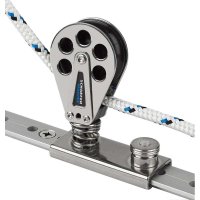
Sorry for the confusion, Gareth. Maybe I should've called them low profile genoa cars. This query isn't about genoa positioning, it's about the actual hardware. Here it is with visual aids. I currently have this type of genoa car/block (though MUCH older and not in this great of shape):

Image.jpeg

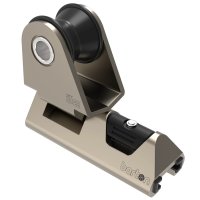
I am considering switching to this type of genoa car/block, but since I have no experience with them, was wondering what the opinions are of anyone who does:
Image 1.jpeg

It's not the brand I'm concerned about, so much as it is the style. Hope that clears things up.
 

peaman

Contributing Partner
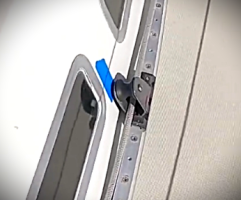
Nothing wrong with the taller block, with the spring to keep it upright. I have the lower style, but because the track is so close to the house, the block has left lots of small dings in the soft metal of my port light frames. I would like to replace them, and I intend to stick with the low profile style.
 

Prairie Schooner

Jeff & Donna, E35-3 purchased 7/21
Brian,

We're rigged with low cars as you've described on the inside track and the springy things on the outer. When hard on the wind I use the inside tracks with the standard jib sheets. When sailing off the wind I run an auxiliary sheet through the outer track springy block to a ST winch on the cabin top. This opens up the slot a little and I think improves performance. It's straining at gnats for cruising, but it's one of the ways I amuse myself. It leaves Donna bemused, but she humors me. The cabin top block isn't ideal, but we only have one set of big winches in the cockpit. When off the wind the pressure on the sails, hardware, and lines isn't as great, so they seem to handle the loads.

Since we got the boat I couldn't get the sheaves on the low inner cars to spin and the line lead out weird, rubbing on part of the sheave frame. We purchased Garhauer low cars to replace the originals. If I'm going to install them, I need to do some tweaking. I won't be to the boat for several more weeks so can't give full details on this at the moment. I'll report on those developments. The build quality is great but there are some secondary features that aren't optimal.

If you're going to use low cars on the outer track, the only thing I'd say is to try to mock up the geometry to be sure the lines will lead without chafe or obstruction. Check this through the full range of possible car position.

Cheers,
Jeff

 

bsangs

E35-3 - New Jersey
If you're going to use low cars on the outer track, the only thing I'd say is to try to mock up the geometry to be sure the lines will lead without chafe or obstruction. Check this through the full range of possible car position.
Yeah, we've had that chafe issue with the existing spring block. I'm going to finally tackle it with a cheek block at the aft end of the track so that the sheet will lead directly to the winch. Now go enjoy your honeymoon and stop worrying about my hardware. :)
 

Dave G.

1984 E30+ (SOLD)
The outer track is always an issue with stanchions too. You can lead back to cheek blocks or add a second car to the outers in the optimum position to the winch. Both methods allow you to get the clew in the correct trim position without having to worry about getting the line to the winch. I liked the second car as it made cranking a little easier than going around a cheek block. The horizontal angle to the winch was way better with the car too, on my boat anyway.
 

Mark David

Member II
fwiw, our low profile / bobbin style cars can accommodate two jib sheets at the same time which can be helpful when changing leads
 

bsangs

E35-3 - New Jersey
The outer track is always an issue with stanchions too. You can lead back to cheek blocks or add a second car to the outers in the optimum position to the winch. Both methods allow you to get the clew in the correct trim position without having to worry about getting the line to the winch. I liked the second car as it made cranking a little easier than going around a cheek block. The horizontal angle to the winch was way better with the car too, on my boat anyway.
I was actually pondering a second car instead of a cheek block, so that’s very good to know. Thanks Dave.
 

gareth harris

Sustaining Member
There is no inner track on the 35II so I have not had to deal with some of the issues raised here.

My only other thoughts are as to which type of block would be easier to operate by feel in the dark, or when your fingers are cold.

Gareth
Freyja E35 #241 1972
 

Loren Beach

O34 - Portland, OR
Senior Moderator
Blogs Author
The outer track is always an issue with stanchions too. You can lead back to cheek blocks or add a second car to the outers in the optimum position to the winch. Both methods allow you to get the clew in the correct trim position without having to worry about getting the line to the winch. I liked the second car as it made cranking a little easier than going around a cheek block. The horizontal angle to the winch was way better with the car too, on my boat anyway.
Same for our boat. i.e. having a second Garhauer block at the rear-most end of the track sends the line tail into the winch at the best angle to avoid a potential override. I also have a blog entry about our owner-built plinths under each winch that much reduced any chances of an override and also make cranking much easier.
 
Last edited:
Top