Guest viewing is limited

Retractable lazy jack (similar to EZ jack or jiffy jack)

Dave G.

1984 E30+ (SOLD)
I have a Doyle StackPack on my 30+ which has a large mainsail for a 30'er anyway. Like any other lazy jack system there is always the issue with battens when raising the sail. Particularly since I have do that at the mast and can't manipulate the boom from there. So I need to be dead into it to not have issues. I'm hoping to get lines run back to the cockpit this season which will help with that for sure. The only other complaint would be aesthetics as it's not the most attractive addition for sure. I try and leave the boom running downhill a bit to let the water run out if it rains. It's a pretty tight cover and also has a zipped front that goes around the mast so not much gets in. It's real pleasure at the end of the day to just drop the sail into the bag tidy it up a little bit and zip it all up nice and neat. Or if you take a day trip to another port just drop the sail in the bag, dock, have some lunch then motor out and raise the sail and off you go. No need to zip it all up for a day trip. It's a good system and does exactly what it should. It came with the boat when I bought it & I'm not sure if I would have gone this route on my own and from what I've seen I think the Dutchman system is interesting too.
 

goldenstate

Sustaining Member
Blogs Author
Goldenstate so basically... your high point for the blocks is at 3/4 high on the mast, right?
Thank you for the calculation!! I really need it!!
Keep going,:D:D:D:D boys!! I think there are a lot of people thinking do this project this season ;)
I'm copying Christian's design.

Planning to set the eye-strap connection on the under-side of the upper spreader, 1-1.5 feet outboard of the mast.
 

G Kiba

Sustaining Member
Consider not attaching the lazy jack lines to the mast. If you can attach to your spreaders (maybe a few inches from the mast) you can widen at the top a little making dropping and hoisting a bit easier.
 

Dave G.

1984 E30+ (SOLD)
I trimmed my battens to the leach angle which essentially was cutting the top corner off and it helped quite a bit. Never have any problems dropping the sail and that's due to how the lines run so there really isn't anything to snag coming down. I guess if you tried hard enough you may get it snagged but it would be difficult. Not sure about attaching Lazy Jack lines to your spreaders, mine are on the side of the mast. I would want a rigger to sign off on attaching anything that could pull straight down on a spreader if something went haywire.
 

K2MSmith

Sustaining Member
1/4" rope too narrow?
I'm using 1/4 Dyneema. it is a bit narrow...If I were to do it again I might go up one size - maybe 5/16". It's not really a strength issue, it's more about having a bit more stiffness in the lines, but it probably doesn't make much difference. You won't have to modify your cover if you retract them after use.
 

Kenneth K

1985 32-3, Puget Sound
Blogs Author
I'm not a lazy-jack guy (I currently have a Dutchman and will probably keep it), but there is a certain elegance in that system shown in Post #4.

As you pull in on P6 and let out an equal amount on P5, all the triangles that end in rings magically fold in on themselves until all the rings are touching and tucked in neatly at the gooseneck (P6). Would probably work well with only 2 inner triangles/rings, too.
 
Last edited:

JSM

Sustaining Member
I have installed Mack Sails Mack Pack on my last boat as well as our 34-2 and couldn't be happier. The system is simple and the lazy jacks are retractable. I added a down haul line to the head of the main that runs down to the base of the mast and back to the cockpit. When its time to douse the main we head up into the wind, release the halyard and haul in on the downhaul. The sail flakes up nicely on top of the pack and no one has to leave the cockpit.
Once back at the dock the sail gets pushed down into the pack and gets zipped shut.
 

Parrothead

Member III
Here are some notes on my system:
  • Conventional full batten main
  • The control cleats are on either side of the boom at the gooseneck
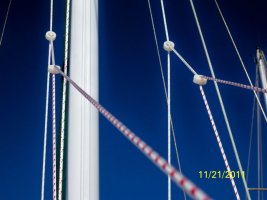
  • When collapsed the rings and most of the rig are along the boom. Note: plastic rings protected from prolonged UV by the sail cover.
  • I made the rings out of UHMW sourced from kitchen cutting board
  • Upper blocks mounted on the spreaders prevent mast slap when collapsed
 

Attachments

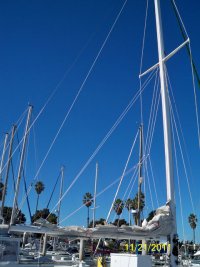
  • Tom's lazy jacks 1.JPG
    Tom's lazy jacks 1.JPG
    104.6 KB · Views: 33
  • Tom's lazy jacks 2.JPG
    Tom's lazy jacks 2.JPG
    77.8 KB · Views: 34
  • Lazy Jacks.pdf
    73.4 KB · Views: 31

Loren Beach

O34 - Portland, OR
Senior Moderator
Blogs Author
I'm copying Christian's design.

Planning to set the eye-strap connection on the under-side of the upper spreader, 1-1.5 feet outboard of the mast.
Please do not do that. It is common when hoisting sail and getting under way to control the swinging of the boom by tightening the main sheet against the lazy jacks. And then, if you are on the house top and the boat lurches and you put your weight on the boom, that is a huge down force on the spreaders. Some folks do put the upper block on the spreader, close to the spar anyway; very risky. Very.
 

Christian Williams

E381 - Los Angeles
Senior Moderator
Blogs Author
My installation was installed by a well known rigger to his specs, and it was approved in advance by Oliver McCann of UK Sails here.

There should never be an instance when the weight of the boom is on the lazyjacks, for obvious reasons. And of course there can't be, which is s why the topping lift is there. It is the topping lift that prevents the boom from falling on your head, not the lazyjacks.

Also, spreaders are supposed to be strong enough to stand on. The attachment of lazyjacks near the root is a non-issue for spreaders.

I think Loren has a rod vang, which may have spring in it, and allow abuse if the topping lift has been removed. There is no concern with a topping lift supporting the boom at all times.
 

Parrothead

Member III
Additional comments on my system in part addressing Loren's cautions:
  • As Christian said, my un-raised-sail boom loads are carried by the topping lift.
  • The lazy jacks remain collapsed until after raising sail and their deployment is the final part of my sail raising protocol. Even with the blocks attached to the spreaders my batten ends at the leach had a habit of snagging the lazy jack if deployed so I changed my procedure.
  • Collapsing the jacks to the boom allows the sail cover to be used without modification.
 

Christian Williams

E381 - Los Angeles
Senior Moderator
Blogs Author
My lowest, longest batten does snag when raising. I have to wait for the right moment as the boom swings free, then yank the halyard so the batten-end jumps past the jack. Once used to it it's just a procedural matter, even if reefing during a reach when the boom is outboard and the sail is luffing.

The snag factor is related to how far outboard on the boom the aft lazyjack is attached. If you position that attachment so the batten can't snag, then the end of the sail falls off the boom. The compromise position can be decided by testing during installation. I.e., by tying the outboard jack on the boom in various positions to see what happens.

After many experiments I leave the jacklines rigged all the time, at dock and under way. It's just a preference.
 

Dave G.

1984 E30+ (SOLD)
Question, in the event the topping lift gets mistakenly released or worse yet it fails, and your sail jams halfway down in a blow what could happen ? I ask as1/4" Dyneema is about 7500lb breaking strength and while yes you should be able to stand on the spreaders that's a mere 200lbs of force. Is there a weak link in the LJ system that will fail to prevent damage/failure up high ? Does anyone know what the maximum downward force a spreader can safely absorb ? I am definitely not the expert here so genuinely want to understand what is safe based on stated specs in a worst case scenario but if it's failsafe would be a good way to eliminate the batten s snag issues for sure.
 

Parrothead

Member III
Re: Fail safe, I can only speak to the system on my boat. In the pdf drawing I provided earlier, releasing the horizontal line at the boom cleat forward allows it to be pulled back through the outboard boom cheek block and the spreader block dropping the entire system to the deck.
 

Christian Williams

E381 - Los Angeles
Senior Moderator
Blogs Author
We all have to assure that the topping lift or rigid vang are not subject to failure, either by age or by a system subject to human error--such as forgetting to secure the length of the topping lift before lowering or reefing a sail. Topping lifts should be adjustable only within a set limit, say a foot or two for convenience when rigging a cockpit cover or working on the boom end. They shouldn't have the potential to run free.

As a critical system, the topping lift needs periodic review. Ericson often used wire fixed at the mast truck, with adjustment at the lower end. The boom end is easy to examine. The top shackle requires climbing the mast.

A boom that falls unsupported to the deck when the sail is lowered, well, that's not good.
 
Last edited:

Dave G.

1984 E30+ (SOLD)
I guess it's a remote chance of the "perfect storm" of events that could cause any spreader damage. That being said my jack lines terminate between my spreaders so not sure it would work for me in anyway. With the StackPack the lines attach to the top of the pack so when you raise the sail there is a much wider base for the sail to move up through. When you get to full hoist the top of the pack is pulled up against the sail, off the boom. Pretty good system but as I said earlier not the most attractive to look at. I don't think the remote chance of buckling a spreader at the absolute wrong time could enhance the convenience enough, in my "murphy's law" mind anyway.
 

Loren Beach

O34 - Portland, OR
Senior Moderator
Blogs Author
Actually the spring return in our rod vang does a great job of holding up the boom, even with the weight of the furled sail.
However----- with the main sheet tight, the boom will still swing several feet from side to side if you push it or lean on it.
Visitors and crew have to be cautioned about this outcome when/if they lean on it while standing on the housetop.

That's because the springs in the tube compress and allow boom lateral movement. When we drop the sail the main halyard is immediately brought back and clipped onto the end of the boom, tightened up, and then the main sheet is socked up tight.

We like the rod vang and would not want to go back to the old system with a topping lift snagging on the battens on our main, but like all solutions, there are always some new problems appearing. :)
 

Dave G.

1984 E30+ (SOLD)
I too have a rigid vang and no topping lift so have same spring effect without halyard attached to the boom end. That said I did have vang come loose from the mast fitting once when the the pin worked its way out somehow. It is just a push pin with the little spring balls on the end to hold it in. Luckily I noticed pretty quick and was sailing upwind. Reminds me to replace that with a pin with ring hole. Anything could happen that would put a lot of weight on a spreader that is not designed to be structural in that direction. I'm sticking to the mast fittings for LJ.
 

K2MSmith

Sustaining Member
Actually the spring return in our rod vang does a great job of holding up the boom, even with the weight of the furled sail.
However----- with the main sheet tight, the boom will still swing several feet from side to side if you push it or lean on it.
Visitors and crew have to be cautioned about this outcome when/if they lean on it while standing on the housetop.

That's because the springs in the tube compress and allow boom lateral movement. When we drop the sail the main halyard is immediately brought back and clipped onto the end of the boom, tightened up, and then the main sheet is socked up tight.

We like the rod vang and would not want to go back to the old system with a topping lift snagging on the battens on our main, but like all solutions, there are always some new problems appearing. :)
I have hydraulic a navtec vang which also holds the boom up without a topping lift. I also used to have a short piece of dyneema on the tail end of the boom that the main halyard connected to so that it acted as a toping lift after the main came down and was stored. I am thinking of returning to that because I don't like compression on the navtec cylinder all the time as it is prone to leaking. I have to just figure out where to tie/splice the little dyneema loop because now my boom end sheaves are all taken up by reef lines.
 

Loren Beach

O34 - Portland, OR
Senior Moderator
Blogs Author
I have to just figure out where to tie/splice the little dyneema loop because now my boom end sheaves are all taken up by reef lines.
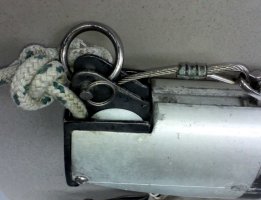
Our Kenyon end casting has holes in the top large enough for an SS ring to be held by a pin. Halyard is clipped to that ring.
( Picture is convenient as I have the boom home for another month while the boat is in the shop.)
 

Attachments

  • O-34 Kenhyon End Casting.jpg
    O-34 Kenhyon End Casting.jpg
    166.2 KB · Views: 10
Last edited:
Top