• Untitled Document

    Join us on May 22nd, 7pm EDT

    for the CBEC Virtual Meeting

    EY.o May Zoom Meeting

    All EYO members and followers are welcome to join the fun and get to know the people you've met online!

    See the link below for login credentials and join us!

    May Meeting Info

    (dismiss this notice by hitting 'X', upper right)

Shaft Seal Leak - Yacht Sinks

Pete the Cat

Sustaining Member
I had a PSS bellows break on a delivery a couple decades ago with a full crew on nicely maintained Swan 48. We were going up the California coast from San Diego to San Francisco and were, at the time, quite a few miles offshore and had been motoring for a couple days (you don't sail on a Northbound delivery). First notice should have been the bilge alarm, but it apparently was inop (Learning: Always test the bilge pumps and alarm circuits before any offshore trip/ inspect engine and bilge compartments at least every two hours while underway--no matter what). A offwatch crew complaining of wet socks was. my first clue. The bellows had a slit in it and was actually spraying salt water mist all over the engine area but also was leaking profusely--bilge pumps had been running but we did not hear them. We ended up sailing the rest of the way to Sausalito from Monterey uphill because there was no way to repair this underway and the engine would not restart after we stopped it. Wrapped the seal with Saranwrap, towels and tape. My understanding that PSS has greatly improved the bellows construction since then. But this is the reason I do not recommend them for folks who are actually going to do offshore passages. You can repair and repack the old stuffing boxes underway and make them mostly dripless with some the proper materials and close attention to the break in process. Having said that, I think PSS works fine for most day and coastal sailors. But going offshore is different and requires a different mindset and prep.
 

Kenneth K

1985 32-3, Puget Sound
Blogs Author
I must admit I am confused about this -- I mean, the shaft takes up most of the space in there; I would have assumed I could stuff a sock, or cut up a T-shirt to get stuff to cram in around it to stop the leak, or slow it enough that the pump could keep up.

Not to try to make comparisons with what may may/not have happened here, but I did have a PSS rupture back in 2021. I did a blog post about it here.

I think the things that made my ordeal manageable were; 1) I heard the exact moment the seal ruptured and was able to start addressing the leak within a few minutes, 2) it was daylight in smooth water, and, 3) I had the initial bilge pump capacity (a rule 800 and and 500 pump) to stay ahead of the leak. Under these conditions I was able to take materials I had on hand (trash bags and zip-ties) and slow the leak enough that I could leave the boat, get more materials, and make temporary repairs that lasted until I could haul out days later.

But it's well worth running through the what-if scenarios: If you wake in the dark to find a salon full of water, how are you going to find the leak? Once underwater, you can't hear the leak any more, and may not see the water streaming in even if looking right at it. So now you're feeling around in the dark possibly on your belly or side. If your body is sloshing around or floating while doing so, you now likely need one hand just to hold your body steady. If a flashlight is in your other hand, how do you fix the leak? If you have a headlamp on, is it waterproof?

Also, once the water gets above the floorboards, all of the bilge access plates will have floated up off of the sole. Now you have six or eight open holes in your slippery floor. Just walking through the cabin is now a hazard. If you twist your ankle stepping any one of those open holes, yourself chances of fixing the leak or executing your self-rescue go down even further.
 
Last edited:

Christian Williams

E381 - Los Angeles
Senior Moderator
Blogs Author
On the E38 the shaft seal is at the level of the TAFG. Meaning if the bilge reaches the floorboards, it is still accessible or only awash.

If the cabin floor is well submerged, it would really challenge any solution.*

Personally I just cannot imagine being unaware of bilge level. You can hear the bilge pump go off, and that always requires investigation. We are fiberglass, not wood expected to leak in a storm.

When closing up the boat at the dock I leave the bilge cover off, so when I can return I see dry and replace cover. This is really just to confirm rainwater has been automatically pumped out. It also prompts me to wipe away slime and keep keel bolts exposed to air. Any time the bilge pump goes off it's a red flag and a fast check.

A bilge pump that never goes off is almost as concerning as one that does. Is it operative? Is the Water Witch or float functioning?

But boats do sink, so I am missing something here somewhere.

*The solution being to wrap a leaking dripless. I carry a fitted rectagle of Sunbrella for that, with wrapping line and hose clamps to secure the wrap. Wrapping a dripless means the prop can no longer spin, but the engine can run in neutral for battery charging and the boat can still be sailed.
 

Drewm3i

Member III
I had a PSS bellows break on a delivery a couple decades ago with a full crew on nicely maintained Swan 48. We were going up the California coast from San Diego to San Francisco and were, at the time, quite a few miles offshore and had been motoring for a couple days (you don't sail on a Northbound delivery). First notice should have been the bilge alarm, but it apparently was inop (Learning: Always test the bilge pumps and alarm circuits before any offshore trip/ inspect engine and bilge compartments at least every two hours while underway--no matter what). A offwatch crew complaining of wet socks was. my first clue. The bellows had a slit in it and was actually spraying salt water mist all over the engine area but also was leaking profusely--bilge pumps had been running but we did not hear them. We ended up sailing the rest of the way to Sausalito from Monterey uphill because there was no way to repair this underway and the engine would not restart after we stopped it. Wrapped the seal with Saranwrap, towels and tape. My understanding that PSS has greatly improved the bellows construction since then. But this is the reason I do not recommend them for folks who are actually going to do offshore passages. You can repair and repack the old stuffing boxes underway and make them mostly dripless with some the proper materials and close attention to the break in process. Having said that, I think PSS works fine for most day and coastal sailors. But going offshore is different and requires a different mindset and prep.
I would be very tempted to use another, non-bellows style, of shaft seal.

Typically bellows are used when a u-joint or similar is employed (as on a sterndrive), as the driveshaft requires the ability to articulate the seal, aka bellows. For a shaft seal, bellows make no sense to me over something like a proper double-clamped steel reinforced tube.

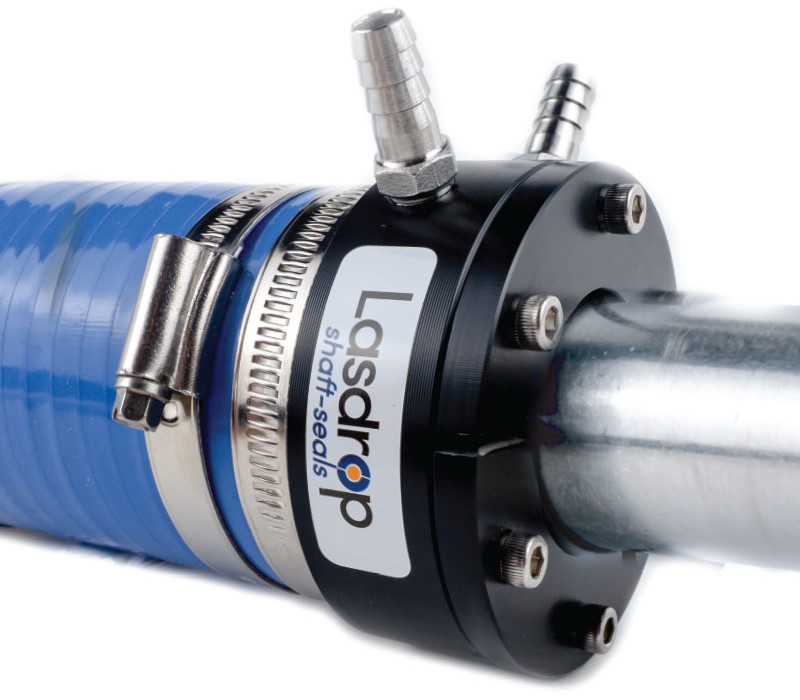
Something more like this:


Or this:


Dave G.

1984 E30+ (SOLD)
Something more like this:
Those also have rubber/plastic tubes that go between the rotor and shaft log. I personally believe the PSS seals to be the tried & tested product. I know nothing about the DSS & Glide products above and I don't know anyone that has installed either. I'm sure they work fine too but they all seem have the same basic design. Yes I guess there is a minute chance of a rupture but I would not feel in the least bit concerned going offshore with a PSS shaft seal.
 
Top