Guest viewing is limited

Using a haulout grid

p.gazibara

Member III
Hello all,
Curious if anyone has ever hauled out on a grid before, using the tide.

Cinderella has some growth on her being in the river all winter. I have access to a club grid that’s 100 yards from our berth, but I haven’t ever used one before.

I know there is a knack to putting a fin keeler on a grid, curious if anyone has ever done it on the second gen (internal ballasted)

I know there are voids between the glass and lead and have drilled a hole in the bottom of the keel before to let water out, there is an air gap before you hit lead with the drill bit.

Is there a section of the keel that is strongest for the boat to rest on? A section to avoid?

Cheers,
-p
 

Bolo

Contributing Partner
To be honest I never heard of a haulout grid before so I looked it up, on line of course. We’re I sail there are tides but not like the ones you need for using a haulout grid or a tidal grid. Are they the same thing? But there is a wealth of info on it so I included the link on what I found. I must admit, it looks like a sketchy way if getting a sailboat out of the water. Having it tip over on you, literally, seem to me to be one of the more undesirable possibilities..


Loren Beach

O34 - Portland, OR
Senior Moderator
Blogs Author
These used to be common for (mostly) use by fishing or smaller work boats throughout the NW. There were some in the Astoria/Warrenton area still in use in the early 80's. IMHO it would prove difficult to balance (fore n aft) for a fin keel vessel. Most would need a bow support. Lines holding the vessel against the pilings would be adjusted as the tide dropped, to prevent the hull from falling over.
Best by far for long-keel hulls. I found one modern grid in Puget Sound, and note that they reference a number of banned uses for theirs --- click on their site link for tidal grid.
(Back in the old days, it was routine for cleaning and repainting bottoms this way for wooden work boats with an appropriate hull form.)


Trivia: there are still lots of ports with marine railways, which supports the vessel similarly. With appropriate blocking at the bow these haul sailboats out of the water regularly.
I watched them haul our previous Niagara 26 this way for the purchase survey. I had not seen a marine railway in use before and it was very interesting. I recall asking if the boat could just "stand" on its keel, and the operator said Yup Of course, as sailboats are designed to rest on their keels.
That surveyor and others since then have confirmed this, with the caveat that some cheaply-built boats may not fare as well... :(

Edit: both our prior boat (Niagara 26) and present boat have external cast lead keels.
 
Last edited:

Bolo

Contributing Partner
These used to be common for (mostly) use by fishing or smaller work boats throughout the NW. There were some in the Astoria/Warrenton area still in use in the early 80's. IMHO it would prove difficult to balance (fore n aft) for a fin keel vessel. Most would need a bow support. Lines holding the vessel against the pilings would be adjusted as the tide dropped, to prevent the hull from falling over.
Best by far for long-keel hulls. I found one modern grid in Puget Sound, and note that they reference a number of banned uses for theirs --- click on their site link for tidal grid.
(Back in the old days, it was routine for cleaning and repainting bottoms this way for wooden work boats with an appropriate hull form.)


Trivia: there are still lots of ports with marine railways, which supports the vessel similarly. With appropriate blocking at the bow these haul sailboats out of the water regularly.
I watched them haul our previous Niagara 26 this way for the purchase survey. I had not seen a marine railway in use before and it was very interesting. I recall asking if the boat could just "stand" on its keel, and the operator said Yup Of course, as sailboats are designed to rest on their keels.
That surveyor and others since then have confirmed this, with the caveat that some cheaply-built boats may not fare as well... :(
“I recall asking if the boat could just "stand" on its keel, and the operator said Yup Of course, as sailboats are designed to rest on their keels.” Stand but not balance.
 

Captain Pete

Member II
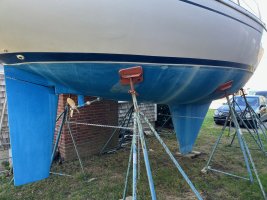
A guy at our club annually used to tie his Cal 30 up to our pier resting it on a concrete pad put there back in the day before brownell trailers.
Local tides are 9'-12'. He would just move the lines and fenders as the tide went down and up. Boat only rested on the keel. Seemed like a brave crazy soul. He always did it all by himself with no issues. I am told most of the weight of boats on stands rests mostly on the keel anyway. Stands mostly hold it upright.
 

Attachments

  • IMG_5801.jpg
    IMG_5801.jpg
    274.1 KB · Views: 6

p.gazibara

Member III
It’s done quite regularly here. They normally have a line off the bow cleat to a point on the forward pile and back to a winch. Same for the stern. Between the two you can supposedly adjust the pitch of the boat.

From what I understand you put the biggest fenders you have out to begin with and as the tide goes out you remove them for smaller ones and the boat will lean against the dock/piles nicely.

I would normally dive the boat with a scraper, but there isn’t very much vis up the river at the moment.

The club manager won’t be available to coach me this time, so I’ll have to go for a dive instead.

Thanks for the input.

cheers,
-P
 
Top