Retired from newspapers and television, currently sailing Thelonious II, a 1984 Ericson 381.
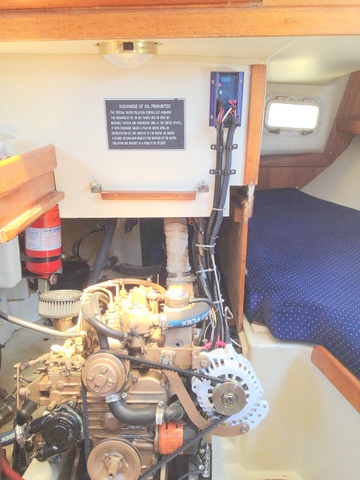
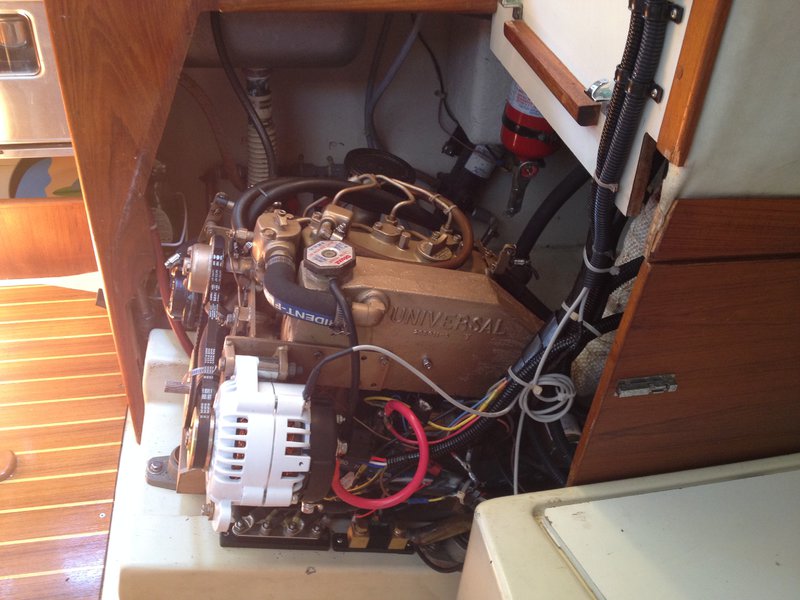
The external regulator is mounted on the bulkhead, outside the engine compartment. The new Balmar alternator is white, to make you feel special.
The issue is power. How much electricity do you need on board, and for how long, before reattaching to the mothering 110 outlet at the dock. It's one of those issues that requires assessing your actual present and future use of the boat. It is further complicated by the Rubik's-cube challenge of battery capacity, charge rate and energy expenditure, for which the solutions are given in Navajo.
Will you ever want refrigeration, air conditioning or a microwave? Is your energy draw per cruising day 200 amps or 20? Should there be a generator, solar panels, a wind generator? Do they make a crank for an Iphone? Do you need much electricity at all? It's not a bad question--Chichester won the first solo transatlantic race with paraffin running lights. And since the wind usually blew them out immediately, he actually used less paraffin than expected.
I adopted the minimalist approach. Once committed to warm beer after three days the mind is clarified--especially if you only have two Group 27 deep cycle batteries. And will use only one of them for house loads, since the second is reserved for starting the engine. Why not more or larger batteries? There's simply no good place for them on the E32-3. So be it.
What electronics shall we use, then, on this hypothetical 30-day cruise, and how shall we recharge the puny battery that will power them? What is the expected daily draw, in amperes? What is an ampere, exactly? What is the nature of the Buddha, exactly? Do you think any Zen master would answer that? Let's keep the irrelevant questions to a minimum.
I installed a Victron battery monitor. A battery monitor makes it easy to see the draw of every appliance, and tracks the daily descent of battery charge from 100 percent to about 50 percent, which is the sweet spot for recharging. Long-distance cruisers avoid running the batteries below that level, then recharge only to 85 percent. The last 15 percent to full charge is slow and, if using the alternator to do it, burn more fuel than it's worth. Maine Sail's tutorial on battery monitors is here. Chew slowly.
My daily energy budget is relatively low, computed by multiplying the appliance draw x duration, for amp-hours.
Binnacle GPS/chart plotter........0.5 x 2 hours= 1 (No need to keep the GPS on continually)
AIS.......................................................0.5 x 24 hours= 12
Running Lights...............................0.7 x 8 hours = 5 (LEDs)
Cabin lights.....................................0.5 x 2 hours = 1 (LED and kerosene)
Stereo...............................................2.0 x 2 hours =4 (at 2 amps my stereo is blasting Funiculi Funicula extremely loud)
Total 22 amp hours/day
Notice there's no fridge, no single sideband, no autopilot--not much of anything electrical. My Trojan battery is rated at 100 amp hours. Theoretically, a draw of 30 or so amps would take it down well above 50 percent, with a comforting fudge factor for use of VHF communications and heliarc welding.
I have a servo-pendulum wind vane for sailing, and only use the Raymarine wheel pilot when motoring. On a slow-response setting, that's only about 2 amps in calm conditions.
But the batteries of Iphone, Satphone, Laptop and GoPro also have to be topped off daily, although they don't show on the Victron.
So, how to recharge? There are many, many approaches. I chose to use the M25 diesel. It's not passive like solar, it costs fuel to run, it has moving parts, and experienced cruising hands don't think using the auxiliary engine is the best way to go about maintaining a charge in batteries. But I'm not living aboard with cats. I'm extending my cruising range and independence. I have an engine already. It runs, so it might as well earn its keep. I'd like to skip a windmill or solar power plant overhead.
However, my stock alternator, rated at 51 amps and with an internal regulator, would take hours and hours to recharge the batteries even at the minimal usage given. That means fuel burn, and my tank holds about 20 gallons. To recharge in less than an hour daily, I need more output: somewhere around 60 or more amps, as provided easily by the Balmar 100. In order to deliver amperage at a high rate, without overwhelming the battery, a "smart" regulator is necessary. The internal regulators that came with our stock alternators deliver a steady charge, not one tailored to the urgent needs of a half-depleted tub of acid. A smart regulator, usually "external", pours on the coal when the battery is low, then backs off so as not to boil the baby in the bathwater. Do you notice how I provide these explanations in laymen's terms? Thank you. I am a layman.
I bought the Balmar 100 amp alternator kit, which includes the ARS-5 regulator. The best price I found was from Baltimore Battery, $815 for everything. The installation was straightforward, as this model matches the old Motorola alternator in its upgraded bracket. The issue with a more powerful alternator is that it demands more of the engine (1 horsepower for every 25 amps), and puts more strain on the belt. It's all about the belt. The Balmar can be de-powered in several ways to ease the strain, if necessary. A high quality 3/8th belt with perfect pulley alignment and proper tension is right on the edge of adequate. I was unable to use the half-inch belt suggested by Tom Metzger, because that extra 1/8 in width brushed a bolt on my water pump. So far, in ten hours, I have no dust.
It is remarkable to see my batteries now go from 70 percent charged to 90 percent charged in much less than an hour of motoring time. If you plan this upgrade, there is reading to do. A place to start is here: https://marinehowto.com/category/alternators/
That's a link to Maine Sail, who in 2021 suffered a massive stroke. If you have profited over the years from his generous and masterful free explanation of yacht systems issues, send him some money at https://marinehowto.com/
Is a 100-amp alternator too much for a single belt to drive? See here.
Say, a new material to play with!
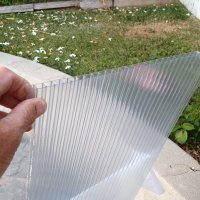
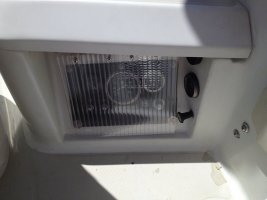
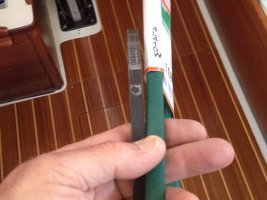
New to me, anyhow. It goes by the name of 8mm Twin-Wall Polycarbonate sheet. Stiff, plastic cardboard. I had to buy some to make a spare Sailomat windvane, then used the leftovers to make a hinged splash guard for the cockpit instruments. Apparently its great consumer value is for replacing greenhouse glass. But I know there are boat uses waiting to be discovered. I might try it as a lightweight drizzlestopper for the companionway, as a fair-weather hatch board. It's fun just to hold this stuff in your hand, and it cuts with any fine-tooth saw.