Retired from newspapers and television, currently sailing Thelonious II, a 1984 Ericson 381.
Ready to go– almost.
There’s a dockside test in which the SPX-5 system moves the wheel. Pass. There’s a sea trial test, in which a couple of slow two-minute turns calibrate the fluxgate compass. Our deviation was 1 percent, well within range. Pass. Then the SPX-5 does a series of zigzags of increasing scope during its “Auto learn” protocol.
I was feeling pretty good until it failed at Step 7 with the message, “No Pilot.”
The next day I discovered why: a 2A fuse on the course computer had burned out. I bought five 2A fuses and tried again. This time I got to Step 11. Then later, to Step 17. The next day, after calling Raymarine and begging for help from people on the message board along everyone else, Thelonious got to Step 29 before “No Pilot.”
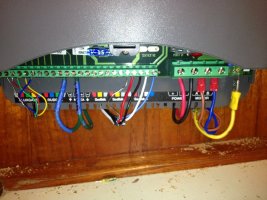
No call back from the manufacturer. But ah! Another victim on the message board had studied a photo I’d posted, and it seemed to him that my fuses were reversed. Why is the 15A fuse located over the Seatalk port, which is communication only and uses hardly any power? Why is my 2Afuse (not visible) located over the 12v power leads for the drive motor? Isn’t it more likely that the drive motor would use the 15A, and the Seatalk port use the 2A?
That made so much sense that in a rush of gratitude I offered the guy my dog.
He was right all right, right as rain--and double the surprise, he didn’t want old wet Harley the Dog. I had burned through four 2A fuses because Raymarine, or Defender, where I bought the unit, had delivered a course computer with the fuses switched. Eventually, a Raymarine tech commented in response that he had “never seen fuses switched at the factory.”
I took this as a veiled suggestion that I had caused the problem myself. OK, Ray, whatever you say.
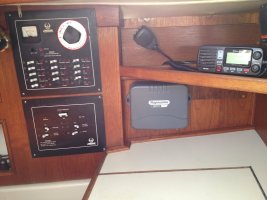
In sum, the installation took me a week, working every day, and I also put in a new VHF. It might have been three days without Raymarine’s don’t-give-a-damn packaging and slow support, but I think it’s easy to underestimate the labor involved in the project. Snaking and securing wires takes time. Gear has to go home for work and then come back. I had to alter some woodwork, make a lot of holes, grovel for wire runs (for Pete’s sake bring somebody to help you), make numerous trips to WM for screws and electrical connections, order and fit the instrument box and extra bracket, drill stainless, study Calder and make my usual mistakes and do-overs. As for the panel, which now has even more stuff crammed in it than before:
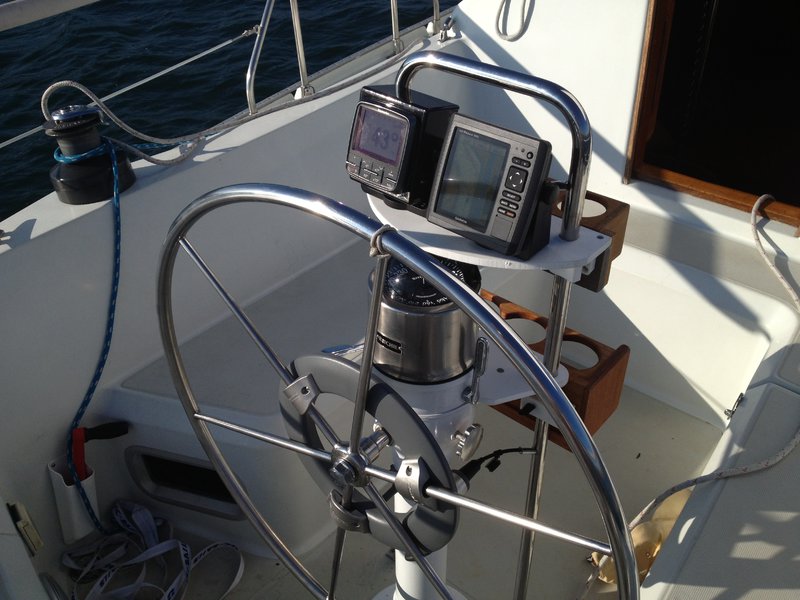
It’s fair to say that learning an old boat’s 12v systems is not like studying diagrams in a library. If you simply drop a breaker screw it can be 20 minutes of retrieval. Some of my problems were caused by the new-to-market status of both the 50s and the P70. When neither salesmen nor forums have much experience with them, you're a beta-tester. That’ll change fast. But the Garmin is a neat and inexpensive unit and ought to be a good replacement GPS/sounder for many of us.
As for the SPX-5, so far it seems to work. Does it make noise? Yes – grrr grrr grrr, loud but not hysterical (I’ll bet the CPT is quieter). Does it hold a course under power? Yes. Under sail? We’ll see.
Here’s a question: Should you save money buying such devices on line, or head directly for West Marine or another local chandler? When my GPS order got bollixed, WM was a mile away and solved the problem instantly. While Defender had a better price for the SPX-5, my WM store has them in inventory, gets free one-day deliver if it doesn’t, and the staff often has some degree of hands-on knowledge. I don’t look forward to shipping back to Defender or Raymarine any failed components.
It’s great to be free of the tyranny of the helm when sailing alone or with others. My particular installation was a pain in the butt for the reasons reported above. Should I have hired a professional installer?
Nah, gotta know how the thing works -- in case it doesn’t.
Here's a video of the unit under sail:
There’s a dockside test in which the SPX-5 system moves the wheel. Pass. There’s a sea trial test, in which a couple of slow two-minute turns calibrate the fluxgate compass. Our deviation was 1 percent, well within range. Pass. Then the SPX-5 does a series of zigzags of increasing scope during its “Auto learn” protocol.
I was feeling pretty good until it failed at Step 7 with the message, “No Pilot.”
The next day I discovered why: a 2A fuse on the course computer had burned out. I bought five 2A fuses and tried again. This time I got to Step 11. Then later, to Step 17. The next day, after calling Raymarine and begging for help from people on the message board along everyone else, Thelonious got to Step 29 before “No Pilot.”
No call back from the manufacturer. But ah! Another victim on the message board had studied a photo I’d posted, and it seemed to him that my fuses were reversed. Why is the 15A fuse located over the Seatalk port, which is communication only and uses hardly any power? Why is my 2Afuse (not visible) located over the 12v power leads for the drive motor? Isn’t it more likely that the drive motor would use the 15A, and the Seatalk port use the 2A?
That made so much sense that in a rush of gratitude I offered the guy my dog.
He was right all right, right as rain--and double the surprise, he didn’t want old wet Harley the Dog. I had burned through four 2A fuses because Raymarine, or Defender, where I bought the unit, had delivered a course computer with the fuses switched. Eventually, a Raymarine tech commented in response that he had “never seen fuses switched at the factory.”
I took this as a veiled suggestion that I had caused the problem myself. OK, Ray, whatever you say.
In sum, the installation took me a week, working every day, and I also put in a new VHF. It might have been three days without Raymarine’s don’t-give-a-damn packaging and slow support, but I think it’s easy to underestimate the labor involved in the project. Snaking and securing wires takes time. Gear has to go home for work and then come back. I had to alter some woodwork, make a lot of holes, grovel for wire runs (for Pete’s sake bring somebody to help you), make numerous trips to WM for screws and electrical connections, order and fit the instrument box and extra bracket, drill stainless, study Calder and make my usual mistakes and do-overs. As for the panel, which now has even more stuff crammed in it than before:
It’s fair to say that learning an old boat’s 12v systems is not like studying diagrams in a library. If you simply drop a breaker screw it can be 20 minutes of retrieval. Some of my problems were caused by the new-to-market status of both the 50s and the P70. When neither salesmen nor forums have much experience with them, you're a beta-tester. That’ll change fast. But the Garmin is a neat and inexpensive unit and ought to be a good replacement GPS/sounder for many of us.
As for the SPX-5, so far it seems to work. Does it make noise? Yes – grrr grrr grrr, loud but not hysterical (I’ll bet the CPT is quieter). Does it hold a course under power? Yes. Under sail? We’ll see.
Here’s a question: Should you save money buying such devices on line, or head directly for West Marine or another local chandler? When my GPS order got bollixed, WM was a mile away and solved the problem instantly. While Defender had a better price for the SPX-5, my WM store has them in inventory, gets free one-day deliver if it doesn’t, and the staff often has some degree of hands-on knowledge. I don’t look forward to shipping back to Defender or Raymarine any failed components.
It’s great to be free of the tyranny of the helm when sailing alone or with others. My particular installation was a pain in the butt for the reasons reported above. Should I have hired a professional installer?
Nah, gotta know how the thing works -- in case it doesn’t.
Here's a video of the unit under sail: