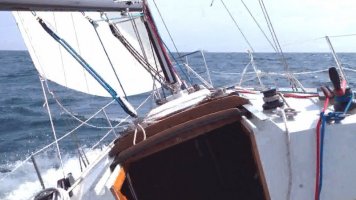
Retired from newspapers and television, currently sailing Thelonious II, a 1984 Ericson 381.
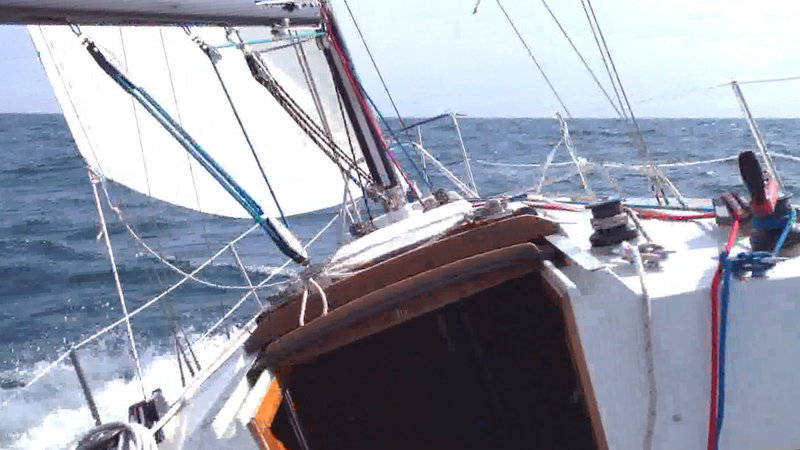
This video is one minute of sailing versus five months of boat work. A familiar ratio? Why do we do this? Why, while grinning along with spray flying, does the mind turn immediately to more things to do upon return to the dock? After so many years I begin to think of it as a pathology.
I put on the 90 percent jib because it’s so easy to tack when alone on board. It’s really a delight. The conditions in the video were two-foot wind chop and about 14 knots at most, whitecaps having just spawned. The main draws well going close to weather with no need to feather up and with the high clew of the little jib I can see everything, unlike the decksweeper genoa. I’ll leave the 90 percent on for the rest of the month, since April and maybe May are the windiest in Santa Monica Bay.
However, what a pain in the butt it is to change roller headsails alone, even at the dock. I now am trying woodworking clamps to hold the luff for flaking while I yank the long folds, but even so it’s tedious and there isn’t enough room on the side decks. There was a time when every boat had hanks and we stuffed sails into bags. I miss that until I remember that the boat was full of wet sail bags and we thought little of tossing one of them up through a forward hatch, which today would result in my orthopedist smiling and ordering a new Jaguar. But I still don’t like cranking half a genoa around a wire. It just don’t look good, as Berra told Mantle about playing drunk.
The 32-3 can be tacked like a dinghy with the small headsail on, it just flops over with a flick of the wrist. However…
If you wanted a laugh yesterday you would have had one watching me in the quarter-mile wide Marina Del Rey cut, raising the main alone. As yet I have no autopilot, so to head up enough to haul the main halyard I sail a luffing course across the cut, set the wheel drag, and scramble. The idea is to get the main up before a tack is necessary, which gives you about 300 yards. On a weekend, with the narrow cut full of boats, it would be a real comedy. Even uncrowded it’s a gymnastic exercise that accurately reveals the compromises of the running gear.
I refer to the biggest joke in modern yachting: “all lines led back to the cockpit.” With a tiller in the singlehanded transpac, OK: you need to be able to raise the chute at midnight when the wind drops below 30 knots while steering with your knees. With a wheel, however, even aroudn the buoys, you're trapped with the deck controls entirely out of reach. Sure I can work the jib sheets. But halyards? Vang? Reefing? One is not Plastic Man, able to fling an arm 12 feet. And all that line running running back from the mast through all those blocks and brakes means a foul any time you douse, so you have to go to the mast anyhow. And if you need to haul a halyard at the mast, the slack line at your feet must be reintroduced to its run to the cockpit, an action which is exactly impossible without assistance. And--am I beating this to death?--after lowering the mainsail from the safety of the cockpit, with no fouls of the halyard you managed not to be standing on and the clutches and blocks that this time didn't foul, what you have accomplished is--a lowered mainsail. Now what? Don't you have to climb on the cabin house with sail ties?
Winches on the mast are a simpler approach. They put everything within reach of where the short-handed sailor usually winds up in a sail-handling emergency. Under normal conditions they actually make everything easier for the master, commander and host. At least that is my experience. A system designed to make it unnecessary to leave the cockpit is like wearing one shoe to reduce walking. Logical, but leaves you hopping on one foot.
The 32-3 is about the biggest boat I am comfortable with for solo sailing. I don't mean solo sailing like Chichester and Slocum, but solo sailing with seven people on the boat who are arguing about foreign policy while balancing their wine cups on the winches and who don’t hear the command “ready about” unless you place your hand heavily upon their shoulder. Such a crew are delightful company as long as you recognize that you're sailing singlehanded. And I am quite proud of my learned ability to participate in lively conversation (not just nods and grunts) while operating the boat without assistance, so as to preserve in the minds of the guests the idea that sailboats are effortless Zen instruments, which they are, right? Ready about. Ready About. Hello?
Where was I. Ah, yes, the easy-sailing 32-3. The sails are sufficiently small. The boat is agreeably light. The cockpit is ergonomically good. The two-speed Barients mean an easy trim with any headsail. Over the years I chartered the usual crop of modern wide-bodies, most of them in the 37-foot range, and there is a world of difference. The furniture-store models are quite good on some points of sail, but not all. I recall one that was so difficult to steer in a quartering sea I felt I needed two helpers at the wheel, as if rounding the Horn in a square-rigger. The 32-3 is pretty good all around. Perhaps all that means is that a boat should fit the needs of the owner. And it takes many years and many revisions to learn what those are.
And, drat, those needs change. But never mind. Here we are in a nice breeze with the little jib up, slipping along with no fuss at all, the gulls crying, a sea lion broaching with a glance and a grin and just for a moment, as a swell lifts the stern, perfect.
Here is Loren's O34 referenced in the comments below. For more on jibs:
Self Tacking Jibs, anyone?
One of the guys at our YC converted his smaller RF jib to a self tacking 95% jib last year. He put a wire-cable traveler on his housetop just in front of the mast. The jib is still a furler. He single-hands his boat, a Catalina 30, a lot more than he ever did before. So far he is delighted...