Guest viewing is limited

Head-spinning (no, not that head) LiFePo Contemplation

Filkee

Sustaining Member
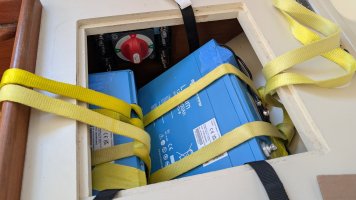
Probably to distract myself from winter anxiety about swapping out my chain plates, I decided to swap out my batteries too. I’m poised to go Victron DC-DC, ditch the Renogy controller and embrace one, big beautiful 314ah battery. I’ve already ripped out my panel and installed an isolate switch, but every time I want to press buy online, I choke and start watching YouTube again. The yacht club is running the launch on LiTime, my business class friends are using SOK, the robots tell me WattCycle and Marine HowTo which has helped my through other things says Epoch and that WattCycle is yesterday. But Prowse says a dumb WattCycle is the thing. I’m longing for the days of Consumer Reports settling it all for good, but would accept even a murmur from the crowd here. Meanwhile, I ski’d over my mooring yesterday…
 

Attachments

  • IMG_1957.jpeg
    IMG_1957.jpeg
    94.6 KB · Views: 20

ConchyDug

Member III
I have 5 100ah(100lbs total weight) LiTime batteries after watching Prowse tear one apart 4yrs ago. They can run an aircon or linear drive autopilot... no problem. The 5th one I put in has BT built in, which is cool but not needed. I got the "mini" version which is a pouch design which all the keyboard warriors like to hate on. Prowse straight up drilled thru one and it didn't reach the point of thermal runaway, so I'm pretty confident they won't burn the boat up. If it fails whoopty-do it's $250 and they've already lasted longer than the original FLA the boat came with. I'd install 2 batteries just for redundancy, you can isolate one and still rock on with the good one.
 

vanilladuck

E32-3 / San Francisco
Blogs Author
I just finished the upgrade to LiFePO4 on Rumour. Here's the short-list:
  • 2 x 200Ah Victron SmartLFP 12,8V batteries (can already hear @Christian Williams protesting my shenanigans :p)
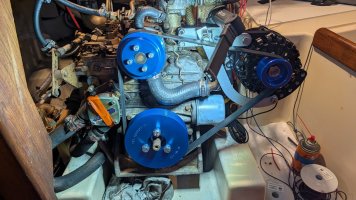
  • Arco A225s alternator and corelated J10 serpentine belt conversion
  • Arco Zeus alternator regulator
  • an assortment of Victron components: Smart BatteryProtects, SmallBMS, etc
PXL_20250205_020558866.MP.jpg

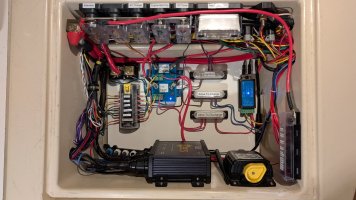
I went with Victron because I wanted a lack of surprises and the ability to tap into the logic of the battery's BMS. With Victron (and Epoch and a couple others), one can plug in an external BMS device which can intelligently signal to cut chargers or loads when the internal battery BMS says it's in trouble -- before the BMS disconnects the negative terminal. This allows direct charging of the Victron LiFePO4 batteries from the alternator. The BMS will signal to the Zeus to pull field current if there is an overvoltage, imbalance, or overtemperature condition in either battery. The old battery box has been repurposed for this charging system control, positive bus fusing, the regulator, and shunt measurements.

original_9e3fda43-7228-445e-82cd-cbb25293eeec_PXL_20260206_034602124.jpg

I have the alternator detuned to a max output of 160A. It will push ~250A cold and ~190A hot, so I might have some tuning to do in the future.

PXL_20260129_011819640.jpg

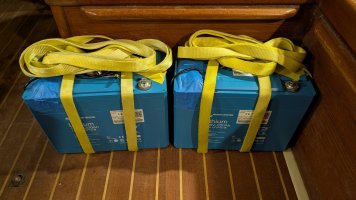
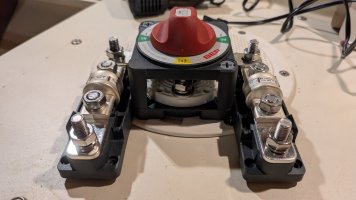
I wanted two batteries rather than one large one for redundancy. If one battery suffers a failure, I rely on the other. Real estate is an issue on the E32-3... I found a nesting location under the port side berth in the salon. I built a little shelf and installed a 1-2-BOTH-OFF switch with T-class fuses. Dead shorts on lithium batteries produce huge currents due to the miniscule internal resistance of the battery. The isolator switch can be used to de-energize DC for the entire boat from the new battery box or isolate a failed battery.

PXL_20250205_020724659.MP.jpg PXL_20250208_225852504.MP.jpg

'Like' if you would like a video or blog article about this ;)
 
Last edited:

vanilladuck

E32-3 / San Francisco
Blogs Author
A statement not often heard on a sailing website:
"I have the alternator detuned to a max output of 160A."

:egrin: lol


Does the alternator regulator need cooling air? Perhaps some vent holes in the battery box?

Nice install!

Thanks Ken!

I've been wondering the same thing.. So far, leaving the engine cover on hasn't resulted in an alternator temperature above 40C. This alternator is built to run up to 110C. I have limits set at 90C. And at least for now, I'm monitoring via the mobile app when running the engine.
 

vanilladuck

E32-3 / San Francisco
Blogs Author
I also realize I'm running the engine around SF Bay in winter with an ambient temp of <=60F (15C). I imagine I'd see hotter alternator temps in the tropics or warmer environments. I'm not sure how much hotter things will run if I were in the tropics with 80-90F (27-32C) ambient temps. Any thoughts and maybe with some science?
 

Christian Williams

E381 - Los Angeles
Senior Moderator
Blogs Author
Motoring for a week through the North Pacific High in 90F air and 80F water, one stretch of 36 hours engine-on, presented no problem to my 100 amp Balmar and standard belt. I don't recall what the alternator temp was, but my Balmar and its regulator are inside the engine box, where it gets pretty hot.

Not saying that's ideal, just recording the experience.
 

Kenneth K

1985 32-3, Puget Sound
Blogs Author
The E-323 engine compartment is vented to the whole back of the boat and is vented by to cowls. A few folks have even moved the hose that feeds the blower (if you have one) to the highest part of the engine compartment to extract the warmest air. Most folks don't bother. With a remote regulator located in the battery box, that's a second heat-generating unit to consider. The stock E323 battery box has no cross ventilation--just the small finger-hole panel-lift to act as a vent. If you cover that small hole with the quarterberth cushion, there is likely no ventilation at all.
 

Loren Beach

O34 - Portland, OR
Senior Moderator
Blogs Author
The stock E323 battery box has no cross ventilation--just the small finger-hole panel-lift to act as a vent. If you cover that small hole with the quarterberth cushion, there is likely no ventilation at all.
Having spent several delivery days on a 32-3, I recall that indeed the battery compartment was molded in, and not served by any ventilation. I would guess that a 2" hole near the top and led via a hose to a small "muffin fan" might solve the problem. (?)
 

vanilladuck

E32-3 / San Francisco
Blogs Author
re: the non-ventilated battery box, there were no warnings in the Arco manual for the regulator about temperature control. The manual suggested mounting the regulator vertically if in a compartment with moisture, so that the harness connections don't get wet. Searching around online didn't produce any warnings about heat generation either.
 

Kenneth K

1985 32-3, Puget Sound
Blogs Author
there were no warnings in the Arco manual for the regulator about temperature
I assumed those were heat sink fins on the unit in the battery box photo in post #4, above. But maybe they're not. I'd probably just call the guys at Arco and ask them.

If ventings is required, I wasn't thinking a fan, just two vent holes. One placed hi and one low to let convection take place.
 
Top