
You are using an out of date browser. It may not display this or other websites correctly.
You should upgrade or use an alternative browser.
You should upgrade or use an alternative browser.
Cabin Top Repair (E35-3) Advice Wanted
- Thread starter Hagar2sail
- Start date


It helps to have the hood in place on your Tyvek bunny suit.And I have never had epoxy in my hair.


Ok well many fun times in a bunny suit with the well recommended hat on and I am done with the repair. Ended up going with g10. Had to break it into two rectangles to get the appropriate fit to the overhead, but happy with how it came out.
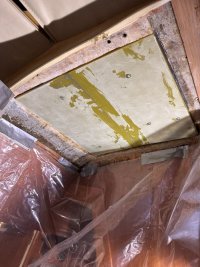
A little irritated that on the 4th and final layer of 1708 the epoxy kicked faster and I ended up with some dry spots. I mixed another batch, but the epoxy already in the cloth was refusing the new epoxy at least that is my theory. Even three layers of 1708 is likely plenty, as the original skin I took off wasn’t that thick.
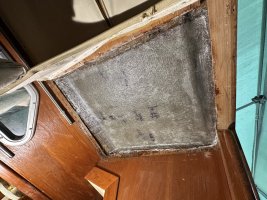
A little irritated that on the 4th and final layer of 1708 the epoxy kicked faster and I ended up with some dry spots. I mixed another batch, but the epoxy already in the cloth was refusing the new epoxy at least that is my theory. Even three layers of 1708 is likely plenty, as the original skin I took off wasn’t that thick.
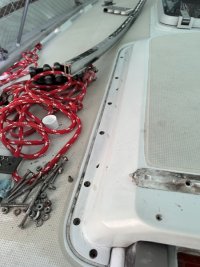
Now the next task is putting everything back on. One question is for the sea hood / turtle shell. That has a HUGE contact area. I don’t know what it was installed with last time. Seemed more adhesive than silicone, but then it felt like they came back later and filled between the sea hood and deck with silicone, as that wasn’t very well adhered, but had not yellowed.
I am waffling between polysulfide (lifecaulk) and totalboat “seal”. Anyone have any experience with that product? I certainly don’t want to use polysulfide between the hood and deck, it would yellow and look terrible.
I am contemplating putting polysulfide at the hood to deck interface, then coming back with silicone for the “seal” layer between the deck and hood. But I always hate using silicone. I will be sanding the current gel coat a little in case it was silicone used so at least new silicone or another product will have a chance to stick.
Does all my random ramblings make sense?
here is a picture before removal, the mildewed line is what I believe was silicone between the hood and the deck, but considering how hard it was to remove, they definitely used something stronger than silicone under the hood flange to the deck.
I am waffling between polysulfide (lifecaulk) and totalboat “seal”. Anyone have any experience with that product? I certainly don’t want to use polysulfide between the hood and deck, it would yellow and look terrible.
I am contemplating putting polysulfide at the hood to deck interface, then coming back with silicone for the “seal” layer between the deck and hood. But I always hate using silicone. I will be sanding the current gel coat a little in case it was silicone used so at least new silicone or another product will have a chance to stick.
Does all my random ramblings make sense?
here is a picture before removal, the mildewed line is what I believe was silicone between the hood and the deck, but considering how hard it was to remove, they definitely used something stronger than silicone under the hood flange to the deck.

Prairie Schooner
Jeff & Donna, E35-3 purchased 7/21
Now the next task is putting everything back on. One question is for the sea hood / turtle shell. That has a HUGE contact area. I don’t know what it was installed with last time. Seemed more adhesive than silicone, but then it felt like they came back later and filled between the sea hood and deck with silicone, as that wasn’t very well adhered, but had not yellowed.
I am waffling between polysulfide (lifecaulk) and totalboat “seal”. Anyone have any experience with that product? I certainly don’t want to use polysulfide between the hood and deck, it would yellow and look terrible.
I am contemplating putting polysulfide at the hood to deck interface, then coming back with silicone for the “seal” layer between the deck and hood. But I always hate using silicone. I will be sanding the current gel coat a little in case it was silicone used so at least new silicone or another product will have a chance to stick.
Does all my random ramblings make sense?
here is a picture before removal, the mildewed line is what I believe was silicone between the hood and the deck, but considering how hard it was to remove, they definitely used something stronger than silicone under the hood flange to the deck.
View attachment 55671
I reinstalled ours with butyl tape because I have the feeling I'll be replacing the traveler in the next few years. That would not be my choice for a semi-permanent installation. Whatever you do, you might want to make it somewhat removable, especially if you may have a fuel tank or traveler replacement in your future. I do try to avoid silicone.
One thing I noticed when taking it off is the use of various piles of washers to adjust the height of the hood relative to the adjoining deck surface. I didn't put these back in as carefully as I ought and the mismatch occasionally bothers me. fwiw
The repair with G10 looks great. When the apocalypse comes, that part of the boat will be the last to vaporize.


And of course a sea hood isn't meant to be watertight anyhow, since the hatch has to slide under. They have drain holes to let inevitable water out.
My caulk is white, and discolored by mildew. I wonder if gray wouldn't be a better choice of color.
My caulk is white, and discolored by mildew. I wonder if gray wouldn't be a better choice of color.