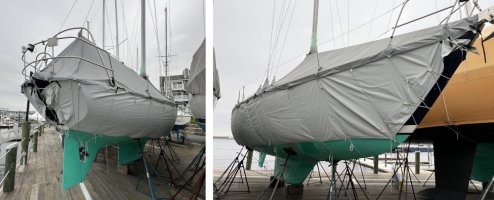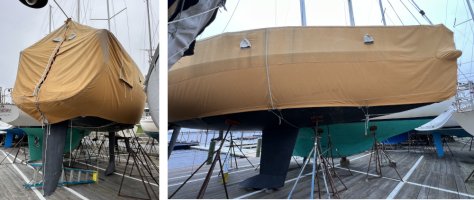
E38-200 - Using Waxed Canvas Tarps for Winter cover

JP in Sandusky

E38 on Lake Erie
Thanks to several folks here, I was reminded to winterize my cockpit drains when we covered Moon Shadow a couple of weeks ago. This is, well, not really up to my standards. Knowing what I know now, if we use the tarps again next year, I expect I will do a few things differently.

Two large waxed canvas tarps were in-storage when we purchased the boat, included with the various kit that was included in the purchase. The PO had been having the yard shrink wrap the boat, but I gather the original owner had used these tarps. They show some age, but the tarps were in surprisingly usable condition. The tarps were marked with sharpie in a few places; for example "mast center, bow." My brother and I generally used these labels as our starting point.

Our real issue is the mast is still un-stepped from shipping the boat across the state of New York. So, without a mast or boom, we got a little. . . . . "creative."

Day 1
Moon Shadow winter covering day 1.jpgMoon Shadow winter covering day1 2.jpg
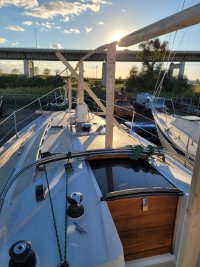
The backbone is simply 2x4 posts with 1x3 firring strips bent over them. I'll have some thoughts about this at the end of the process. Keep in mind, we drove seven hours, took some measurements, went to the lumber yard, and then built this beautiful structure all before 6pm. That is, give me a break, we were tired before we started cutting. Also, given that I can be the world's slowest woodworker, I kept telling myself all day, "It does not need to be beautiful. Nobody will see under the tarps. It is temporary. Just build the thing. Jigsaws and screws are not for fine craftsmanship."

(Note in the second picture, you can see an upside down plastic trash can tied down over the mast hole. Given the water that was accumulating on the white tape covering that hole, I'd recommend this simple solution to anyone keeping the mast off their boat for more than a day or two.)

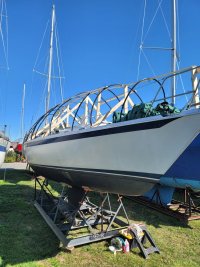
End of day 2:
Moon Shadow winter covering day 2.jpg
Now you can see the "big idea" starting to come together and fail all at the same time. That is 1" water line. After bracing the center posts, we bent the water line into arches, in desperate hopes to of creating a structure that would still allow me to move around underneath after covering the boat. We failed at this goal of easy access after covering. I think we succeeded, though, it building a structure that would limit snow and ice accumulation.

We drilled holes and used zip ties to attach the water line to the stanchion plates and the spine of the structure. My brother suggested, repeatedly, that I should take down the stanchions and lifelines completely, and just use the 2x4 frame as support for my tarps.

I did not listen to such foolishness. :p I had a plan in my head that I was determined to see finished. Surely, this was the simpler option.....

But in the end, he was correct. Without the mast and boom, we had created a frame that was more weak, cumbersome, and costly than necessary. I did not want the wait of the heavy tarp nor snow-load to press my stanchions out. Going around the stanchions is common enough for "flush deck" style winter covers, but those covers have slits/openings where they meet any standing rigging or lifelines. They are also, as the name implies, flush to the deck.

Securing the tarps around the obstacles was a pain. I made it extra difficult by deciding to use the "old, old" running rigging as my lines, and I did not want to cut those lines into pieces either. (I am not sure why, since I don't really know what else to do with 20 year old lines. I really need help sorting out "what stuff" that was in the storage unit is worth keeping, for any reason.)

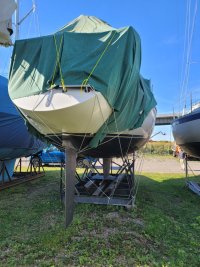
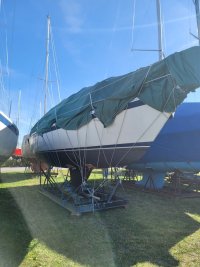
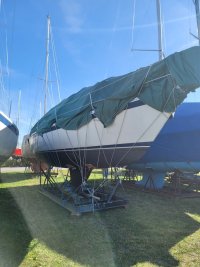
Final result:
Moon Shadow winter covering finish1.jpgMoon Shadow winter covering finish2.jpg
Moon Shadow winter covering finish3.jpg

The bow of the boat is pointing to the most likely direction of the wind. So, the forward tarp overlaps "on top" of the aft tarp. You can see the big issue with my stubborn refusal to remove the stanchions. I don't think that tarp is going anywhere, unless it simply tears from old age in high winds. Compared to her neighbors on the hard, though, Moon Shadow has the ugliest dress at the ball. :esad:

I do have access into the cockpit from the starboard side. Once inside, standing room in the cockpit, but accessing the foredeck involves quite a bit of gymnastics.

Next year will be better!
 

Christian Williams

E381 - Los Angeles
Senior Moderator
Blogs Author
As a resident of a no-snow zone, I innocently wonder why hauled-out yachts are covered in snowy climes. That is, why covering the cockpit only, with its drains, might not be be sufficient.

No doubt there's an obvious answer. But gelcoat is pretty tough, and of course boats in more brutal UV latitudes endure 12 months uncovered.
 

Prairie Schooner

Jeff & Donna, E35-3 purchased 7/21
As a resident of a no-snow zone, I innocently wonder why hauled-out yachts are covered in snowy climes. That is, why covering the cockpit only, with its drains, might not be be sufficient.

No doubt there's an obvious answer. But gelcoat is pretty tough, and of course boats in more brutal UV latitudes endure 12 months uncovered.

For me it comes down to the destructive power of freezing/expanding water. Our current climate change profile offers unpredictable cycles from 50º - 10º running November to April with varying amounts of precipitation. There are lots of nooks and crannies on a boat where water can seep in, and unpredictably so. Anyplace two parts come together. Also, if the boat is just sitting for six months, might as well also protect it from UV damage. Additionally, a cover makes a somewhat more comfortable envelope for working on the boat in marginal weather.

Yet, there are people in northern climes, some in our august community here, who do not cover their boats in winter and still sail them from year to year. So, clearly there are different opinions and experiences.
 

bsangs

E35-3 - New Jersey
As a resident of a no-snow zone, I innocently wonder why hauled-out yachts are covered in snowy climes. That is, why covering the cockpit only, with its drains, might not be be sufficient.

No doubt there's an obvious answer. But gelcoat is pretty tough, and of course boats in more brutal UV latitudes endure 12 months uncovered.
Along with what Jeff said, there's the weight issue of accumulated snow too. A couple years ago, one of our liveaboard marina neighbors was away on a two-week business trip. He doesn't cover his boat during winter. We had a significant snowfall, followed by an icing event, and no thawing warm up in the forecast. When I went to the marina to check on my shrink-wrapped boat following the storm, noticed this neighbor's boat was wayyyy too low in the water. A few of us set about removing the snow and ice before anything bad happened. I assume that additional weight can be potentially problematic to uncovered boats stored on the hard as well, though I have no firsthand experience with it. With the shrink wrap, the snow just slides off.
 

JP in Sandusky

E38 on Lake Erie
As a resident of a no-snow zone, I innocently wonder why hauled-out yachts are covered in snowy climes. That is, why covering the cockpit only, with its drains, might not be be sufficient.

No doubt there's an obvious answer. But gelcoat is pretty tough, and of course boats in more brutal UV latitudes endure 12 months uncovered.
I'm new, so I'm largely going with what everyone else around here is doing. My thinking is similar to @Prairie Schooner. It is about freeze/thaw cycles. I suspect my hatches and portlights would not survive more than a dozen freeze/thaw cycles.

It is not "just boats," though, that get these efforts. Garden sheds, barns, and garages fill to the brim every October and November. All types of outdoor accessories are piled in for good keeping.

Our patio furniture is stored inside. It is amazing what the expanding power of water freezing can do to woven furniture, glass tables, and even wooden porch swings. Hammock, tractors, window boxes for flowers, mowers, bicycles, ..... it is all covered or put indoors. Extra critical if bigger horizontal surfaces are involved, snow can is heavy. Shoveling snow is one of the leading causes of heart attacks around here.

As to drains, we have a drain at the bottom of our basement steps, which connects to our foundation perimeter drain. If sleet comes, followed by a hard freeze, that drain will freeze over. If I forget about it, we can accumulate a couple of feet of water against our basement door, if it rains hard enough, which all eventually presses around the weather stripping and floods the basement. I am a slightly concerned about this for the boat, actually. If the "gutter drains" (? not sure what they are called, drains at the edges of the side decks, foreward of the cockpit) freeze over, I am not sure how much ice might accumulate on the edges of the deck/hull joint.

I'd move to SoCal, NC, or GA if I could get the rest of the family to commit. Morehead City, NC in the summer months, then sail toward the Virgin Islands in November...... :egrin:
 

windblown

Member III
Blogs Author
As a resident of a no-snow zone, I innocently wonder why hauled-out yachts are covered in snowy climes. That is, why covering the cockpit only, with its drains, might not be be sufficient.

No doubt there's an obvious answer. But gelcoat is pretty tough, and of course boats in more brutal UV latitudes endure 12 months uncovered.
Avoiding an accumulation of snow requires a cover in our area. Imagine a build-up of 12“ -24” in the cockpit, burying winches, traveler, clutches, and tracks, and weighing down on hatches and anchor locker. Now imagine that accumulation going through cycles of melting and freezing over a period of weeks or months while additional snowfalls build on top. The snow and ice on the deck make it treacherous to attempt checking on the boat or systems for many weeks,
With a winter cover, the snow and rain run off, and a cozy tent allows access to work in the cockpit or concentrate on projects below deck. Antifreeze can be replenished in hoses or bilge as needed, and the boat and skipper can hibernate.
In the spring, the cover that has captured dirt and grime comes off, and spring cleaning is manageable. Without a cover, every crevice and intersection of deck and hardware would have to be cleaned.
 

Joliba

1988 E38-200 Contributing Member
As a resident of a no-snow zone, I innocently wonder why hauled-out yachts are covered in snowy climes. That is, why covering the cockpit only, with its drains, might not be be sufficient.

No doubt there's an obvious answer. But gelcoat is pretty tough, and of course boats in more brutal UV latitudes endure 12 months uncovered.
I have owned a keelboat stored outdoors in a snowy region north of Chicago every year since 1981. Other than a couple of years with a cover, I have mostly gone without a full cover and never used shrink wrap. Since owning the E38-200 beginning in 2008, we have only covered the cockpit usan inexpensive tarp.
I have never detected any damage attributable to snow or ice. I contend that the worst wear and tear to the boats is caused by UV exposure when there is much more direct sunlight during the sailing season.
The common practice of shrink wrap plastic strikes me as an expensive and unnecessary environmental waste burden.
 

Kenneth K

1985 32-3, Puget Sound
Blogs Author
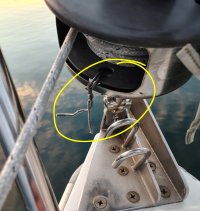
I should probably post this elsewhere, but it is related to winterization. The old Harken furlers have a locking feature (2 holes that line up) between the rotating drum and outer basket. I think the manual says you can actually insert a padlock if desired.
IMG_20251102_163833053_HDR~2.jpg

May prevent some of those classic photos of runaway jibs flailing around wildly under strong winter winds.
 

Dave G.

1984 E30+ (SOLD)
I just used an 15 x 20 plastic "tarp" and covered from the mast back to the stern to keep the snow and ice out of the cockpit. A lot of folks around here do not wrap or cover at all. As others have said UV is much more detrimental to these boats than rain or snow. The only concern I would have with a canvas cover is that snow may stick to that surface more than plastic and create a lot of weight on that tent you have. Maybe have a look after the first significant snowfall to be safe :)
 

JP in Sandusky

E38 on Lake Erie
I have owned a keelboat stored outdoors in a snowy region north of Chicago every year since 1981. Other than a couple of years with a cover, I have mostly gone without a full cover and never used shrink wrap. Since owning the E38-200 beginning in 2008, we have only covered the cockpit usan inexpensive tarp.
I have never detected any damage attributable to snow or ice. I contend that the worst wear and tear to the boats is caused by UV exposure when there is much more direct sunlight during the sailing season.
The common practice of shrink wrap plastic strikes me as an expensive and unnecessary environmental waste burden.
Now this is interesting. Other than a few smaller boats on road trailers, everything I saw in Buffalo seemed to be covered or being actively framed to be covered. The majority of my concern with covering the boat is related to the high winds that happen at the eastern end of Lake Erie, and the damage a flapping cover would cause.

I'm going to continue collecting opinions on this. It would be nice to not need to spend a day or two doing this every fall and spring.
 

JP in Sandusky

E38 on Lake Erie
I just used an 15 x 20 plastic "tarp" and covered from the mast back to the stern to keep the snow and ice out of the cockpit. A lot of folks around here do not wrap or cover at all. As others have said UV is much more detrimental to these boats than rain or snow. The only concern I would have with a canvas cover is that snow may stick to that surface more than plastic and create a lot of weight on that tent you have. Maybe have a look after the first significant snowfall to be safe :)
Another Great Lakes participant that is recommending not covering, or not covering the entire deck. I'm going to be having more conversations about this next summer at the club. There does not seem to be a consensus on best practice or even recommended practice when it comes to winter storage. (Well, the boat yard in Sandusky "strongly encourages" indoor storage, so there is that.)

Regarding the canvas: I has some of the same thinking. While waxed canvass is used for "cowboy tents," those structures are visited and heated with a camp stove. Based on the set-up of the boat and comments from folks I met in Vermont, I've been running on the assumption that the original owner of Moon Shadow knew what he was doing. The boat certainly seems to be in excellent condition decades later. That is, for this year, I had decided to try to mimic what the original owner was doing, as much as I could figure that out. So, I just used the tarps that we found in storage.

I'm glad to have everyone here sharing your experiences. Now I see two of you are in the same region, dealing with the same weather, and you do not cover your boats. Maybe @Christian Williams is onto something. I had a pretty strong opinion that water freezing under my hatches would damage them, but it appears that might not be the case.

Parden me while I go into my Winnie-the-Pooh mode, sitting on my log.....Think, think, think....
 

Joliba

1988 E38-200 Contributing Member
One winter, in about 1990, I decided to construct an elaborate frame out of PVC pipe and covered my entire Sabre 30 with a black plastic-coated tarp. At the time, a coal-burning power plant was operating very near the boat yard. Winter gales would whip up the coal dust from the “mountains” of stored fuel, adding to the soot from the smokestacks that would settle in the yard in calmer weather.
The sides of the tarp, flogging hard in the strong winds, simply ground the evil black dust into the white topsides of my boat’s hull. The hours of work to erect the frame and laboriously attempt to clean the mess in the spring convinced me to go uncovered in subsequent years.
The following year, the melting snow miraculously scoured the coating of black dust from the boat like an advancing glacier. After a rinsing by early spring rains the boat was cleaner than when I had hauled her in the fall… I threw away the tarp and the frame.
 
Last edited:

Prairie Schooner

Jeff & Donna, E35-3 purchased 7/21
On the Other Hand

x 2025 f_46 sm.jpeg

x 2025 t_46 sm.jpeg

These are a couple of our neighbors in the winter boat yard. I guess the next steps are a full tent or indoor storage. If we had unlimited boat bucks, I'd do something like this. I'll bet they're easier to install than the two-part homemade waxed-canvas homeless tent we inherited with our boat. Otherwise it would take 10-15 years to pay for itself against shrink-wrap fees. Highly unlikely we'll have the boat that long. And for boats of our vintage it would barely make a blip on resale value.
 

JP in Sandusky

E38 on Lake Erie
I'll bet they're easier to install than the two-part homemade waxed-canvas homeless tent we inherited with our boat. Otherwise it would take 10-15 years to pay for itself against shrink-wrap fees. Highly unlikely we'll have the boat that long. And for boats of our vintage it would barely make a blip on resale value.
I would have thought it impossible to envy a stranger's boat cover. I find I do occasionally, though. To your point, I doubt there is any more functional benefits to some of the nicer covers I see, other than ease of installation.

I have been watching the weather this past week. Buffalo had winds of 68 MPH. Lake Erie had a seiche of over 4'. I wonder if the boats on bubblers on the western end went to the mud.

I suppose this is all normal. You are all likely accustomed to it. As a rookie owner, I think I must be mad to leave my new toy in a place with predictably intense weather.
 

Dave G.

1984 E30+ (SOLD)
Yes if money is NO object all those full covers are very nice indeed. That being said I do not think those boats will fair the winter any better than just covering the cockpit IMHO. Also those covers move, shake, and rattle in the wind which may cause other issues of chafe, wear, etc. Turns out fiberglass is pretty tough stuff when it comes to weather :)
 

ky ed

Extreme Adventurer. E27 trailer sailor from Iowa
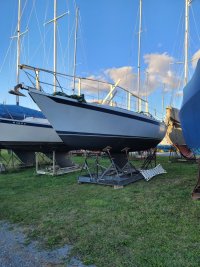
I have a new to me e-27 on trailer in iowa.
Im concerned with any amount of water getting into the deep sump, freezing, expanding and splitting apart keel. I think my best line of defense is to drill a hole into sump and install a garboard drain. Thit im doing today after work.
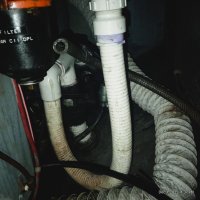
Along with that im concerned with cockpit drain hoses retaining water in the drooping loops of pvc spa drain hoses. While im drilling holes into my new boat i figure what the hell i might as well drill a small hole in the low spots to allow water to drain out before it freezes and ruptures the hoses. Come spring time i plan to run self tapping stainless steel screws into holes i drilled in low parts of hoses.
1000005746.jpg1000005747.jpg Eventually i will change out spa pvc flex hose to decent wire reinforced hoses. Money is tight right now so its a project for later date.
 

Kenneth K

1985 32-3, Puget Sound
Blogs Author
i figure what the hell i might as well drill a small hole in the low spots to allow water to drain out before it freezes and ruptures the hoses.
Maybe I'm not following you. If you drill a hole in the white U-shaped hose, won't water from the cockpit fill the hull and ultimately sink your boat?
 

Prairie Schooner

Jeff & Donna, E35-3 purchased 7/21
I have a new to me e-27 on trailer in iowa.
Im concerned with any amount of water getting into the deep sump, freezing, expanding and splitting apart keel. I think my best line of defense is to drill a hole into sump and install a garboard drain. Thit im doing today after work.
Along with that im concerned with cockpit drain hoses retaining water in the drooping loops of pvc spa drain hoses. While im drilling holes into my new boat i figure what the hell i might as well drill a small hole in the low spots to allow water to drain out before it freezes and ruptures the hoses. Come spring time i plan to run self tapping stainless steel screws into holes i drilled in low parts of hoses.
Eventually i will change out spa pvc flex hose to decent wire reinforced hoses. Money is tight right now so its a project for later date.

Hi Kyle,

I had a little incident that made me lose trust in the water sealing properties of self-tapping screws. Granted, what you're proposing wouldn't have near the water pressure of my hole in the hull. Also, it looks like there's a lot of other PVC in that drain circuit. A surveyor would certainly call that out. But I understand, the expenses can add up quickly.

Ken has a good point, though as I understand it, your winter storage is on land. Still, any water would end up in the bilge. You'd definitely want that 'master' drain.

I grew up in Council Bluffs and am scratching my head on where you'd sail a 27' boat. I can't imagine there's enough deep water in Manawa. A friend had a Catalina 25 on Lake Cunningham, but there was barely enough room to tack there. I don't remember if his boat was a shoal draft.

Cheers,
Jeff
 

ky ed

Extreme Adventurer. E27 trailer sailor from Iowa
Hey jeff.
I will use manawa as a test of every thing. Plan on trailering to Saileorville near Des Moines figure that will be main go to lake. Redrock South East Iowa perhaps, Laka Sacagawea in South Dakota. Really liked Grand Lake of Cherokees in Oklahoma when my son and I canoed from oklahoma City to the Gulf. Man now that was a real journey in self reliance, becoming real men, enduring true hardships and the accomplishment of dipping paddles into salt water! My son lived like savages and we are so in tune with each other after that. Im a real adventure kind of guy i guess. Great lakes are all with in reach. I also did my own Great Loop. Sioux City to Key West on a 25 ODay. That was a trip i dreamed of since i was 13. 63 now and where did all the time go? Are we near the same age Jeff?
 

Prairie Schooner

Jeff & Donna, E35-3 purchased 7/21
Hey jeff.
I will use manawa as a test of every thing. Plan on trailering to Saileorville near Des Moines figure that will be main go to lake. Redrock South East Iowa perhaps, Laka Sacagawea in South Dakota. Really liked Grand Lake of Cherokees in Oklahoma when my son and I canoed from oklahoma City to the Gulf. Man now that was a real journey in self reliance, becoming real men, enduring true hardships and the accomplishment of dipping paddles into salt water! My son lived like savages and we are so in tune with each other after that. Im a real adventure kind of guy i guess. Great lakes are all with in reach. I also did my own Great Loop. Sioux City to Key West on a 25 ODay. That was a trip i dreamed of since i was 13. 63 now and where did all the time go? Are we near the same age Jeff?

Those sound like good options, Kyle. My sister lives in Omaha and my brother-in-law likes Merritt for fishing. Last time I saw Lake Manawa there were a lot of lily pads. What does your E27 draw? What year, model is it?* Is it shoal draft? I'm surprised the boat ramp would go deep enough to launch a fin keel sailboat. But I haven't been on the lake in many decades. Remember, tack on the bump!
Those sound like some real cool adventures. Doubly cool to do them with your son.
I'm a bit older than you, at 70. Lewis Central, class of 1973.
Cheers,
Jeff

p.s. *You might want to put your boat model, year, and engine type in your signature line. I find it helps me get more targeted advice. Go to the blue strip at the top of the page, click on your name/purple K and you should see a menu where you can click on 'signature'.
 
Top