
JP in Sandusky
E38 on Lake Erie
Thanks to several folks here, I was reminded to winterize my cockpit drains when we covered Moon Shadow a couple of weeks ago. This is, well, not really up to my standards. Knowing what I know now, if we use the tarps again next year, I expect I will do a few things differently.
Two large waxed canvas tarps were in-storage when we purchased the boat, included with the various kit that was included in the purchase. The PO had been having the yard shrink wrap the boat, but I gather the original owner had used these tarps. They show some age, but the tarps were in surprisingly usable condition. The tarps were marked with sharpie in a few places; for example "mast center, bow." My brother and I generally used these labels as our starting point.
Our real issue is the mast is still un-stepped from shipping the boat across the state of New York. So, without a mast or boom, we got a little. . . . . "creative."
Day 1
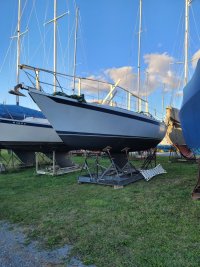
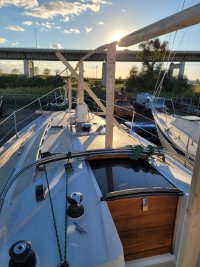
The backbone is simply 2x4 posts with 1x3 firring strips bent over them. I'll have some thoughts about this at the end of the process. Keep in mind, we drove seven hours, took some measurements, went to the lumber yard, and then built this beautiful structure all before 6pm. That is, give me a break, we were tired before we started cutting. Also, given that I can be the world's slowest woodworker, I kept telling myself all day, "It does not need to be beautiful. Nobody will see under the tarps. It is temporary. Just build the thing. Jigsaws and screws are not for fine craftsmanship."
(Note in the second picture, you can see an upside down plastic trash can tied down over the mast hole. Given the water that was accumulating on the white tape covering that hole, I'd recommend this simple solution to anyone keeping the mast off their boat for more than a day or two.)
End of day 2:
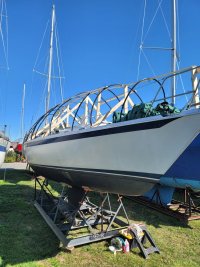
Now you can see the "big idea" starting to come together and fail all at the same time. That is 1" water line. After bracing the center posts, we bent the water line into arches, in desperate hopes to of creating a structure that would still allow me to move around underneath after covering the boat. We failed at this goal of easy access after covering. I think we succeeded, though, it building a structure that would limit snow and ice accumulation.
We drilled holes and used zip ties to attach the water line to the stanchion plates and the spine of the structure. My brother suggested, repeatedly, that I should take down the stanchions and lifelines completely, and just use the 2x4 frame as support for my tarps.
I did not listen to such foolishness. I had a plan in my head that I was determined to see finished. Surely, this was the simpler option.....
But in the end, he was correct. Without the mast and boom, we had created a frame that was more weak, cumbersome, and costly than necessary. I did not want the wait of the heavy tarp nor snow-load to press my stanchions out. Going around the stanchions is common enough for "flush deck" style winter covers, but those covers have slits/openings where they meet any standing rigging or lifelines. They are also, as the name implies, flush to the deck.
Securing the tarps around the obstacles was a pain. I made it extra difficult by deciding to use the "old, old" running rigging as my lines, and I did not want to cut those lines into pieces either. (I am not sure why, since I don't really know what else to do with 20 year old lines. I really need help sorting out "what stuff" that was in the storage unit is worth keeping, for any reason.)
Final result:
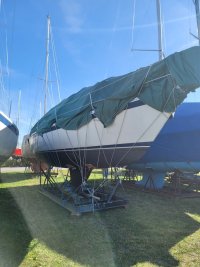
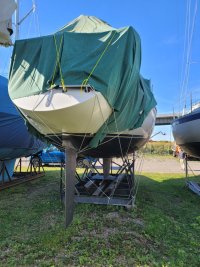
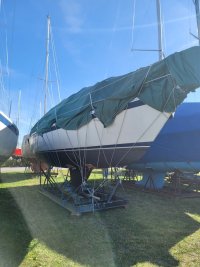
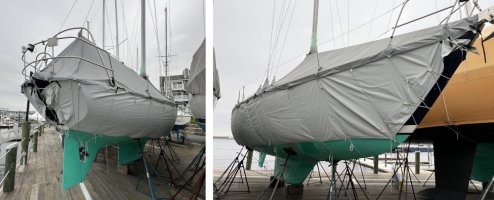
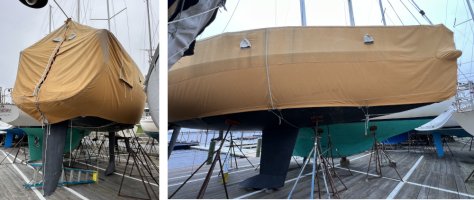
The bow of the boat is pointing to the most likely direction of the wind. So, the forward tarp overlaps "on top" of the aft tarp. You can see the big issue with my stubborn refusal to remove the stanchions. I don't think that tarp is going anywhere, unless it simply tears from old age in high winds. Compared to her neighbors on the hard, though, Moon Shadow has the ugliest dress at the ball.
I do have access into the cockpit from the starboard side. Once inside, standing room in the cockpit, but accessing the foredeck involves quite a bit of gymnastics.
Next year will be better!
Two large waxed canvas tarps were in-storage when we purchased the boat, included with the various kit that was included in the purchase. The PO had been having the yard shrink wrap the boat, but I gather the original owner had used these tarps. They show some age, but the tarps were in surprisingly usable condition. The tarps were marked with sharpie in a few places; for example "mast center, bow." My brother and I generally used these labels as our starting point.
Our real issue is the mast is still un-stepped from shipping the boat across the state of New York. So, without a mast or boom, we got a little. . . . . "creative."
Day 1
The backbone is simply 2x4 posts with 1x3 firring strips bent over them. I'll have some thoughts about this at the end of the process. Keep in mind, we drove seven hours, took some measurements, went to the lumber yard, and then built this beautiful structure all before 6pm. That is, give me a break, we were tired before we started cutting. Also, given that I can be the world's slowest woodworker, I kept telling myself all day, "It does not need to be beautiful. Nobody will see under the tarps. It is temporary. Just build the thing. Jigsaws and screws are not for fine craftsmanship."
(Note in the second picture, you can see an upside down plastic trash can tied down over the mast hole. Given the water that was accumulating on the white tape covering that hole, I'd recommend this simple solution to anyone keeping the mast off their boat for more than a day or two.)
End of day 2:
Now you can see the "big idea" starting to come together and fail all at the same time. That is 1" water line. After bracing the center posts, we bent the water line into arches, in desperate hopes to of creating a structure that would still allow me to move around underneath after covering the boat. We failed at this goal of easy access after covering. I think we succeeded, though, it building a structure that would limit snow and ice accumulation.
We drilled holes and used zip ties to attach the water line to the stanchion plates and the spine of the structure. My brother suggested, repeatedly, that I should take down the stanchions and lifelines completely, and just use the 2x4 frame as support for my tarps.
I did not listen to such foolishness.
I had a plan in my head that I was determined to see finished. Surely, this was the simpler option.....But in the end, he was correct. Without the mast and boom, we had created a frame that was more weak, cumbersome, and costly than necessary. I did not want the wait of the heavy tarp nor snow-load to press my stanchions out. Going around the stanchions is common enough for "flush deck" style winter covers, but those covers have slits/openings where they meet any standing rigging or lifelines. They are also, as the name implies, flush to the deck.
Securing the tarps around the obstacles was a pain. I made it extra difficult by deciding to use the "old, old" running rigging as my lines, and I did not want to cut those lines into pieces either. (I am not sure why, since I don't really know what else to do with 20 year old lines. I really need help sorting out "what stuff" that was in the storage unit is worth keeping, for any reason.)
Final result:
The bow of the boat is pointing to the most likely direction of the wind. So, the forward tarp overlaps "on top" of the aft tarp. You can see the big issue with my stubborn refusal to remove the stanchions. I don't think that tarp is going anywhere, unless it simply tears from old age in high winds. Compared to her neighbors on the hard, though, Moon Shadow has the ugliest dress at the ball.
I do have access into the cockpit from the starboard side. Once inside, standing room in the cockpit, but accessing the foredeck involves quite a bit of gymnastics.
Next year will be better!