Yet another Racor thread

Phr3d

Member III
I hesitate to burden you all with another task, but you are a really good people to talk with about this kind of thing.

The filter debacle (clogged) has produced some remarkable (only in the sense of "making a remark") data and also exposed some problems that probably need to be dealt with now. I am going to have to buy some parts for the model on the boat (several aspects have been "improved" and various parts have been superseded) and was having difficulty locating part numbers until I spoke with the Racor tech support guy in Mississippi.

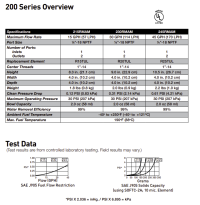
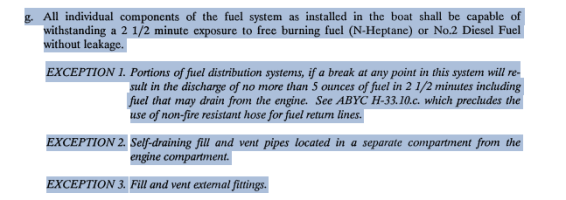
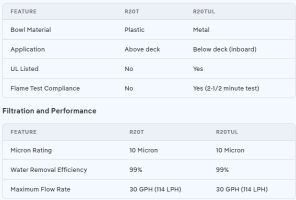
  1. The coastguard no longer approves a filter with a plastic sight bowl; that is without a metal heat shield - and may (will?) cite if boarded.
  2. The parts to upgrade my filter (200 series) will approach the cost of another filter.
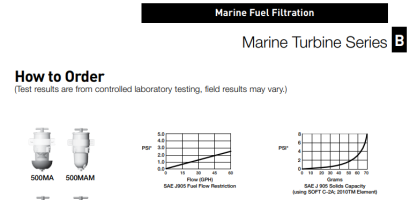
  3. The solids capacity is reduced on the model that has both the sight bowl and the metal shield (turbine 500MA).
  4. Putting a vacuum gauge with a drag pointer (to monitor filter life) is more straightforward on the turbine version.
  5. Changing this stuff is expensive unless going to a used product on ebay...

Thoughts?


1772722668367.png1772722668377.png
 

Loren Beach

O34 - Portland, OR
Senior Moderator
Blogs Author
I have a blog entry about my change from the OEM Racor to a remote-mount 500 series Racor. One of my better changes, if I do say so. Note that Christian posted some good information about the supposed requirement for the flame shield.

I believe that the USCG detail you have heard about is part of a larger list of ABYC requirements for the engine compartment regarding fire safety.
I have never heard of a routine "safety boarding" that included any (as in zero) demands to inspect an engine compartment. All that said, you boat in a different USCG District than do I. Perhaps others in your area will weigh in with information.

Speaking of Racor filtering, check out reply #18 in this prior thread, https://ericsonyachts.org/ie/threads/layla-ii-has-been-treated-to-new-hull-paint-color.9588/
 
Last edited:

bsangs

E35-3 - New Jersey
1. The coastguard no longer approves a filter with a plastic sight bowl; that is without a metal heat shield - and may (will?) cite if boarded.
We do a voluntary safety check every season. The USCG rep comes around our marina, asks if we'd like a check. I've always said, "Yes." (If you pass, you get a nice mast sticker that says you're compliant, and my overachieving wife will never say no to an achievement sticker. Ever.) He checks the engine bay, including the Racor filter and we have always had a plastic sight bowl. In fact, just replaced the entire housing early last season and the new one has a plastic sight bowl. We've never been dinged for it, or told to replace it. I'm having a hard time figuring out how a "sight bowl" with no ability to sight is even remotely helpful.
 

Loren Beach

O34 - Portland, OR
Senior Moderator
Blogs Author
I pass a Vessel Safety Check (receiving a spiffy new sticker!) every year for the last (at least) 3 decades. The engine room is not on the standardized list of items to be inspected, and has never been mentioned. The inspector is almost always a member of the USCG Aux.
The "list" is pretty basic, but we have always considered it a nice way to get into a safety-oriented mind set for a new season of sailing/cruising. Also a good reminder to take all the fire extinguishers in for their annual checkup. And... check to see if we still have at least one 3-pack of flare shells within their three year date ( a requirement to pass).
It's also a reminder to check all... the exterior navigation lighting for function!

Link: https://cgaux.org/vsc/
 

Christian Williams

E381 - Los Angeles
Senior Moderator
Blogs Author
My surveyor (eight years ago) cited the Racor for no flame shield. I argued to the insurance company that they were not required for diesel. The guy at Geico shrugged and said he would not require the change.

If buying a new one, choose flame shield (no retrofit available). If using an old one, argue ambiguity of regulation.
 

Frank Langer

1984 Ericson 30+, Nanaimo, BC
So how would the shield make a significant difference in a fire, when the fuel hose from the tank to the Racor filter is rubber, ie. flammable?
Frank
 

Loren Beach

O34 - Portland, OR
Senior Moderator
Blogs Author
So how would the shield make a significant difference in a fire, when the fuel hose from the tank to the Racor filter is rubber, ie. flammable?
The standard that is to be theoretically met is the number of seconds or minutes before a smaller fire burns thru plastic and rubber to release more fuel into the compartment (i.e. buying some time). IIRC, the flame shield requirement for the fuel filter bowl is related to gasoline engines, but confess that I have not read the ABYC guidelines. A consult with a good surveyor should produce some enlightenment. Hopefully.
 

ConchyDug

Member III
Man I'd tell the Puddle Pirates/Aux Puddle Pirates to pound sand and move the bowl outside the engine compartment depending if the state requires it. Recreational boats do not require a COI and Vessel Safety Checks are just that voluntary. You however have to stay compliant with state laws, which as we know vary a bit. If you own an "Inspected Vessel"(for hire) I'd assume you know the requirements which are mandatory and covered in the CFRs, but you personal boat that isn't for "hire" is not required to adhere to them.
 

Phr3d

Member III
1772800152598.png


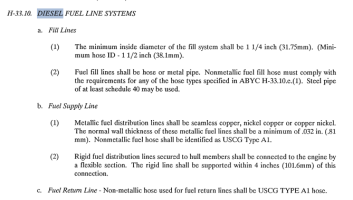
So page 2 of the ABYC (coincidentally this document has the same printing as my boat was built - 1990) has this:

1772798514273.png
Page 13 talks about fuel line:
1772798676908.png

Pages 14 and 15 (https://law.resource.org/pub/us/cfr/ibr/001/abyc.H-33.1989.pdf) go into detail about how to do clamps well.


My main goals have been influenced by riding a tandem bike with my wife for literally thousands of miles. She didn't like getting flats or the bike to break. We now have about 1500 miles on the boat.

So, I've (maybe subconsciously) thought not sinking or not getting stranded will keep my wife happy. I suppose now I have to add not catching fire to this list.

Boarding seems more the hassle described above (and other places linked) but the concern about insurance $$$ being affected by questionable fuel delivery pieces (also mentioned elsewhere) seems reasonable.

I like that diesel is "less flammable" than gasoline (https://fireemergencytips.com/is-diesel-flammable). But it still burns. Making sure the stuff doesn't get loose in the boat seems to make changing the fuel lines a good idea too....

Still not sure what the best course of action is on the filter...
 

Phr3d

Member III
The "in the boat" from ABYC apparently can be interpreted as "above deck" and "below deck".

1772932111437.png
 

mjsouleman

Mark "Souleman" Soule
Moderator
I have taken the Coast Guard Auxiliary Vessel Safety Exam and pending 4 supervised examinations, will be conducting VSC's this Spring. The following is taken from the official documentation:

VESSEL SAFETY CHECK (VSC)
To be completed by a U.S. Coast Guard approved Vessel Examiner.
See the back of this form for a brief explanation of required items.
A Federal Requirements pamphlet is also available.

VESSEL SAFETY CHECK DECAL REQUIREMENTS
Item Yes No N/A
1. Display of Numbers
2. Registration/Documentation
3. Personal Flotation Devices (PFD)
4. Visual Distress Signals (VDS)
5. Fire Extinguishers
6. Ventilation
7. Backfire Flame Control
8. Sound Producing Devices/Bell
9. Navigation Lights
10. Pollution Placard
11. MARPOL Trash Placard
12. Marine Sanitation Devices
13. Navigation Rules
14. State and/or Local Requirements
15. Overall Vessel Condition: as applies
a. Deck Free of Hazards / Clean Bilge
b. Electrical - Fuel Systems
c. Galley - Heating Systems

In the Brief Explanation of VSC Required Items Section
Under - 15. OVERALL BOAT CONDITION: As it applies to this
Vessel. Including, but not limited to:

b. Electrical and Fuel Systems: The electrical system must be
protected by fuses or manual reset circuit breakers. Switches and fuse panels
must be protected from rain or water spray. Wiring must be in good condition,
properly installed and with no exposed areas or deteriorated insulation.
Batteries must be secured and terminals covered to prevent accidental arcing..
If installed, self-circling or kill switch mechanism must be in proper
working order. All PWCs require an operating self circling or kill switch
mechanism.
Fuel Systems - Portable fuel tanks (normally 7 gallon capacity or less)
must be constructed of non-breakable material and free of corrosion and leaks.
All vents must be capable of being closed. The tank must be secured and
have a vapor-tight, leak-proof cap. Each permanent fuel tank must be properly
ventilated.
 

Phr3d

Member III
I have taken the Coast Guard Auxiliary Vessel Safety Exam and pending 4 supervised examinations, will be conducting VSC's this Spring. The following is taken from the official documentation:

VESSEL SAFETY CHECK (VSC)
To be completed by a U.S. Coast Guard approved Vessel Examiner.
See the back of this form for a brief explanation of required items.
A Federal Requirements pamphlet is also available.

VESSEL SAFETY CHECK DECAL REQUIREMENTS
Item Yes No N/A
1. Display of Numbers
2. Registration/Documentation
3. Personal Flotation Devices (PFD)
4. Visual Distress Signals (VDS)
5. Fire Extinguishers
6. Ventilation
7. Backfire Flame Control
8. Sound Producing Devices/Bell
9. Navigation Lights
10. Pollution Placard
11. MARPOL Trash Placard
12. Marine Sanitation Devices
13. Navigation Rules
14. State and/or Local Requirements
15. Overall Vessel Condition: as applies
a. Deck Free of Hazards / Clean Bilge
b. Electrical - Fuel Systems
c. Galley - Heating Systems

In the Brief Explanation of VSC Required Items Section
Under - 15. OVERALL BOAT CONDITION: As it applies to this
Vessel. Including, but not limited to:

b. Electrical and Fuel Systems: The electrical system must be
protected by fuses or manual reset circuit breakers. Switches and fuse panels
must be protected from rain or water spray. Wiring must be in good condition,
properly installed and with no exposed areas or deteriorated insulation.
Batteries must be secured and terminals covered to prevent accidental arcing..
If installed, self-circling or kill switch mechanism must be in proper
working order. All PWCs require an operating self circling or kill switch
mechanism.
Fuel Systems - Portable fuel tanks (normally 7 gallon capacity or less)
must be constructed of non-breakable material and free of corrosion and leaks.
All vents must be capable of being closed. The tank must be secured and
have a vapor-tight, leak-proof cap. Each permanent fuel tank must be properly
ventilated.

Thanks for sharing this, it made me realize that there are multiple players in this - ABYC, Boat Builders, whoever the PO was and what was done to the boat prior, Coast Guard, Insurance, and others. I have to seriously doubt they will have identical lists.
 

Phr3d

Member III
My surveyor (eight years ago) cited the Racor for no flame shield. I argued to the insurance company that they were not required for diesel. The guy at Geico shrugged and said he would not require the change.

If buying a new one, choose flame shield (no retrofit available). If using an old one, argue ambiguity of regulation.
Christian, I remember reading something about you putting in some plates for inspection on the fuel tank. Did you have to clean the tank? And, this is now way off-thread, but was there sludge in the tank?
 

Phr3d

Member III
So I pulled the gauge out of the tank and did an inspection through that opening. No sign of any accumulated matter. Every bead on every weld could be seen along all lower edges of the tank. I could not see the upper corners well though - that bugs me a little now. I guess I was assuming whatever may have been the clog would be lower in the tank or by the pickup tube but there was nothing in neither.

Internet literature indicates that diesel is produced with biocide. Dunno how long that is effective. I also read that letting the tank go nearly empty may cause more condensation build up. Going to the gas dock is a bit of a production but I guess I could swing past pretty easily with a 5 gallon jug and start doing a "regular" top-off instead of filling up with 12-17 gallons every 3-5 months.

I have to assume that not every fuel dock is equal and that those differences will cause results to vary on the 500 hour maintenance interval on the Racor and may require some consideration for what my brother the engineer calls "snake oil".

Bottom line, after replacing the Racor filter and priming, I did add some BioborMD ("Prevents corrosion and water build up, Reduces soot and smoke, etc.") and I have the biocide and plan to add both products next fill up.

The Yanmar runs great again.
 

peaman

Contributing Partner
Going to the gas dock is a bit of a production but I guess I could swing past pretty easily with a 5 gallon jug and start doing a "regular" top-off instead of filling up with 12-17 gallons every 3-5 months.
This is what I do. I haven't visited a fuel dock since the day I first took possession of my boat 5 years ago. My yellow diesel jug lets in enough light that I can see exactly what crap may have been in the fuel. I use a "rattle siphon" to go from jug to tank. I fill my jug at a roadside gas station, so there is no red dye in it: that makes it easy to see any contaminants in the fuel filter bowl.
 

Christian Williams

E381 - Los Angeles
Senior Moderator
Blogs Author
I could not see the upper corners well though -

On my tank there was no glop at all on the upper tank--it was all gravity. So no worries.
 
Top