Shaft Seal Leak - Yacht Sinks

Alan Gomes

Sustaining Partner
He has a packing gland though, be a little harder with a PSS for the shaft to leave the boat.
Not if you place a hose clamp or a zinc on the exposed portion of the shaft, placed between the front of the shaft log and the coupler.
 

Pete the Cat

Sustaining Member
I had a PSS bellows break on a delivery a couple decades ago with a full crew on nicely maintained Swan 48. We were going up the California coast from San Diego to San Francisco and were, at the time, quite a few miles offshore and had been motoring for a couple days (you don't sail on a Northbound delivery). First notice should have been the bilge alarm, but it apparently was inop (Learning: Always test the bilge pumps and alarm circuits before any offshore trip/ inspect engine and bilge compartments at least every two hours while underway--no matter what). A offwatch crew complaining of wet socks was. my first clue. The bellows had a slit in it and was actually spraying salt water mist all over the engine area but also was leaking profusely--bilge pumps had been running but we did not hear them. We ended up sailing the rest of the way to Sausalito from Monterey uphill because there was no way to repair this underway and the engine would not restart after we stopped it. Wrapped the seal with Saranwrap, towels and tape. My understanding that PSS has greatly improved the bellows construction since then. But this is the reason I do not recommend them for folks who are actually going to do offshore passages. You can repair and repack the old stuffing boxes underway and make them mostly dripless with some the proper materials and close attention to the break in process. Having said that, I think PSS works fine for most day and coastal sailors. But going offshore is different and requires a different mindset and prep.
 

Kenneth K

1985 32-3, Puget Sound
Blogs Author
I must admit I am confused about this -- I mean, the shaft takes up most of the space in there; I would have assumed I could stuff a sock, or cut up a T-shirt to get stuff to cram in around it to stop the leak, or slow it enough that the pump could keep up.

Not to try to make comparisons with what may may/not have happened here, but I did have a PSS rupture back in 2021. I did a blog post about it here.

I think the things that made my ordeal manageable were; 1) I heard the exact moment the seal ruptured and was able to start addressing the leak within a few minutes, 2) it was daylight in smooth water, and, 3) I had the initial bilge pump capacity (a rule 800 and and 500 pump) to stay ahead of the leak. Under these conditions I was able to take materials I had on hand (trash bags and zip-ties) and slow the leak enough that I could leave the boat, get more materials, and make temporary repairs that lasted until I could haul out days later.

But it's well worth running through the what-if scenarios: If you wake in the dark to find a salon full of water, how are you going to find the leak? Once underwater, you can't hear the leak any more, and may not see the water streaming in even if looking right at it. So now you're feeling around in the dark possibly on your belly or side. If your body is sloshing around or floating while doing so, you now likely need one hand just to hold your body steady. If a flashlight is in your other hand, how do you fix the leak? If you have a headlamp on, is it waterproof?

Also, once the water gets above the floorboards, all of the bilge access plates will have floated up off of the sole. Now you have six or eight open holes in your slippery floor. Just walking through the cabin is now a hazard. If you twist your ankle stepping any one of those open holes, yourself chances of fixing the leak or executing your self-rescue go down even further.
 
Last edited:

Christian Williams

E381 - Los Angeles
Senior Moderator
Blogs Author
On the E38 the shaft seal is at the level of the TAFG. Meaning if the bilge reaches the floorboards, it is still accessible or only awash.

If the cabin floor is well submerged, it would really challenge any solution.*

Personally I just cannot imagine being unaware of bilge level. You can hear the bilge pump go off, and that always requires investigation. We are fiberglass, not wood expected to leak in a storm.

When closing up the boat at the dock I leave the bilge cover off, so when I can return I see dry and replace cover. This is really just to confirm rainwater has been automatically pumped out. It also prompts me to wipe away slime and keep keel bolts exposed to air. Any time the bilge pump goes off it's a red flag and a fast check.

A bilge pump that never goes off is almost as concerning as one that does. Is it operative? Is the Water Witch or float functioning?

But boats do sink, so I am missing something here somewhere.

*The solution being to wrap a leaking dripless. I carry a fitted rectagle of Sunbrella for that, with wrapping line and hose clamps to secure the wrap. Wrapping a dripless means the prop can no longer spin, but the engine can run in neutral for battery charging and the boat can still be sailed.
 

Drewm3i

Marine Surveyor
I had a PSS bellows break on a delivery a couple decades ago with a full crew on nicely maintained Swan 48. We were going up the California coast from San Diego to San Francisco and were, at the time, quite a few miles offshore and had been motoring for a couple days (you don't sail on a Northbound delivery). First notice should have been the bilge alarm, but it apparently was inop (Learning: Always test the bilge pumps and alarm circuits before any offshore trip/ inspect engine and bilge compartments at least every two hours while underway--no matter what). A offwatch crew complaining of wet socks was. my first clue. The bellows had a slit in it and was actually spraying salt water mist all over the engine area but also was leaking profusely--bilge pumps had been running but we did not hear them. We ended up sailing the rest of the way to Sausalito from Monterey uphill because there was no way to repair this underway and the engine would not restart after we stopped it. Wrapped the seal with Saranwrap, towels and tape. My understanding that PSS has greatly improved the bellows construction since then. But this is the reason I do not recommend them for folks who are actually going to do offshore passages. You can repair and repack the old stuffing boxes underway and make them mostly dripless with some the proper materials and close attention to the break in process. Having said that, I think PSS works fine for most day and coastal sailors. But going offshore is different and requires a different mindset and prep.
I would be very tempted to use another, non-bellows style, of shaft seal.

Typically bellows are used when a u-joint or similar is employed (as on a sterndrive), as the driveshaft requires the ability to articulate the seal, aka bellows. For a shaft seal, bellows make no sense to me over something like a proper double-clamped steel reinforced tube.

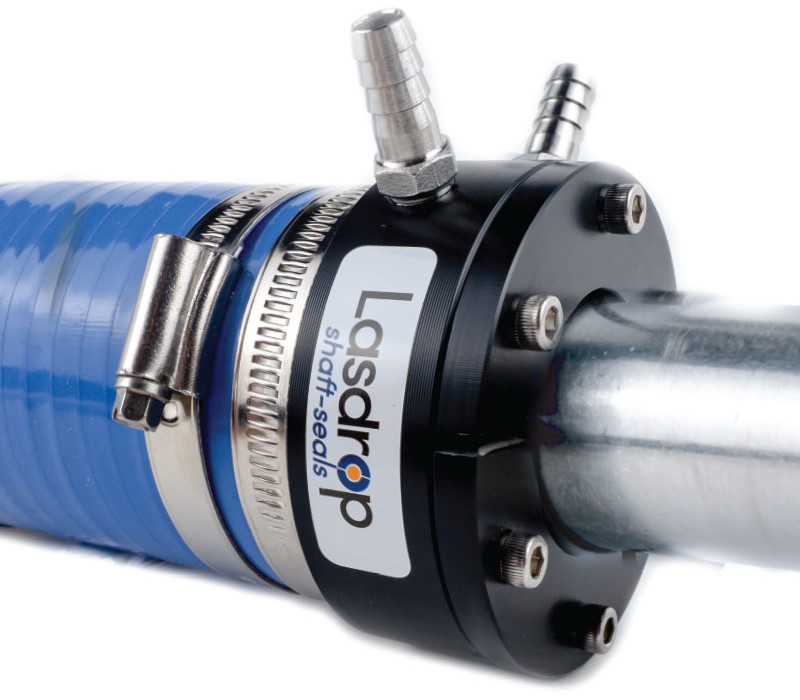
Something more like this:


Or this:


Dave G.

1984 E30+ (SOLD)
Something more like this:
Those also have rubber/plastic tubes that go between the rotor and shaft log. I personally believe the PSS seals to be the tried & tested product. I know nothing about the DSS & Glide products above and I don't know anyone that has installed either. I'm sure they work fine too but they all seem have the same basic design. Yes I guess there is a minute chance of a rupture but I would not feel in the least bit concerned going offshore with a PSS shaft seal.
 

bigd14

Sustaining Partner
Blogs Author
After finally getting the entire fuel system cleaned and all hoses replaced I was finally able to start the engine up. Yay! However other problems soon surfaced including a Volvo MDI (Mechanical Diesel Interface) starter problem which is a known issue for the D1-30 engine and for the purposes of this conversation, a janky PSS shaft seal.

The shaft seal unit appears to be sound, and the bellows are nice and firm with no cracking or damage. However, the bellows and the carbon flange are a bit misaligned, resulting in some minor leakage, especially at higher rpm’s. PYI put out a technical bulletin about this in 2019 and apparently offer a larger carbon flange to help with these misalignment issues.

I will be hauling the boat out in a month and had planned to replace the bellows, but seeing the misalignment I guess I should order a whole new unit from PSS with the oversized flange. Of course I will check the alignment between strut, stern tube and engine during the haulout.

Questions for the group:

1. For 34-2 owners can someone confirm stern tube size? I measured 1.75 inches but couldn’t get a fully accurate measurement as the bellows was in the way.

2. Has anyone dealt with a misaligned PSS like this? The service bulletin says to first try to move the bellows to align it better, then compress it more, before ordering a bigger carbon flange, but I am scared of doing this in the water in case I cause an irreversible leak.

3. I am aware of the opinions about a traditional stuffing box vs various shaft seal models. I do like a dry bilge with a minimum of fussing, and will be doing coastal cruising so plan on using a shaft seal style unit. I am most familiar with PSS shaft seal. Are there other models than the PSS that people have used and like better?

Thank you!


1780589531702.jpeg
 

Attachments

  • pyi-service-bulletin.pdf
    1.3 MB · Views: 4

Dave G.

1984 E30+ (SOLD)
My first thought is if the alignment is correct how could the seal be that far out of position ? Is your stern tube not parallel with the shaft ? My curiosity wants to know how the Volvo MDI senses that problem ?
 

bigd14

Sustaining Partner
Blogs Author
My first thought is if the alignment is correct how could the seal be that far out of position ? Is your stern tube not parallel with the shaft ? My curiosity wants to know how the Volvo MDI senses that problem ?
Unknown about alignment, I’ll investigate during haulout. The MDI issue is completely separate.

I should have put this discussion into a Maintenance and Mechanical discussion oops.
 

Loren Beach

O34 - Portland, OR
Senior Moderator
Blogs Author
It's been a while, close to a decade, but I once had some spray coming from our PSS face seal. Following some advice (might have been from fellow Ericson owners, it's been a while) I pulled the bellows back a wee bit and worked a cotton towel/rag all around the face surfaces. A little water came in but not much. The concept was that sometimes an organic bit or two gets into the interface and disturbs the meniscus that forms the seal. I can believe it since we boat in fresh water with varying amounts for silt, slime, and little plant bits in it. Most of the year visibility here is less than a couple of feet.
Anyhooooo, that little bit of cleaning restored the function/dryness immediately.

One other time, I looked closely and noted that the shaft had "sagged" down some, i.e. not exiting the stern tube in the center. Re-aligning the engine cured that. I could tell from the look of the bellows, after this caught my eye.

Please note that the basics of shaft alignment are equally important whether you use a bronze stuffing box or any of the rotating seal systems.
 

Christian Williams

E381 - Los Angeles
Senior Moderator
Blogs Author
I had a similar issue, caused by the water irrigation tube at the top of the stator. The tube, which led to a specialized seacock on the hull nearby, tended to put side pressure on the stator, , causing it to misalign.

This is a can of worms, but basically the irrigation tube is absolutely unnecessary on sailboats which are restricted to hull speed of 6 knots or so. PSS says it can be removed, and PSS makes a nut to seal the existing hose fitting.

You will encounter many opinions on this issue, and have to sort them yourself. I suggest speaking with PSS, and pressing home with questions until the legal boilerplate is penetrated to your satisfaction. PSS protocols have changed over the years, in response to accidents, and to the demands of boatyards in setting their own CYA installation procedures.

My particiular story is in this multi-topic video. For PSS issue, skip to minute 06:44 after the first segment, then to the conclusion at minute 18.55. Select "Watch on YouTube"' for full resolution.

 
Last edited:

bigd14

Sustaining Partner
Blogs Author
The tube, which led to a specialized seacock on the hull nearby, tended to put side pressure on the stator, , causing it to misalign.
Thank you Christian, now that I look at it, I am sure this is the issue. The hose coming off the PSS loops to starboard and the bellows is offset to port. It’s probably been just enough pressure over time to displace it. The bellows has probably taken a set this way so I am loath to try to realign it before I replace the entire unit. Perhaps I will install a zip tie to apply some gentle pressure to starboard to prevent any further movement.
 

Prairie Schooner

Jeff & Donna, E35-3 purchased 7/21
I'm of the opinion the "irrigation tube" is not needed on our boats. I believe it's also a failure risk that you don't need or want. I never encountered any issues without a tube. Just be sure to BURP IT when you splash !

When the mechanic installed the new PSS in 2022 he said he would leave it out. But his assistant put it in anyway. *shrug*
When I put new (clear) hose on it during last year's coolant/exhaust redux I discovered a secondary use. It's a great internal waterline indicator.
 

bigd14

Sustaining Partner
Blogs Author
I see that PSS now sells a “low speed” version of their shaft seal. I guess they realized that the vent isn’t needed for sailboats.


But I may go with the “Pro” series which offers a more robust bellows with a longer lifespan and just put a plug in it (which they sell for $42). This also has the retention collar, which one could buy at McMaster for a few dollars (I did this on the 30).


Ideally they would sell a low speed Pro version. Maybe I will call them and see if they can customize one for me.
 

Nick J

Contributing Partner
Moderator
Blogs Author
That's good to know. I thought they stopped selling those a few years ago. It still doesn't come up as an option when you click on the PSS Shaft Seal general page though. As long as you use a high quality metal fitting and hose for the vent, I think it's a good solution. A friend of mine had the low speed version on his last boat and he didn't burp it the first time it went back in the water. The air bubble never cleared and he ruined the new seal on the 15 minute trip from the sling to his slip. It cost him another haul out and shaft seal.
 

Jim Picerno

1989 38-200
My boat goes in the water soon, so after reading this thread I now have yet another thing to worry about <grin>. I've had my boat about a year and I have no idea when the current PSS shaft seal was put in. I've inspected it and it doesn't leak. Given my sailing plans for this summer will be day sailing with maybe some overnights I'm going to roll the dice and worry about replacing it next season. My mitigation plan if I did suffer a leak was similar to what was mentioned above, namely plastic bags, or saran wrap with flex seal tape or zip ties. My previous boat had a traditional stuffing box using flax packing material so I'm not familiar with this "burping" procedure. Any one care to elucidate me on this? The boat's been on the hard all winter so I don't recall if it has an "irrigation tube" with a thru-hull or if it's dry. Finally anyone familiar with the "lip seal" shaft seal product by Tides Marine? Looks similar in design to the product mentioned by Drewm3i. I read that you'd normally install one or two replacement lip seals on the prop shaft upstream from the shaft seal. This gives you the option to install new "lip seals" with the boat in the water which sounds pretty interesting.


Loren Beach

O34 - Portland, OR
Senior Moderator
Blogs Author
Thanks for the video link. More complicated than my old PSS seal, but the ability to refresh the seal w/o a haul-out is nice.
As for "burping" it's a good idea for many boats, and depends on shaft angle into shaft alley.

Most diesels that I have read about specify a down-angle of less that 15 degrees when planning the install. Our particular boat has a much shallower angle and we never burp the seal interface after a launch. "Burping" is just shorthand for grabbing the front of the bellows and pulling it back a 32nd or two by hand. Sea water will instantly flow out around it, showing that the shaft alley is fully flooded and water is reaching the face seal to create a vital new meniscus -- note that the two parts of the face never actually wear directly on each other.
 

Jim Picerno

1989 38-200
Thanks for the video link. More complicated than my old PSS seal, but the ability to refresh the seal w/o a haul-out is nice.
As for "burping" it's a good idea for many boats, and depends on shaft angle into shaft alley.

Most diesels that I have read about specify a down-angle of less that 15 degrees when planning the install. Our particular boat has a much shallower angle and we never burp the seal interface after a launch. "Burping" is just shorthand for grabbing the front of the bellows and pulling it back a 32nd or two by hand. Sea water will instantly flow out around it, showing that the shaft alley is fully flooded and water is reaching the face seal to create a vital new meniscus -- note that the two parts of the face never actually wear directly on each other.
Thanks Loren.
 
Top