Guest viewing is limited
  • Untitled Document

    Join us on May 22nd, 7pm EDT

    for the CBEC Virtual Meeting

    EY.o May Zoom Meeting

    All EYO members and followers are welcome to join the fun and get to know the people you've met online!

    See the link below for login credentials and join us!

    May Meeting Info

    (dismiss this notice by hitting 'X', upper right)

Water coming in Bilge

EngineerSailing

Member II
I'm new to salt water and salt water sailing
I recently did a Gulf crossing to Clearwater FL

I'm not use to much if any water getting into my bilge on a sunny day
Took 56 hours for the 2nd hop
No measurable water came in the last 6 hours with sails dropped motoring in the inlet against tide change and to anchor
Across the 50 hours of concern I wanted to get a rate of ingress so I turned off the bilge pumps and closed the thru hulls
In total I hand bailed 30 gallons

If even that's <3Quarts per hour
But it wasn't
On starboard wind with flat sea water ingress was measurably less
On Port wind fighting 6-7ft sea I was bailing >1.5GPH
At 1 point I dropped sails in the Gulf and motored through 2.5-3+ ft waves with a 2.5 sec period
Water still coming in bilge motor only but slower

Thoughts on concern level and source? Or is this how the ocean says Hi

Side Note: Predict Wind showed favorable wind driving the whole trip before leaving, a few hours 1st day of 3ft wave, few hours 2nd day 2.5ft waves and the rest was expected to be Champaign sailing smooth
So much for PredictWind prediction knowing the future, perhaps another reality of Ocean sailing, inland weather prediction is usually pretty close
 

Christian Williams

E381 - Los Angeles
Senior Moderator
Blogs Author
Some things to check.

1. Anchor locker drain, if any. if the hose separates from the stem outlet, water comes in. But only in waves, which submerge the opening in the stem. Which is why you only get water coming in when sailing hard.

2 If your boat has a packing gland at the top of the rudder tube, to prevent seawater from overflowing the tube, check that. Tt may be leaking or otherwise compromised from inattention or lack of grease. This is a case where the water only comes in when the stern squats during motoring, or in a heavy sea state, and can be hard to diagnose since it only happens then. A run at full throttle will reveal any such ingress.

3. Dripless shaft seal. Is the accordion rubber pushing firmly on the rotating plate? Debris can interfere.

4. Leakage through rubrail as result of rubrail screws missing or loose. Forum has reports of this, but it probably wouldn;t cause the bilge to fill.

5. Keel bolts loose, keel about to fall off or explode. Chances are very low although that is always the first thing that comes to mind.
 

ky ed

Extreme Adventurer. E27 trailer sailor from Iowa
wind and wave predictions are fair at best under 12 hours. Any thing after that is guessing game. Check what Cristian said. Then add stantions, deck to hull joint, any through hulls and hose connections, spay water on things and check for leaks topside, both packing glands, of coarse its gonna take some detective work to figure it out. What you were getting per hour is unacceptable for real! Packing on prop shaft should drip a few times per 60 seconds at rest a drip is ok every ten minuets maximum. While your digging around check for good quality below water line hose and they are double clamped with good hose clamps and are not cracked, wrong size or hard and stiff. A couple cheap water detection alarms is definitely recommended. I have a buzzer on bilge pump so I know when it runs.,......
 

Kenneth K

1985 32-3, Puget Sound
Blogs Author
Also check scupper drain hoses. The outboard scupper drains are often submerged when heeled. Some folks even get water entering up through the drain into cockpit. If there's a leak / crack in the hose, water ends up in the bilge.
 

EngineerSailing

Member II
Some things to check.

1. Anchor locker drain, if any. if the hose separates from the stem outlet, water comes in. But only in waves, which submerge the opening in the stem. Which is why you only get water coming in when sailing hard.

2 If your boat has a packing gland at the top of the rudder tube, to prevent seawater from overflowing the tube, check that. Tt may be leaking or otherwise compromised from inattention or lack of grease. This is a case where the water only comes in when the stern squats during motoring, or in a heavy sea state, and can be hard to diagnose since it only happens then. A run at full throttle will reveal any such ingress.

3. Dripless shaft seal. Is the accordion rubber pushing firmly on the rotating plate? Debris can interfere.

4. Leakage through rubrail as result of rubrail screws missing or loose. Forum has reports of this, but it probably wouldn;t cause the bilge to fill.

5. Keel bolts loose, keel about to fall off or explode. Chances are very low although that is always the first thing that comes to mind.
Anchor locker drain is a hole drilled in the front of it

I like how the rudder tube is high above water line on this boat, I recently installed me packing
In the Gulf I got in the engine room/Bay couple times didn't see or feel an issue on the rudder

Dripless appeared good, only saw drip when I touched it

I'll check today for missing screws in rub rail

Yesterday I got a rag to sop the bilge completely dry
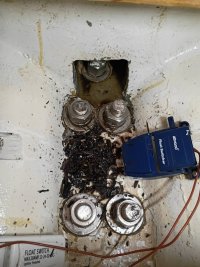
Lots of rotten wood coming out from under the mast step for what I thought was an all fiberglass hull
See pic
I motored to a different anchorage (2.5nm) after cleaning, and this morning checked and appears still bone dry
Is it a reasonable assumption there will be salt water seeping up from there if is a problem with keel bolts?
 

Attachments

  • IMG_20260510_173136887_HDR.jpg
    IMG_20260510_173136887_HDR.jpg
    165.9 KB · Views: 29

EngineerSailing

Member II
Also check scupper drain hoses. The outboard scupper drains are often submerged when heeled. Some folks even get water entering up through the drain into cockpit. If there's a leak / crack in the hose, water ends up in the bilge.
We did have issues with water coming up the cockpit drains and water in the cockpit

None of the hoses are original
 

Christian Williams

E381 - Los Angeles
Senior Moderator
Blogs Author
Anchor locker drain is a hole drilled in the front of it

Confirm that the hose from anchor locker to the hole in the bow is attached on the inside. Probe hole. Pour hose water into anchor locker and see if it comes out at the bow.

The junk in the bilge looks like wood rot from the underside of floorboards.
 

EngineerSailing

Member II
Anchor locker drain is a hole drilled in the front of it

Confirm that the hose from anchor locker to the hole in the bow is attached on the inside. Probe hole. Pour hose water into anchor locker and see if it comes out at the bow.

The junk in the bilge looks like wood rot from the underside of floorboards.
Floor boards are good teak and holly
The rotten wood is definitely coming out the hole in fiberglass of the bilge pictured from under the mast step
 

Kenneth K

1985 32-3, Puget Sound
Blogs Author
Floor boards are good teak and holly. The rotten wood is definitely coming out the hole in fiberglass of the bilge pictured from under the mast step
The wood could just be left over scrap/cuttings/sawdust that never got vacuumed up after construction of the cabinetry and wooden bulkheads. Still, it's good to clean it up because it can clog bilge pumps. Those areas boxed in under the TAFG (the "hidden" sections between the molded bilges) can trap several ounces of water in them even when the molded bilges are bone dry.

Various methods to dry out the sub-TAFG areas: turkey baster, wet vac, the freed-up end of one of your diaphragm pump hoses, washcloths stuffed into the holes/cutouts, a small suction hose connected to a vacuum source.

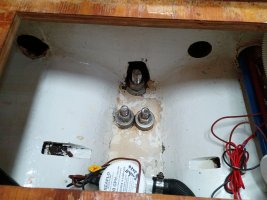
Is that a keel bolt shown inside the cutout in your photo? You said that photo is from under the mast. How do you access that keel bolt?
 

EngineerSailing

Member II
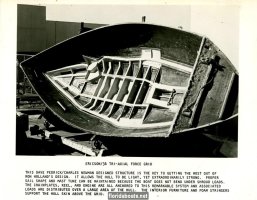
Does the E36RH have a TAFG?
I don't know what you call it
I'm just trying to stay Afloat and get it out of here to the Caribbean

Got caught by storm bands today, water coming down the inside the mast into the bilge

I think the bolts are not leaking, however my keel is fiberglassed in so unless fiberglass rips open I should not have water from the keel bolts

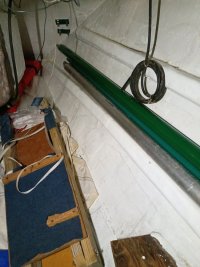
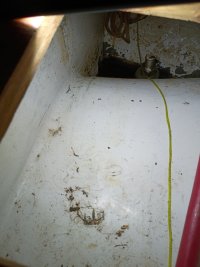
Here are more pics of bilge and structure on the E36RH
 

Attachments

  • 17786224514908467912086605016128.jpg
    17786224514908467912086605016128.jpg
    184.6 KB · Views: 16
  • 1778622509402255091749025951186.jpg
    1778622509402255091749025951186.jpg
    128.2 KB · Views: 16
  • 17786226256306143635940881209122.jpg
    17786226256306143635940881209122.jpg
    98.2 KB · Views: 16

Prairie Schooner

Jeff & Donna, E35-3 purchased 7/21
I don't know what you call it
I'm just trying to stay Afloat and get it out of here to the Caribbean

Got caught by storm bands today, water coming down the inside the mast into the bilge

I think the bolts are not leaking, however my keel is fiberglassed in so unless fiberglass rips open I should not have water from the keel bolts

Here are more pics of bilge and structure on the E36RH
Ericson 35-3 00c TAFG.jpg
ericson 36RH TAFG original photo.jpg

Tri Axial Force Grid
It's a separate frame or backbone/ribcage tabbed to the inside of an Ericson hull layup to give it extra rigidity. Many other makes just have individual beams kind of like floor joists glued to the inside of the hull. The TAFG is an entire structure. As an engineer you'll understand it better from the visuals than I can explain it.
In many places the TAFG is hollow underneath. It can sometimes be difficult to tell whether you're looking at that or the hull.
.
You haven't by any chance screwed anything to the sole (floor panels) lately, have you? I was surprised how much water came in through this little hole even after I 'plugged' it with a screw. post #54
.
It's an awful feeling seeing that bilge fill up. Good luck with this Carlton.
J
 

mjsouleman

Mark "Souleman" Soule
Moderator
I'm new to salt water and salt water sailing
I recently did a Gulf crossing to Clearwater FL

I'm not use to much if any water getting into my bilge on a sunny day
Took 56 hours for the 2nd hop
No measurable water came in the last 6 hours with sails dropped motoring in the inlet against tide change and to anchor
Across the 50 hours of concern I wanted to get a rate of ingress so I turned off the bilge pumps and closed the thru hulls
In total I hand bailed 30 gallons

If even that's <3Quarts per hour
But it wasn't
On starboard wind with flat sea water ingress was measurably less
On Port wind fighting 6-7ft sea I was bailing >1.5GPH
At 1 point I dropped sails in the Gulf and motored through 2.5-3+ ft waves with a 2.5 sec period
Water still coming in bilge motor only but slower

Thoughts on concern level and source? Or is this how the ocean says Hi

Side Note: Predict Wind showed favorable wind driving the whole trip before leaving, a few hours 1st day of 3ft wave, few hours 2nd day 2.5ft waves and the rest was expected to be Champaign sailing smooth
So much for PredictWind prediction knowing the future, perhaps another reality of Ocean sailing, inland weather prediction is usually pretty close
When I purchased Sterling II in Toronto and motored/sailed her to New Port R.I., I would run the bilge pump at the end of each day. Once home, I had the dripless replaced. Mine was simply old and as with any new to me boat, there are delayed maintenance issues that need attention.
 
Top