
N.A.

E34 / SF Bay
I know, don't do it. But... some races are long enough to require (and allow) engine charging, but not engaging the prop. So the engine would run under little load while charging.

How bad is this? I see posts elsewhere about a need for a lot of engine work after doing this on a sail to Hawaii (e.g. 20-30 hours of engine run in neutral, spread ofver weeks), and comments that it is not bad if one keeps the rpm low.

I looked at the Balmar alternator specs, and they show (for a 120A alternator like mine) 20A at 1500 rpm, 60A at 1500 rpm, and 100A at 2000 rpm... That's a steep slope (so +8A/100 rpm over 1500), so knowing how hard one could run the engine does make a meaningful difference. And 1500 rpm seems to be a real minimum, but is already over idle.

Not interested in doing a race that costs me an engine rebuild/replacement. Especially if it costs me engine replacement in some unknown marina in Hawaii right before I have to return... all of which is affecting my figuring re: additions to my electrical system (different post.)

--> Advice (re: engine problems, or allowed/advisable rpm in neutral while charging for a Yanmar 3GM30F) would be appreciated.


PS: Balmar specs, with nice chart of output vs rpm for different size alternators. Note rapid rise above 1500 rpm:
https://balmar.net/wp-content/uploads/2017/11/PDS-60-120-DV.pdf
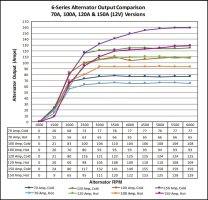
Balmar Aternator Outputs 111525.jpg
-->
 

ConchyDug

Member III
Alternators will load an engine. Especially big ones, you'll hear the engine load up when the alternator starts charging. It's like 1hp per 25amps so on smaller hp diesels that's a high percentage on higher hp engines it washes out. Looking at an engine's power output chart with hp/tq you can probably figure out the sweet spot where it's loaded enough
 

peaman

Contributing Partner
Looking at an engine's power output chart with hp/tq you can probably figure out the sweet spot where it's loaded enough
If you have a battery monitor that shows battery amperage both coming and going, you can also watch that to help decide what engine speed to run for a good charging rate.
 

N.A.

E34 / SF Bay
Thanks, both of you!

- Having such a battery monitor installed now : )

- I looked up the power curve (thanks for the suggestion), and the Yanmar 3GM30F produces 6-7 hp at 1400 rpm, 13 at 200 rpm, and about 18 at 2500 rpm. Respective alternator outputs (for my 120A Balmar) are about 20A at 1500, 60A at 2000, and 100A at 2500, so 1, 2.5, and 4hp, always less than 25% of the engine hp output at that rpm.

I suspect that's the issue: just charging, a 27hp engine is essentially never loaded much.


PS: somewhere on these boards I saw someone mention that for fuel efficiency it is best to run at the peak of the torque curve; that seems to be 2800 rpm for the 3GM30F, if anyone wants that info.The same page shows fuel consumption minimum at 2600 rpm FWIW. Page 1-8 (pdf p 27) of the Service Manual, which I found here:
 

Pete the Cat

Sustaining Member
One of the thing folks seem to miss in all this charging talk is the issue of "smart" regulators that many (most?) are using. When you observe your battery monitor, you will see that the alternator will be asked to put out its highest output (usually nothing near what the manufacturer tells you) only for a very short time and it will go to the much reduced amp output stages as a result of heat in the alternator (if you have that sensor) and the reduced charging regimen to protect the batteries and their heat buildup (most smart regulators monitor battery temp). This means that charging in neutral is a very slow process with flooded or gel batteries and most have a FL or AGM somewhere in their systems---so that it generally takes hours to totally top off your batteries in the last 10% of charge cycle running the diesel--I am talking hours. While li batteries will accept a very high charge rate--much higher than flooded or gel, there seems to be a problem with most standard alternators in this scenario; lion batteries can burn up a standard alternator quickly if it is not monitored and controlled by the BMS or an external smart regulator. Unless you have a very special alternator (and giant powder coated Balmars sold at very high prices are not much better than high output truck alternators with USCG ignition protection--though they may have improved them recently) but none of them defy physics of heat and energy production, it will shut down when it gets hot- which will be very quick in the enclosed hot engine compartment. Your battery monitor will confirm what I am telling you. My view is that running an engine to charge makes sense until your regulator goes to reduced power mode--which, in most cases, is going to be much faster than the battery system (alternator, regulator, batteries) sellers will tell you. So put as much solar as you can on your boat (with another regulator) to top things off. As a cruiser who is sailing, run the engine and alternator only until it tapers the amperage significantly and let the solar top it off--otherwise you will likely be running the engine for a very long time in most setups. I hope this makes sense. I know systems vary, but I believe that this is something common to many. Makes me realize that spending a lot money on very high output alternators, sophisticated regulators, and exotic batteries is a bit oversold as a solution if you really are going cruising and need an effective way to capture amps. A lot of these systems seem to appeal to bragging rights at the dock more than a practical solution for cruising sailors trying to keep their electrical needs met. I think Nigel Calder would agree with me. I am always interested in feedback from the real world.
 
Last edited:

Loren Beach

O34 - Portland, OR
Senior Moderator
Blogs Author
A lot of these systems seem to appeal to bragging rights at the dock more than a practical solution for cruising sailors trying to keep their electrical needs met.

That generally echoes my observations, but with one caveat. I know of several sailors (and trawler owners) who really enjoy technology and the learning and using it. It is kind of a "hobby" in addition to sailing.
By contrast, I am content to just install stuff that works for my limited needs, and really hate to have to constantly futz with it! :)
 

Kenneth K

1985 32-3, Puget Sound
Blogs Author
and giant powder coated Balmars sold at very high prices are not much better than high output truck alternators with USCG ignition protection
Reminds me of some of the earliest advice I got from two local shipwrights right after I got my boat. That was, “Don’t run out a buy the biggest Balmar alternator you can find. Most of the electrical problems we work on are from people who did just that.”

Years later, I realized that probably wasn't meant as a dig on a local company (in Ballard, Wa) but likely more of a comment about making big changes to one part of an inter-connected system. A bigger alternator affects pulley & drive belt capacity, engine load, engine compartment heat and ventilation, wiring capacity, fusing, the need for properly terminated wiring connections, and, of course alternator regulator requirements.

The old trailer connectors Ericson used were known to be a weak point, but mostly for that silly 10ga circuit that carried alternator current (from a 50A Motorola) to the ammeter at the engine panel and then all the way back to the starter solenoid, where it eventually charged the batteries. The circuit was a bad idea with the 50A alternator, which likely rarely put out more that 20A. But it becomes a really really bad idea (and a fire hazard) with a 100A alternator that may be periodically cranking out 40A.

Another similar weakness was the old Universal alteranator brakcket. A bad idea with a 50A alternator, but a nightmare-in-waiting for the high-torque requirements of a 100A alternator.

Many owners here were savvy enough to do the research and make the necessary changes to ALL of the related systems when upsizing alternators. Others were not.
 

Pete the Cat

Sustaining Member
One of the thing folks seem to miss in all this charging talk is the issue of "smart" regulators than many (most?) are using. When you observe your battery monitor, you will see that the alternator will be asked to put out its highest output (usually nothing near what the manufacturer tells you) only for a very short time and it will go to the much reduced amp output stages as a result of heat in the alternator (if you have that sensor) and the charging regiment to protect the batteries and heat buildup (most smart regulators monitor battery temp). This means that charging in neutral is a very slow process with flooded or gel batteries and most have these somewhere in their systems---so that it generally takes hours to totally top off your batteries in the last 10% of charge cycle running the diesel--I am talking hours. While li batteries will accept a very high charge rate--much higher than flooded or gel, there seems to be a problem with most standard alternators in this scenario; lion batteries can burn up a standard alternator quickly if it is not monitored and controlled by the BMS or an external smart regulator. Unless you have a very special alternator (and giant powder coated Balmars sold at very high prices are not much better than high output truck alternators with USCG ignition protection--though they may have improved them recently) but none of them defy physics of heat and energy production, it will shut down when it gets hot- which will be very quick in the enclosed hot engine compartment. Your battery monitor will confirm what I am telling you. My view is that running an engine until the alternator makes sense until your regulator goes to reduced power mode--which, in most cases, is going to be much faster than the battery system (alternator, regulator, batteries) sellers will tell you. So put as much solar as you can on your boat (with another regulator) to top things off. Run the engine and alternator only until it tapers the amperage significantly and let the solar top it off--otherwise you will likely be running the engine for a very long time in most setups. I hope this makes sense. I know systems vary, but I believe that this is something common to many. Makes me realize that spending a lot money on very high output alternators, sophisticated regulators, and exotic batteries is a bit oversold as a solution if you really are going cruising and need an effective way to capture amps. A lot of these systems seem to appeal to bragging rights at the dock more than a practical solution for cruising sailors trying to keep their electrical needs met. I think Nigel Calder would agree with me. I am always interested in feedback from the real world.
Reminds me of some of the earliest advice I got from two local shipwrights right after I got my boat. That was, “Don’t run out a buy the biggest Balmar alternator you can find. Most of the electrical problems we work on are from people who did just that.”

Years later, I realized that probably wasn't meant as a dig on a local company (in Ballard, Wa) but likely more of a comment about making big changes to one part of an inter-connected system. A bigger alternator affects pulley & drive belt capacity, engine load, engine compartment heat and ventilation, wiring capacity, fusing, the need for properly terminated wiring connections, and, of course alternator regulator requirements.

The old trailer connectors Ericson used were known to be a weak point, but mostly for that silly 10ga circuit that carried alternator current (from a 50A Motorola) to the ammeter at the engine panel and then all the way back to the starter solenoid, where it eventually charged the batteries. The circuit was a bad idea with the 50A alternator, which likely rarely put out more that 20A. But it becomes a really really bad idea (and a fire hazard) with a 100A alternator that may be periodically cranking out 40A.

Another similar weakness was the old Universal alteranator brakcket. A bad idea with a 50A alternator, but a nightmare-in-waiting for the high-torque requirements of a 100A alternator.

Many owners here were savvy enough to do the research and make the necessary changes to ALL of the related systems when upsizing alternators. Others were not.
You make some critically important points to new owners who are getting acquainted with the factory designs (bracket, starter wiring, trailer connector, and the danger of improving only one part of the system etc). I have a beefed up system on my Tartan 37 that I realized was largely gross overkill (big alternator, sophisticated smart regulator and new hi tech, high capacity battery system) even for the years of cruising I did, and just a pain to maintain--I sail for a week at a time in Maine and generally move coves every day or so I really do not need a huge charging capability nor a huge storage capacity. I suppose it is different if you living on a mooring in Avalon or Two Harbors for a week or a month. I generally day sail or just do an overnight to two on SF Bay with my Ericson and decided to stay with my old Motorola (puts out about 28 amps for a fairly short time even when I have used 40% of their capacity because all regulators taper, the "smart" regulators just taper the charge current more aggressively, which lowers the amps you get for charging time--contrary to what most folks seem to think) charging system and simple AGM batteries. Calder and the books used to say that you should start out with your amperage daily budget for your use and work backwards to the system you design. The sellers start with the products they want to sell you and tell you that you need and we have the "more is always better" idea drilled into our heads. There always seems to be plenty to do on a boat with preventive maintenance without buying stuff that complicates that process. I have seen folks give up sailing because they get lost in the work and cost of managing complex systems. I have a friend in Maine who has nothing by bare stock equipment (one battery, not even a boom vang) on his Cape Dory 25; he sails it every afternoon off his mooring and across Penobscot Bay for a great late afternoon sail. He absolutely refuses to upgrade it in any way and sails more hours than anyone I know in the sailing community there. I see his point.
 

nukey99

Member III
This makes me very glad I stayed in the forum after switching to a trawler. My wife and I are getting ready for some very long trips next summer in our Camano 31 troll. A critical consideration for us is electrical energy to run refrigeration and other items. We are adding 220 watts of Solar, which should get us partway to our energy budget. We have a 200 hp TAMD41-pa diesel with twin alternators. I was thinking we could make up some of the energy with the engine, but now am reconsidering. It might make more sense and be safer to add another panel, and only use the engine for moving and for generating hot water.

Some great comments and insight above.
 

Alan Gomes

Sustaining Partner
This makes me very glad I stayed in the forum after switching to a trawler. My wife and I are getting ready for some very long trips next summer in our Camano 31 troll. A critical consideration for us is electrical energy to run refrigeration and other items. We are adding 220 watts of Solar, which should get us partway to our energy budget. We have a 200 hp TAMD41-pa diesel with twin alternators. I was thinking we could make up some of the energy with the engine, but now am reconsidering. It might make more sense and be safer to add another panel, and only use the engine for moving and for generating hot water.

Some great comments and insight above.
Solar is great. But in Washington, I wonder how often you might go without sun.
 

Captain Pete

Member II
This makes me very glad I stayed in the forum after switching to a trawler. My wife and I are getting ready for some very long trips next summer in our Camano 31 troll. A critical consideration for us is electrical energy to run refrigeration and other items. We are adding 220 watts of Solar, which should get us partway to our energy budget. We have a 200 hp TAMD41-pa diesel with twin alternators. I was thinking we could make up some of the energy with the engine, but now am reconsidering. It might make more sense and be safer to add another panel, and only use the engine for moving and for generating hot water.

Some great comments and insight above.
The 35-3 I got this spring (and sold this fall) came with two hard solar panels attached to the lifelines like wings. I removed those and replaced with a flexible 100W panel from amazon located on the cabin top. No refrigeration but the batteries were alway charged. It made me a believer in solar and the setup is fairly simple. So I added 2 of the same panels and a controller to my mother ship - an old downeast trawler which has a nearly full sized refrigerator freezer we hardly ever used. The boat would be ideal on a slip with shore power, but I have it on a mooring, so the fridge has been used sparingly when cruising the past few years (and not at all if just on a day outing), supplemented with ice in coolers and daily use of engine and generator for charging. But boy the battery juice would run down overnight if the fridge was left on - so much so that any morning use of the electic head and even starting the main engine was shall we say anemic. This year with the solar we ran the fridge 24/7 the whole time on a 10 day trip, heads worked great, batteries juiced up all the time. Ice we brought on board at the beginning of the trip was still frozen - I was astounded. I have since added two more panels as they are inexpensive and easy to connect and to ensure even more juice in the morning. And they seem to charge enough even when not so sunny.
 
Top